Refinement Surgery for a Higher, More Symmetrical Nose with Closed Autologous Rib Cartilage Augmentation | Nose Lab Clinic
- Dr. Chayoung Kang
- 2025년 7월 1일
- 3분 분량
최종 수정일: 2025년 9월 24일
Hello, this is Dr. Cha-Young Kang, Medical Director at Nose Lab Clinic.
Today, I would like to share a case of a patient who underwent a secondary surgery at our clinic to achieve additional nasal height and improved symmetry after already being satisfied with the results of their primary procedure.
📍 Surgical History

First Surgery
Performed at Nose Lab Clinic
Achieved excellent results with structural stability
Current Surgery
Revision to increase nasal height and correct subtle asymmetry
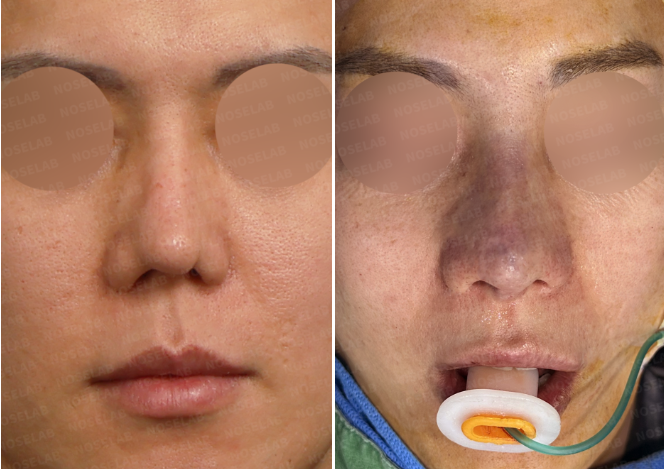
🔎Initial Evaluation Before Closed Autologous Rib Cartilage Nose Refinement

Patient Profile
Very satisfied with the first surgical outcome
Requested additional refinement for further enhancement
Requested Improvements
Slightly higher nasal bridge
Perfect left-right symmetry
Natural yet refined appearance
Current Condition
Stable, well-formed nose from the first procedure
Minor asymmetry and slight lack of height remained
✨ Patient Goals
Increase nasal height
Perfect left-right symmetry
Achieve a natural, sophisticated aesthetic
💉 Surgical Details
Autologous Rib Cartilage Augmentation
Layered structural reinforcement on the existing framework
Precisely tailored height enhancement
Maintained structural integrity
Septal Reconstruction
Corrected minor asymmetries
Perfectly aligned nasal midline
Strengthened nasal support
Nasolabial Angle Adjustment
Refined nasolabial angle to match the enhanced nasal height
Improved facial balance
Alar Base Correction
Adjusted nostril exposure to harmonize with the new nasal height
Improved frontal aesthetic with natural alar positioning
Skin Grafting
Soft tissue reinforcement for a smooth surface
Maintained natural skin contours
Stem Cell Therapy
Accelerated healing and minimized recovery time
Promoted optimal tissue regeneration
Enhanced the stability and longevity of results
✅ Surgical Outcomes of Closed Autologous Rib Cartilage Nose Refinement
Frontal View
Perfect symmetry achieved
Ideal nasal height enhancement
Balanced alar base width
Sophisticated nasal tip

Side View
Elevated, elegant nasal profile
Naturally curved dorsal line
Harmonized nasolabial angle
Balanced facial proportions

Symmetry Correction
Fully aligned nasal midline
Balanced left-right nasal structure

Height Improvement
Achieved the patient’s desired height
Noticeable yet natural enhancement
Seamlessly integrated with facial features

Overall Refinement
Significant upgrade from the first surgery
Enhanced sophistication and elegance
Exceptionally high patient satisfaction
👨⚕️ Specialist’s Commentary


This was a case where the patient was already highly satisfied with the primary surgery performed at our clinic but desired additional refinements to achieve their ideal nasal height and symmetry. Because the initial structural foundation was solid, we were able to focus precisely on the patient’s detailed aesthetic goals.
The patient’s request for a slightly higher nose required a balanced, calculated enhancement that aligned perfectly with their facial proportions. By using autologous rib cartilage, we achieved stable, natural height augmentation.
Although the first surgery had already corrected most asymmetries, the patient sought perfect symmetry. Through meticulous septal reconstruction, we were able to achieve flawless midline alignment.
This revision required a focus on ultra-fine adjustments. Unlike initial surgeries, secondary refinement demands highly detailed work, where small changes create significant visual differences. Precision was critical to deliver the right amount of enhancement without overcorrection.
We incorporated stem cell therapy to accelerate healing and improve soft tissue quality—an especially important step in revision cases to ensure safe, stable long-term results.
Additionally, we adjusted the nasolabial angle and alar base positioning to naturally harmonize the increased nasal height with the surrounding facial structures. Simply raising the nose without these considerations could have resulted in nostril overexposure or an unnatural profile.
Ultimately, we delivered exactly what the patient envisioned: a slightly higher, perfectly symmetrical nose that appears refined and natural, with improved facial harmony. The final outcome represents a significant refinement from the initial surgery and fully met the patient’s expectations.
This case demonstrates that even after a successful primary procedure, further enhancement is possible through carefully planned revision surgery that fully respects the patient’s aesthetic vision.
This case is a representative example of closed autologous rib cartilage nose refinement, which can achieve further nasal sophistication and symmetry in revision rhinoplasty.
Thank you.
Dr. Cha-Young Kang
Medical Director, Nose Lab Clinic


Messenger(WhatsApp) : +82 1057360302
Home page : www.noselab.co.kr
Instagram : noselab_global
YouTube : Noselab
Email : noselab@naver.com


댓글