Case at a glance
- Concerns & goals
- Surgical plan
- Photo timing
These details are excerpts from the original article and captions. Follow a detail to read it in context.
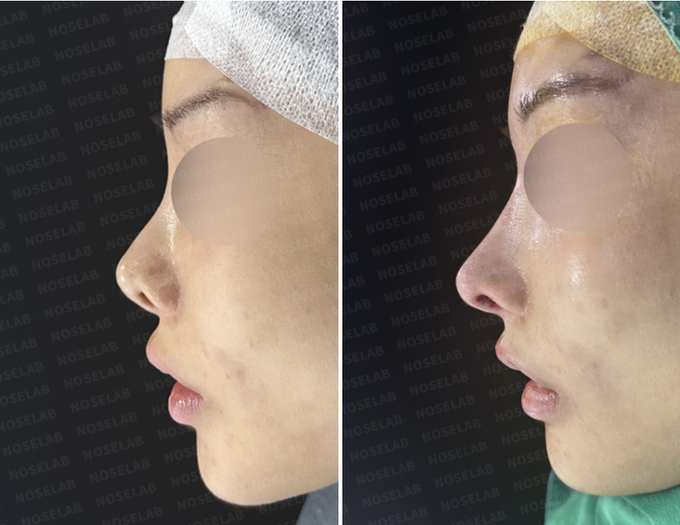
This case demonstrates Closed Rhinoplasty Korea for contracted nose correction following MRSA infection. Severe cartilage loss and tissue damage were reconstructed using rib cartilage, restoring structure, symmetry, and long-term stability.
Author: Dr. Cha-Young Kang, Director, NoseLab Clinic
✅ Case Background
This patient presented with severe nasal contracture, asymmetry, and structural collapse following MRSA infection after previous rhinoplasty procedures.
The infection caused tissue necrosis, cartilage loss, and significant deformation of the nasal structure, requiring implant removal and aggressive medical treatment prior to reconstruction.
In this Closed Rhinoplasty Korea case, the goal was to reconstruct the nasal framework, restore symmetry, and achieve long-term structural stability after infection-related damage.
Key concerns included:
Contracted nasal structure due to infection
Severe septal cartilage loss
Droopy and bulbous nasal tip
Crooked nasal bridge
Nostril asymmetry and collapse
Scar tissue from previous surgery
Structural instability after implant removal
This case required full structural reconstruction following infection control.
If you are experiencing complications after rhinoplasty or infection-related nasal deformity, a precise structural evaluation is essential.
📩 International Consultation


✅ Surgical Approach – Contracted Nose Correction Using Closed Rhinoplasty Korea
Contracted nose deformities following infection are among the most complex conditions in rhinoplasty.
Severe inflammation often leads to cartilage destruction, scar contracture, and loss of structural integrity.
Closed Rhinoplasty Korea allows precise internal reconstruction while minimizing additional trauma to compromised tissues.
✅ Structural Problems Identified
Severe septal cartilage loss
Infection-related tissue damage
Contracted nasal structure
Alar cartilage deformity
Nostril collapse
Scar tissue accumulation
Crooked nasal bridge
✅ Surgical Plan
1. Septal Reconstruction
Complete reconstruction using autologous rib cartilage
Restoration of central support
2. Alar Cartilage Reconstruction
Repair of damaged cartilage
Correction of nostril asymmetry
3. Scar and Necrotic Tissue Management
Removal of scar tissue
Preparation of stable soft tissue environment
4. Structural Realignment
Correction of nasal deviation
Narrowing and stabilization of nasal framework
5. Tip and Columella Correction
Septal extension graft
Improvement of droopy nasal tip
6. Dorsal Reconstruction
Cartilage-based augmentation
Restoration of smooth nasal contour
✅ Surgical Results
Frontal View
Improved symmetry
Straightened nasal structure

Lateral View
Improved tip projection
Balanced profile

Oblique View
Natural contour
Enhanced structural balance

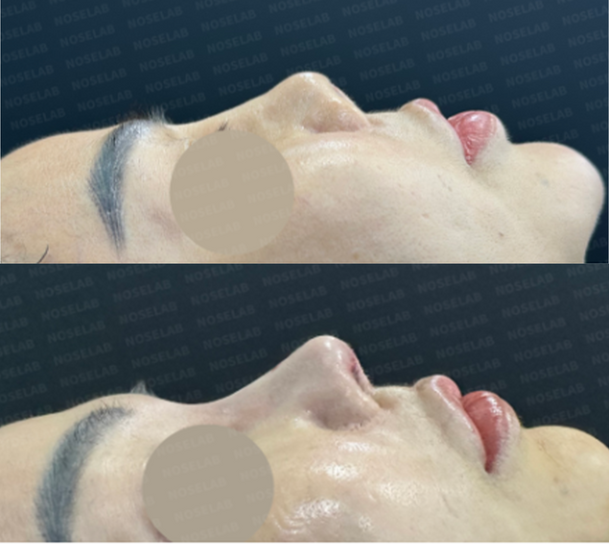
Nasal Base View
Corrected nostril asymmetry
Improved nasal base stability

✅ Functional Outcome
Stabilized nasal structure
Improved airway condition
Reduced risk of recurrence

✅ Surgeon’s Commentary
Contracted nose correction following MRSA infection requires a staged and highly controlled approach.
Infection must be fully resolved before reconstruction, as residual inflammation can compromise surgical outcomes.
In this case, severe cartilage loss required complete reconstruction using autologous rib cartilage to restore structural stability.
Scar tissue removal and soft tissue preparation were essential to prevent recurrence and ensure proper healing.
Closed Rhinoplasty Korea enables precise reconstruction while minimizing additional trauma and preserving blood supply.
Long-term success depends on restoring structural integrity and maintaining a stable healing environment after infection.
✅ FAQ
Q1. Can a contracted nose after infection be corrected?
Yes, after infection control, structural reconstruction is possible.
Q2. Why is MRSA-related rhinoplasty difficult?
Because infection damages cartilage and soft tissue.
Q3. Why is rib cartilage used in these cases?
It provides strong and reliable structural support.

Read the author’s background and the original case context. About these articles
Source updated .