
Case at a glance
These details are excerpts from the original article and captions. Follow a detail to read it in context.
Closed Rhinoplasty Korea – Case Overview
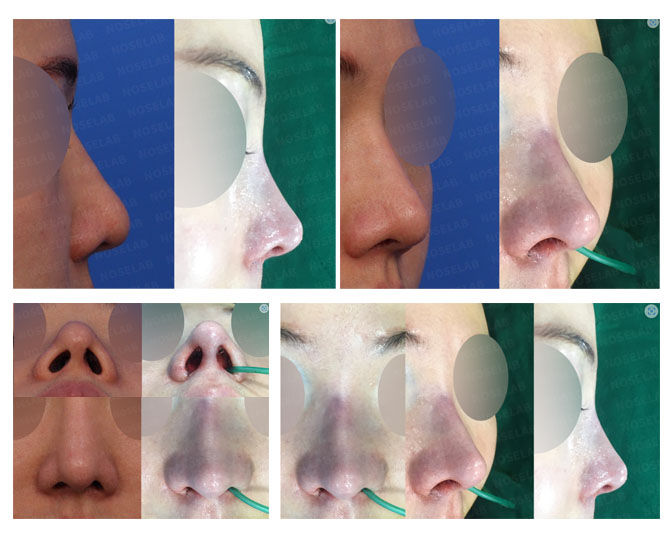
This Closed Rhinoplasty Korea case involved a patient with a deviated nose, bulbous tip, and hump deformity, combined with nostril asymmetry and alar base width imbalance.
The goal was to straighten the nasal bridge, refine the tip, remove the dorsal hump, and achieve nostril symmetry through a scarless closed approach.
Closed Rhinoplasty Korea – Surgical Method
Dr. Kang performed a detailed closed rhinoplasty focusing on both functional and aesthetic correction:
Realigned deviated nasal bridge and corrected septal deviation.
Removed dorsal hump and refined the bulbous nasal tip.
Corrected notching deformity for a smoother nasal contour.
Reduced alar base width and balanced nostril symmetry.
Maintained natural nasal line and proportion without external scars.
Closed Rhinoplasty Korea – Result
After surgery, the nasal bridge became straight and smooth, the hump was removed, and the tip appeared refined and balanced.
Nostril asymmetry was corrected, and the overall nasal line achieved natural harmony and proportion.
Closed Rhinoplasty Korea – Dr. Kang’s Comment
“In this case, we corrected a complex combination of deviation, hump, and notching deformity.Through closed rhinoplasty, the nasal structure and symmetry were restored without external incisions.”
Read the author’s background and the original case context. About these articles
Source updated .


