Case at a glance
- Concerns & goals
- Surgical plan
- Graft & material details
- Photo timing
These details are excerpts from the original article and captions. Follow a detail to read it in context.
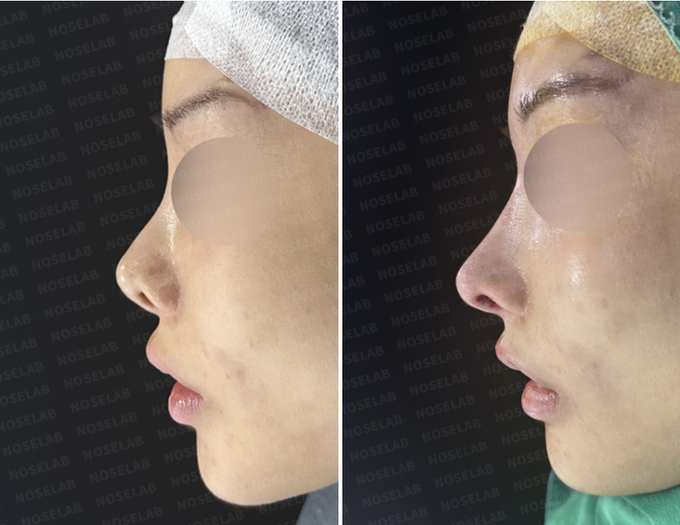
This case demonstrates Closed Rhinoplasty Korea for mesh removal revision rhinoplasty. Autologous rib cartilage reconstruction restored nasal structure, corrected asymmetry, and achieved natural, stable long-term results.
Author: Dr. Cha-Young Kang, Director, NoseLab Clinic
✅ Case Background
This patient presented with an unnatural nasal contour, wide nasal tip, and asymmetry following previous rhinoplasty using mesh, septal cartilage, and osteotomy.
Over time, the mesh contributed to structural irregularities, stiffness, and aesthetic imbalance, leading to dissatisfaction with the nasal appearance.
In this Closed Rhinoplasty Korea case, the goal was to safely remove the mesh, reconstruct the damaged nasal framework, and restore natural balance using autologous rib cartilage.
Key concerns included:
Mesh-related structural irregularity
Wide and bulbous nasal tip
High nasion and imbalance
Nostril asymmetry
Drooping columella
Distorted nasal contour
This case required complete foreign material removal and structural reconstruction rather than simple reshaping.
If you are experiencing unnatural contour or complications after mesh rhinoplasty, a detailed structural evaluation is essential.
📩 International Consultation

✅ Surgical Approach – Mesh Removal Rhinoplasty Using Closed Rhinoplasty Korea
Mesh implants can lead to inflammation, scar formation, and structural distortion over time.
Unlike standard implants, mesh integrates irregularly with surrounding tissue, making removal more complex and increasing the risk of tissue damage.
Closed Rhinoplasty Korea allows careful dissection and complete removal of mesh while preserving surrounding structures and minimizing additional trauma.

✅ Structural Problems Identified
Mesh-induced structural irregularity
Scar tissue and adhesion
Wide nasal tip and bridge
High nasion imbalance
Nostril asymmetry
Damaged septal cartilage
Functional instability
✅ Surgical Plan
1. Mesh Removal
Complete removal of all mesh fragments
Careful dissection to minimize tissue damage

2. Septal Reconstruction
Reconstruction using autologous rib cartilage
Restoration of structural support
3. Tip Refinement
Repositioning of alar cartilage
Reduction of bulbosity
4. Dorsal Adjustment
Lowering of nasion
Smoothing of dorsal contour
5. Structural Reinforcement
Stabilization of nasal framework
Creation of natural contour
6. Functional Correction
Improvement of airflow
Restoration of nasal stability
✅ Surgical Results
Frontal View
Slimmer nasal tip
Improved symmetry

Lateral View
Lowered nasion
Natural profile

Oblique View
Smooth contour
Balanced structure

Nasal Base View
Improved nostril symmetry
Refined tip structure

✅ Surgeon’s Commentary
Mesh-related complications in rhinoplasty require careful removal and structural reconstruction.
Unlike other materials, mesh often integrates irregularly with surrounding tissues, making revision more complex.
In this case, complete mesh removal was essential before reconstruction could be performed.
Autologous rib cartilage provided a strong and stable framework to restore both structure and aesthetics.
Closed Rhinoplasty Korea allows precise removal and reconstruction while minimizing additional trauma.
Long-term success depends on eliminating problematic materials and rebuilding stable nasal support.
📩 International Consultation

✅ FAQ
Q1. Why is mesh problematic in rhinoplasty?
It can cause inflammation, stiffness, and irregular contour over time.
Q2. Is mesh removal difficult?
Yes, it often adheres to surrounding tissue, requiring careful dissection.
Q3. Why is rib cartilage used after removal?
It provides stable and biocompatible structural support.

Read the author’s background and the original case context. About these articles
Source updated .