Case at a glance
- Photo timing
These details are excerpts from the original article and captions. Follow a detail to read it in context.
Hello, I am Dr. Chayoung Kang, Director of Noselab Clinic.
Today, we will talk about autologous rib cartilage rhinoplasty in a revision case where the nose, previously operated using donated rib cartilage, became droopy and crooked due to absorption of the donor material.
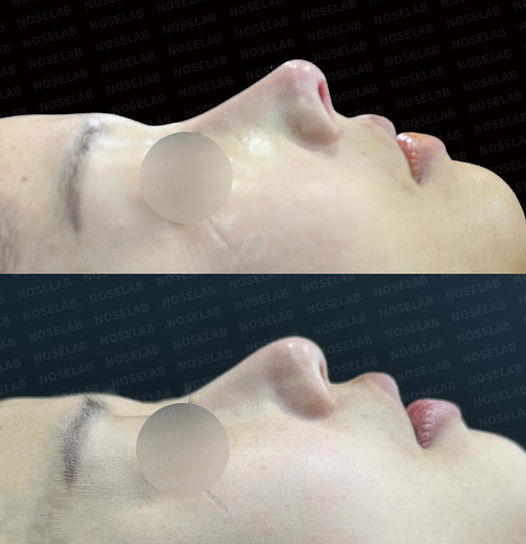
This patient had undergone nasal tip surgery using donated costal cartilage, and it became deformed during the past 2 years, the tip of the nose drooped and bent to the left, so the patient wanted to correct it. After rhinoplasty surgery, they underwent philtrum reduction surgery, so the nostril asymmetry worsened. As the patient had previously undergone multiple rhinoplasty surgeries, including alar reduction, the cartilage in the nose was severely damaged, so donated costal cartilage was used for cartilage reconstruction and nasal septum extension material. We believe that the donor costal cartilage was partially absorbed, resulting in a rapid change in shape.
Therefore, we planned a nasal cartilage reconstruction and nasal septum extension graft surgery using autologous costal cartilage.
Before and After Surgery – Autologous Rib Cartilage Rhinoplasty Results
Let’s compare the before and after surgery photos.

Observing the side view photos, in the before the nose looks compressed and the nasolabial angle is small, these parts have been improved.

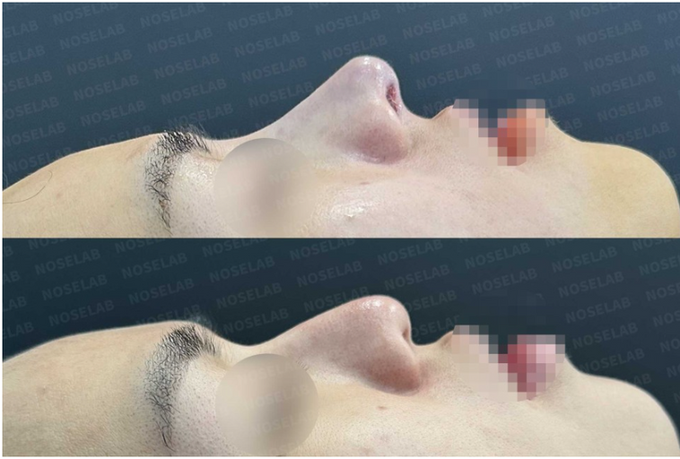
In the 45-angle view photo, we can observe that the nose tip shape has changed.
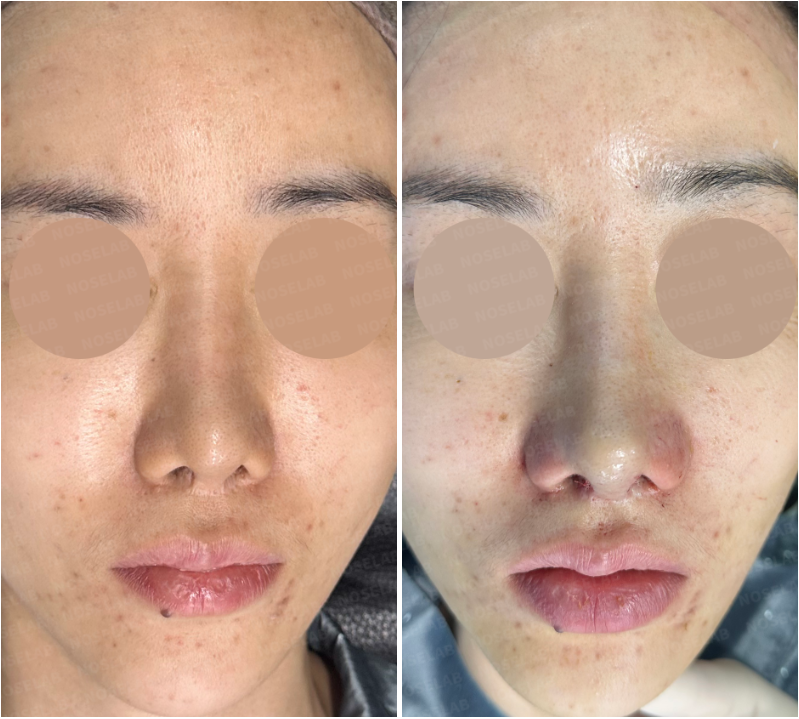
From the frontal view, the nose tip that was tilted to the left side has improved significantly.

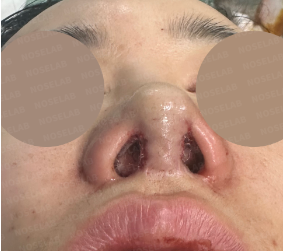
By observing the nostril photos, we can see that the improvement of the asymmetry was limited due to the previous nostril reduction and the philtrum reduction, but the appearance has improved.
Photos Immediately After Autologous Rib Cartilage Rhinoplasty

Dr. Kang’s Opinion – Donated vs. Autologous Rib Cartilage Rhinoplasty
Both donated costal cartilage and autologous costal cartilage are excellent materials for rhinoplasty surgery. But there are definitely differences in pros and cons.
Donor costal cartilage is very convenient to use because it is very simple. However, the cases in which it can be used are limited. In other words, it cannot be used in situations where there has been inflammation, and the absorption rate varies greatly depending on the patient’s immune response. This means that the absorption rate may be different when the same donated costal cartilage is used in different patients. Of course, donated costal cartilage is a very good rhinoplasty material, but if you compare it directly with autologous costal cartilage, there are differences in absorption rate and durability. Therefore, among those who have had surgery using donated costal cartilage, if there is a strong suspicion that the cartilage has been absorbed and deformed, we actively recommend using autologous costal cartilage.
Today, we briefly talked about donated costal cartilage and autologous costal cartilage. I hope this will be of great help to those who are choosing a rhinoplasty material.
Dr. Chayoung Kang
Director of Noselab Clinic

Read the author’s background and the original case context. About these articles
Source updated .