Case at a glance
- Concerns & goals
- Surgical plan
- Graft & material details
These details are excerpts from the original article and captions. Follow a detail to read it in context.
Cleft lip and palate rhinoplasty is a highly complex reconstructive nasal surgery performed to correct congenital asymmetry, nostril collapse, and structural deficiencies caused by cleft deformities.
This case from Nose Lab Clinic in Korea demonstrates how rib cartilage–based septal reconstruction, alar cartilage grafting, and nostril floor reinforcement achieved improved nasal symmetry, projection, and long-term structural stability through a closed rhinoplasty approach.
Author: Dr. Cha-Young Kang, Head Surgeon, Nose Lab Clinic
Published: October 18, 2024
Hello, this is Dr. Cha-Young Kang, head surgeon at Nose Lab Clinic.
Today, I would like to introduce a cleft lip and palate rhinoplasty case in Korea.
Patients with cleft lip and palate often present with congenital asymmetry and structural deficiency. While perfect symmetry is rarely achievable, meaningful improvement is possible through precise planning and structural reconstruction.
Pre-Surgery Consultation
The patient had a history of multiple previous cleft-related surgeries and presented with persistent nasal asymmetry and nostril collapse.
The patient previously underwent:
Cleft lip closure
Bone grafting
Lip asymmetry correction
Nasal reshaping using silicone and ear cartilage

Key Preoperative Concerns
Preoperative evaluation revealed nostril collapse, depressed columella, and skeletal deficiency contributing to severe asymmetry.
Key concerns included:
Pinched appearance of the right nasal tip
Depressed columella with crooked nasal tip
Nostril asymmetry with right nostril collapse
Nasolabial angle < 95°
Right maxillary deficiency confirmed on CT
The patient requested:
Correction of nostril asymmetry
Improved nasal tip projection
Restoration of balance
A more harmonious nasal appearance

CT and 3D CT Analysis
CT imaging confirmed maxillary deficiency, septal deviation, and nasal floor height discrepancy contributing to asymmetry.

CT analysis demonstrated:
Septal cartilage deviation (yellow line)
Nasal floor height difference (red line)
Planned rib cartilage reconstruction (blue area)
The autologous rib cartilage was used to:
Reconstruct the septum
Fill the depressed right nasal floor
Restore a more symmetrical nasal base


Surgical Procedure in Cleft Lip and Palate Rhinoplasty
The surgical strategy focused on restoring structural support and symmetry using autologous rib cartilage through a closed rhinoplasty approach.
Surgical Steps
a) Septal Cartilage Reconstruction
Autologous rib cartilage was used to reconstruct and stabilize the deviated septum.
b) Right Alar Cartilage Reconstruction
Rib cartilage grafting restored the missing alar support and corrected asymmetry.
c) Nostril Correction
A composite graft (cartilage-skin graft) reshaped the shortened right alar base.
d) Nostril Floor Reinforcement
Rib cartilage reinforced the depressed right nasal floor and maxillary defect.
All procedures were performed using a closed rhinoplasty technique, leaving no external scars.
Before and After Results
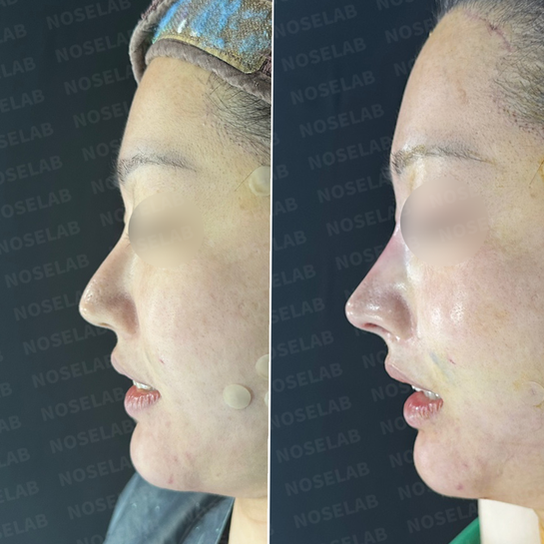
Postoperative comparison demonstrated improved symmetry, refined nasal tip projection, and balanced nasal base alignment.

Frontal View:
Nostril asymmetry significantly improved
Crooked nasal tip straightened
Bulbous appearance refined

Profile View:
Enhanced nasal tip projection
Natural dorsal line created
Nasolabial angle corrected to approximately 95°

Oblique View:
More harmonious nasal bridge line
Improved overall balance

Nostril View:
Collapsed right nostril restored
Columella straightened
Reinforced nasal floor improved symmetry
Final Evaluation
Cleft lip and palate rhinoplasty requires structural reconstruction rather than simple soft-tissue adjustment due to congenital asymmetry and scar tissue.
This case demonstrates that:
Septal reconstruction
Alar cartilage grafting
Nostril floor reinforcement using rib cartilage
can achieve both functional improvement and aesthetic balance, even in complex cleft-related deformities.
While complete symmetry is limited by prior scarring and anatomy, significant enhancement in projection and harmony is achievable through a structural approach.
At Nose Lab Clinic, we prioritize long-term stability and reconstruction, not temporary reshaping.
Q. Why is cleft lip and palate rhinoplasty more complex than standard rhinoplasty?
A. Because congenital asymmetry, skeletal deficiency, and scar tissue require structural reconstruction rather than simple reshaping.
Q. Why is rib cartilage used in cleft rhinoplasty?
A. Rib cartilage provides strong, stable support for septal reconstruction, alar correction, and nostril floor reinforcement.
Q. Can perfect symmetry be achieved in cleft lip and palate rhinoplasty?
A. Complete symmetry is often limited, but significant improvement in balance, projection, and function is achievable.


Read the author’s background and the original case context. About these articles
Source updated .