Closed Rhinoplasty Korea for Complete Nasal Reconstruction
- Dr. Chayoung Kang
- 2월 10일
- 3분 분량
최종 수정일: 3월 26일
Complete nasal reconstruction is required when septal and alar structures are severely damaged after multiple rhinoplasty procedures.
In this case, full reconstruction using autologous rib cartilage restored the nasal framework, corrected deformity, and achieved long-term structural stability through a closed rhinoplasty approach.
Author: Dr. Cha-Young Kang, Director, NoseLab ClinicThis case involves a patient who developed severe nasal deformity and internal structural loss after multiple previous rhinoplasty procedures.
The patient presented with nasal deviation, nostril asymmetry, reduced dorsal height, and instability caused by extensive destruction of internal support structures.
Preoperative CT imaging revealed abnormal findings around an existing implant, raising concern for chronic foreign body reaction and capsule formation.
In this case, structural correction was achieved through closed rhinoplasty korea, focusing on complete reconstruction of the septum and alar structures using autologous rib cartilage.
Complete nasal reconstruction requires rebuilding the entire internal framework rather than isolated correction or simple implant replacement.
If you have undergone multiple rhinoplasty procedures and are experiencing structural instability, nasal deformity, or persistent functional problems, a detailed structural evaluation is essential before determining the appropriate surgical plan.
📩 International Consultation
Surgical Background – Closed Rhinoplasty Korea
Severe structural damage after repeated rhinoplasty requires complete internal reconstruction rather than partial correction.
For this reason, closed rhinoplasty korea was selected to allow full access for septal and alar reconstruction while minimizing additional soft tissue trauma.

Structural Problems Identified
Preoperative evaluation revealed critical structural deficiencies:
Near-total loss of septal cartilage
Severe alar cartilage damage
Nasal deviation
Nostril asymmetry
Reduced dorsal height
Foreign body reaction around implant
These conditions required full structural reconstruction.
Surgical Plan – Structural & Functional Reconstruction
Removal of Previous Materials
Complete removal of implants and fibrotic capsule
Assessment for infection and tissue condition
Full Septal Reconstruction
Reconstruction using autologous rib cartilage
Restoration of central nasal support
Bilateral Alar Cartilage Reconstruction
Rebuilding alar framework using rib cartilage
Restoration of nasal tip support and symmetry
Dorsal Height Restoration
Conservative augmentation within biological limits
Prevention of overcorrection
Nostril Asymmetry Correction
Internal skin grafting
Stabilization of columella and base
Infection Control and Tissue Management
Intraoperative evaluation of serous fluid
Antibiotic irrigation and safe reconstruction
Surgical Results
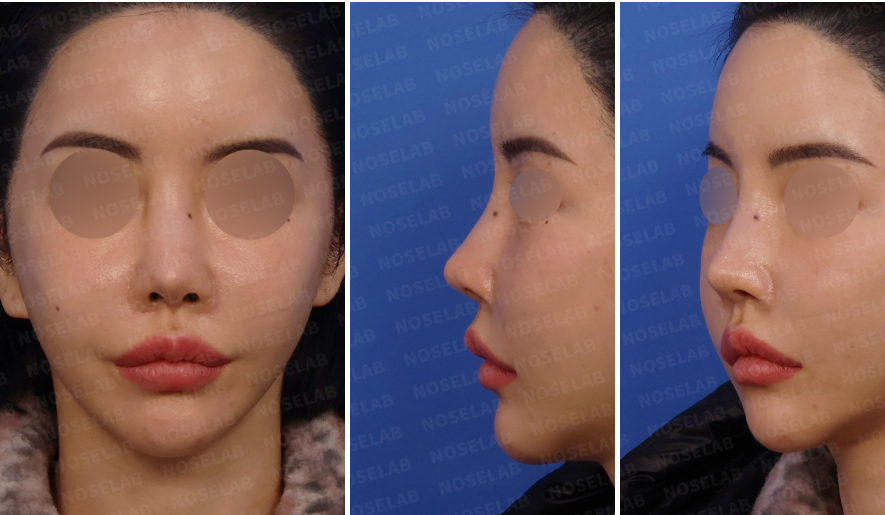
Frontal View
Correction of nasal deviation
Improved symmetry

Lateral View
Restoration of dorsal height
Smooth nasal contour
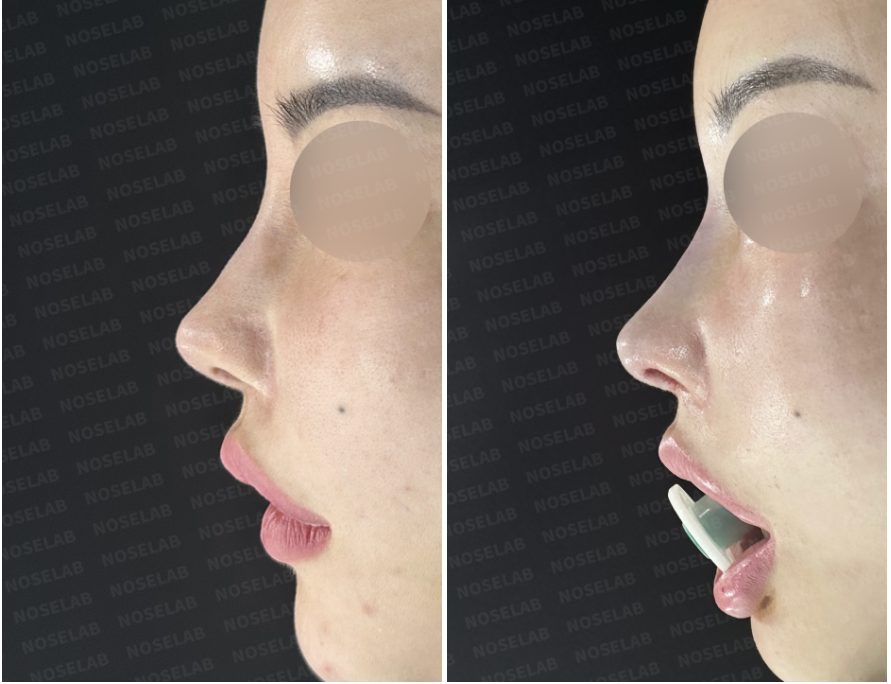
Basal View
Improved nostril symmetry
Stable columellar position

Structural Outcome
Reconstructed internal framework
Strong long-term stability

Surgeon’s Commentary
In patients with multiple prior surgeries, native cartilage is often severely compromised or absent.
In this case, autologous rib cartilage was essential to rebuild the entire internal nasal framework and restore structural stability.
CT imaging findings required careful intraoperative evaluation to rule out infection and ensure safe reconstruction.
After implant removal, weakened tissue conditions required a conservative approach to avoid complications.
Complete nasal reconstruction is not focused on maximal cosmetic change but on restoring stable structure and function.
Because complete nasal reconstruction involves severe structural loss and complex revision conditions, surgical planning must be based on precise anatomical analysis rather than a standardized approach.
If you are considering revision rhinoplasty after multiple failed procedures or have significant structural damage, a comprehensive evaluation is essential to determine the most appropriate reconstruction strategy.
📩 International Consultation
FAQ
Q1. Can closed rhinoplasty be used for complete reconstruction?
Yes. With advanced structural techniques, complete reconstruction can be performed through a closed approach.
Q2. Why is rib cartilage necessary?
It provides strong and reliable support when native cartilage is insufficient or absent.
Q3. Why is a conservative approach important?
Weakened tissue requires staged and stable reconstruction to ensure long-term success.
🎥 YouTube Reference

Messenger(WhatsApp) : +82 1057360302
Home page : www.noselab.co.kr
Instagram : noselab_global
YouTube : Noselab
Email : noselab@naver.com


댓글