Case at a glance
- Surgical plan
- Graft & material details
- Photo timing
These details are excerpts from the original article and captions. Follow a detail to read it in context.
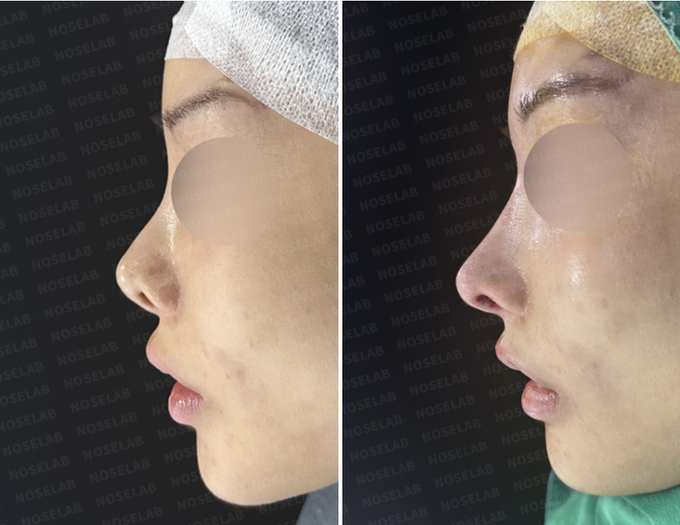
This case demonstrates Closed Rhinoplasty Korea for correcting a severe contracted nose 15 years after initial rhinoplasty. Rib cartilage reconstruction restored nasal structure, improved airway function, and achieved long-term stability and natural balance.
Author: Dr. Cha-Young Kang, Director, NoseLab Clinic
✅ Case Background
This patient presented with a severe contracted nose deformity 15 years after initial rhinoplasty using silicone and septal cartilage.
Despite undergoing revision surgery shortly after the first operation, progressive contraction, structural collapse, and functional problems developed over time.
In this Closed Rhinoplasty Korea case, the goal was to completely release the contracted structure, reconstruct the nasal framework, and restore both function and aesthetic balance.
Key concerns included:
Severe contracted nose deformity
Excessive nostril show
Upturned nasal tip
Nasolabial angle distortion
Nostril asymmetry
Columella deviation
Nasal obstruction and rhinitis
This case required full structural reconstruction rather than simple aesthetic correction.
If you are experiencing similar symptoms such as a contracted nose or breathing difficulty after previous surgery, a detailed structural evaluation is essential.
📩 International Consultation
✅ Surgical Approach – Contracted Nose Correction Using Closed Rhinoplasty Korea
A contracted nose is typically caused by scar contracture, implant-related complications, and loss of structural support following previous surgeries.
In severe cases, both cartilage framework and soft tissue envelope become compromised, requiring complete reconstruction rather than partial correction.
Closed Rhinoplasty Korea allows precise removal of contracted tissue and reconstruction of nasal structure while minimizing additional soft tissue damage.

✅ Structural Problems Identified
Severe scar contracture
Loss of septal cartilage support
Upturned nasal tip due to structural collapse
Excessive nostril exposure
Nostril asymmetry
Columella deviation
Functional airway obstruction
✅ Surgical Plan
1. Preoperative Tissue Preparation
Stem cell therapy to improve skin elasticity
Preparation of soft tissue for reconstruction
2. Contracted Tissue Removal
Complete excision of scar tissue
Removal of implant capsule
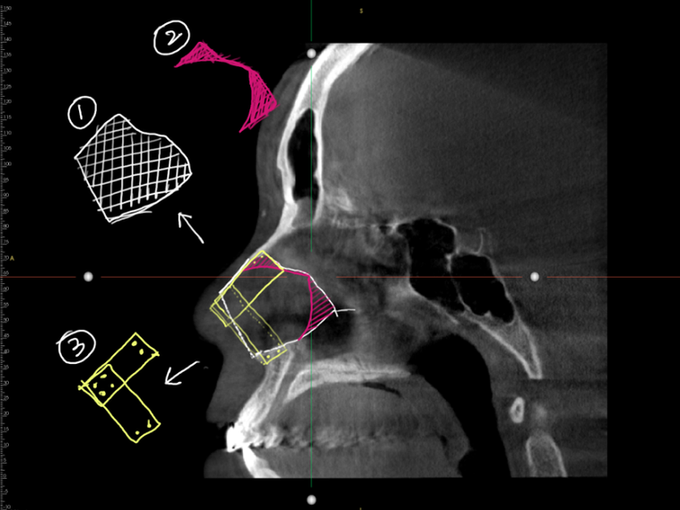
3. Septal Reconstruction
Rib cartilage graft for structural support
Reconstruction of central nasal framework
4. Tip and Columella Reconstruction
Correction of tip rotation
Realignment of columella
5. Alar Cartilage Reinforcement
Restoration of nostril symmetry
Stabilization of nasal base
6. Functional Correction
Improvement of nasal airway
Treatment of obstruction and rhinitis
✅ Surgical Results

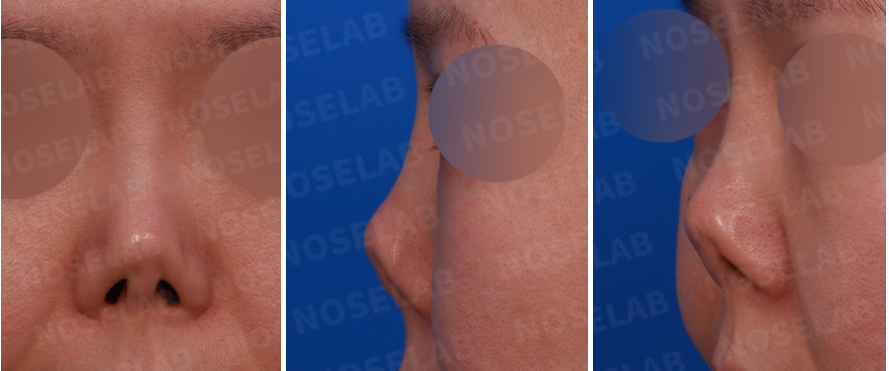
Lateral View
Lowered nasal tip
Improved nasolabial angle

Oblique View
Restored nasal contour
Improved projection


Frontal View
Reduced nostril exposure
Improved symmetry
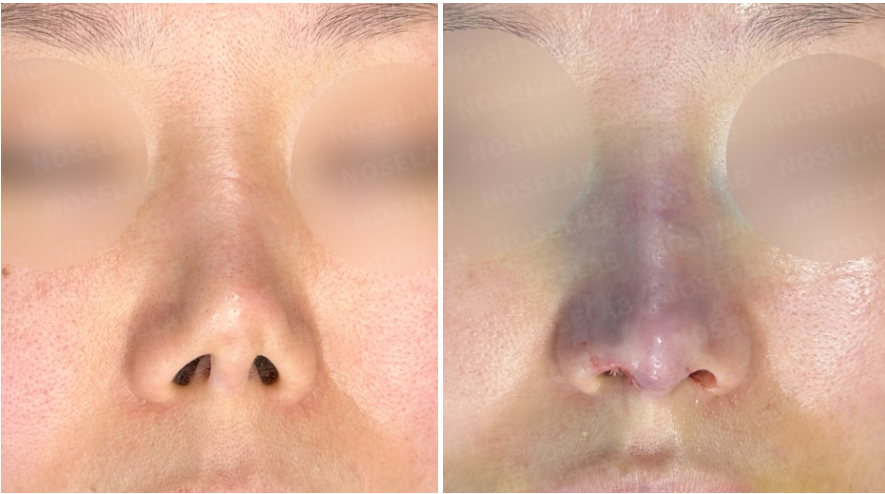
Nasal Base View
Improved nostril symmetry
Corrected columella deviation

✅ Functional Outcome
Improved nasal airflow
Reduced obstruction
Stabilized nasal structure
✅ Surgeon’s Commentary

A contracted nose represents one of the most complex conditions in revision rhinoplasty, involving both structural collapse and soft tissue contracture.
Successful correction requires complete removal of scar tissue and reconstruction of the nasal framework.
In this case, rib cartilage was essential due to the absence of usable septal cartilage. It provided sufficient strength to rebuild the nasal structure and maintain long-term stability.
Soft tissue preparation and expansion were equally important in preventing recurrence of contracture.
Closed Rhinoplasty Korea allows precise reconstruction while minimizing additional trauma to already compromised tissue.
Long-term success depends on restoring both structural integrity and soft tissue balance.

📩 International Consultation
✅ FAQ
Q1. What causes a contracted nose after rhinoplasty?
It is usually caused by scar contracture and loss of structural support.
Q2. Why is rib cartilage used?
It provides strong structural support when septal cartilage is depleted.
Q3. Can a contracted nose be fully corrected?
Significant improvement is possible with proper structural reconstruction.

Read the author’s background and the original case context. About these articles
Source updated .