Case at a glance
- Surgical plan
- Graft & material details
- Photo timing
These details are excerpts from the original article and captions. Follow a detail to read it in context.
Small nose deformity after rhinoplasty is often caused by insufficient structural support and improper proportion rather than lack of height alone.
In this case, structural reconstruction using rib cartilage, radix adjustment, and functional correction restored nasal projection, improved airflow, and achieved balanced facial proportions through a closed rhinoplasty approach.
Author: Dr. Cha-Young Kang, Director, NoseLab Clinic
This case involves a male patient who underwent multiple rhinoplasty procedures elsewhere but continued to experience dissatisfaction due to a small, under-projected nose and ongoing functional discomfort.
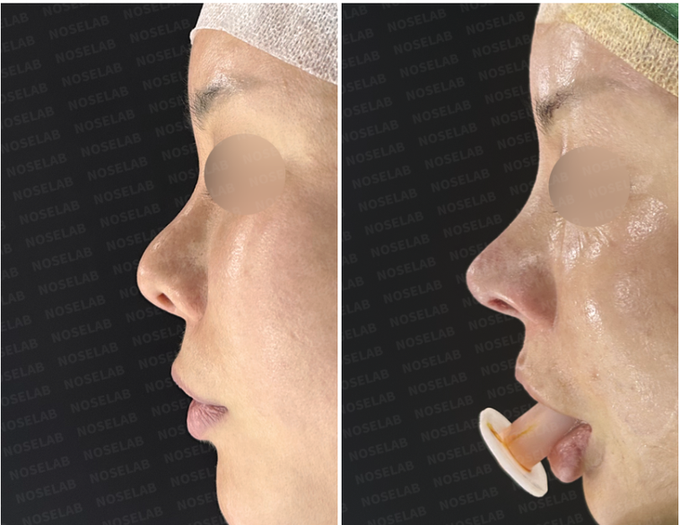
The patient presented with a short nasal length, insufficient tip projection, nostril show, and nasal obstruction despite two prior rhinoplasty surgeries.
Clinical evaluation revealed limited skin elasticity, unstable tip support, residual implant-related issues, and septal deviation contributing to both aesthetic imbalance and breathing difficulty.
In this case, structural correction was achieved through closed rhinoplasty korea, focusing on restoring nasal projection through structural balance rather than excessive augmentation.
Small nose revision requires controlled structural reconstruction and proportional correction rather than simply increasing height.
If you are experiencing a small or under-projected nose after previous surgery, or have concerns about both appearance and breathing, a detailed structural evaluation is essential before determining the appropriate surgical plan.
📩 International Consultation
→ LINE Consultation (Japan only)

Surgical Background – Closed Rhinoplasty Korea
Revision rhinoplasty in small noses requires careful internal reconstruction without overstressing weakened tissue.
For this reason, closed rhinoplasty korea was selected to allow precise structural correction of the nasal framework while minimizing additional external trauma.

Structural Problems Identified
Preoperative evaluation revealed multiple structural issues:
Short nasal length
Insufficient tip projection
Nostril show
Limited skin elasticity
Residual implant-related instability
Septal deviation causing nasal obstruction
These factors required integrated structural and functional correction.
Surgical Plan – Structural, Proportional, and Functional Correction
Removal of Previous Materials
Complete removal of silicone implants and foreign materials
Re-establishment of a stable surgical foundation
Radix Adjustment
Controlled repositioning of radix
Improvement of overall nasal proportion
Nasal Tip Reconstruction with Rib Cartilage
Reinforcement of tip support
Stable long-term projection
Prevention of recurrent collapse
Nasolabial Angle Adjustment
Reduction of nostril show
Improvement of side profile balance
Implant Placement (Dorsal Refinement)
Custom-made implant matched to anatomy
Controlled augmentation without overcorrection
Functional Nasal Surgery
Septal deviation correction
Rhinitis surgery
Improvement of airflow
Surgical Results
Frontal View
Reduced nostril show
Improved nasal proportion

Profile View
Stable tip projection
Natural orientation of nasal tip

Structural Outcome
Smooth and balanced dorsal line
Stable internal framework

Functional Outcome
Significant improvement in nasal airflow
Enhanced breathing comfort

Surgeon’s Commentary
Small nose revision is not solved by simply increasing nasal height.
In cases with limited skin elasticity, aggressive projection can lead to unnatural results and long-term complications.
In this patient, correcting radix position, tip support, and nasolabial angle together was essential for achieving balanced proportions.
Autologous rib cartilage was used to rebuild the nasal framework, providing strong and reliable structural support.
A custom implant was then used to refine the dorsal line while maintaining anatomical harmony.
Successful male revision rhinoplasty requires restraint, structural planning, and respect for tissue limitations rather than excessive augmentation.
Because small nose revision cases involve structural limitations and tissue constraints, surgical planning must be based on precise anatomical analysis rather than a standardized approach.
If you are considering revision rhinoplasty for insufficient projection or functional discomfort, a comprehensive evaluation is essential to determine the most appropriate correction strategy.
📩 International Consultation
→ LINE Consultation (Japan only)
FAQ
Q1. Is revision rhinoplasty necessary for a small nose?
Yes. Structural revision is often required when previous surgery fails to provide stable projection.
Q2. Why is rib cartilage used?
Rib cartilage provides strong and durable support in revision cases.
Q3. Can breathing problems be corrected?
Yes. Functional procedures can be performed simultaneously to improve airflow.
🎥 YouTube Reference
If you’re curious about Dr. Cha-Young Kang’s closed rhinoplasty approach, click to watch the video.
Read the author’s background and the original case context. About these articles
Source updated .