Case at a glance
- Previous treatment
- Surgical plan
- Graft & material details
- Photo timing
These details are excerpts from the original article and captions. Follow a detail to read it in context.
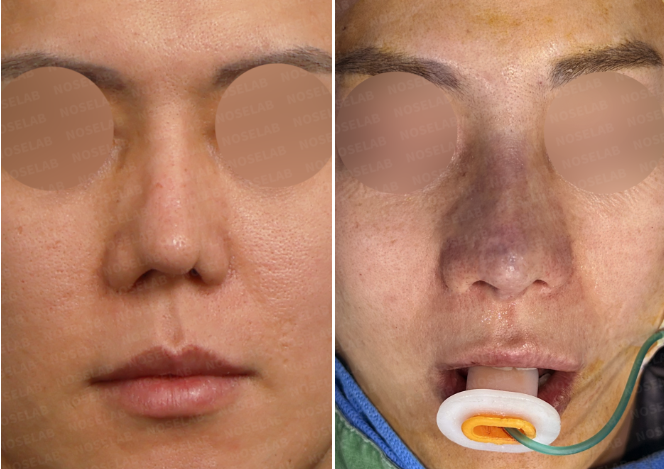
This case reviews contracted upturned nose revision in a patient with excessive nostril show, nasal tip contracture, nostril asymmetry, depressed scar tissue, and structural collapse after multiple previous rhinoplasty procedures. Reconstruction focused on septal rebuilding, dorsal contour restoration, alar cartilage support, and nostril correction using autologous rib cartilage.
Author: Dr. Cha-Young Kang
Clinic: NoseLab Clinic
Published: 2024
Last Updated: 2026
Introduction
Hello, this is Dr. Cha-Young Kang of NoseLab Clinic.
This case involves contracted upturned nose revision in a patient with a long history of nasal surgery complications. The patient developed progressive nasal contracture, an upturned nasal tip, excessive nostril show, and nasal asymmetry after multiple previous surgeries and postoperative inflammation.
The surgery was performed using a closed rhinoplasty / endonasal approach with autologous rib cartilage. The goal was to rebuild the nasal framework, correct the upturned tip, improve nostril symmetry, and restore more stable nasal function.
Patient History – Contracted Nose After Multiple Rhinoplasty Surgeries
The patient presented with a contracted nose, excessive nostril exposure, and an upturned nasal tip caused by repeated surgeries and postoperative inflammation.
Previous Surgical History
The surgical history included:
2012: L-shaped silicone implant
2019: Silicone implant, autologous rib cartilage, alar base reduction, and philtrum reduction
2023: Silicone implant, ear cartilage graft, and alar lowering
2023: Postoperative inflammation after splint removal, treated with antibiotics
2023, five months later: Silicone implant removal
Six sessions of regenerative treatment before revision surgery
After repeated operations and inflammation, the nasal structure became shortened and unstable. The nasal tip rotated upward, nostril exposure increased, and the nasal bridge and tip lost clear structural definition.

Preoperative Analysis – Contracture and Structural Deformity
Preoperative examination showed that the main cause of deformity was structural collapse rather than simple soft tissue imbalance.
Key Findings
The main findings included:
Excessive nostril exposure
Nostril asymmetry
Blunt, upturned nasal tip
Depressed scar tissue at the nasal tip
Flat nasal bridge with poor definition
Inappropriate nasolabial angle
Reduced structural support after previous procedures
These findings confirmed that the case required structural reconstruction rather than minor contour adjustment or implant replacement.

Surgical Plan – Closed Rhinoplasty Korea with Autologous Rib Cartilage
This revision was planned using a closed rhinoplasty Korea approach to allow internal reconstruction without adding an external columellar incision. In a nose affected by repeated surgery and inflammation, preserving soft tissue integrity is important.
The surgical plan focused on rebuilding the septum, restoring nasal length, improving nostril balance, and creating stable dorsal and tip support.
Planned Procedures
The surgical plan included:
Septal extension using autologous rib cartilage
Total septal reconstruction for structural stability
Septal shift to correct nostril asymmetry
Controlled dorsal contour restoration using rib cartilage
Alar cartilage reconstruction
Nasolabial angle adjustment
Surgical Procedure and Reconstruction Strategy
The operation focused on restoring the nasal framework before refining the external contour. In contracted and upturned noses, the internal structure must be rebuilt first to prevent recurrent shortening or instability.
Rib Cartilage Harvesting
Autologous rib cartilage was harvested to provide sufficient material for structural reconstruction. This was necessary because the patient had significant support loss after repeated surgery and inflammation.
Septal Extension and Reconstruction
The septum was reconstructed to correct the contracted and upturned nasal tip. Septal extension helped restore nasal length and provide stronger tip support.
Nostril Asymmetry Correction
Septal shift and structural realignment were used to improve nostril balance. This helped reduce asymmetry caused by contracture and previous surgery.
Dorsal Contour Restoration
Rib cartilage was shaped to restore dorsal contour. The goal was to improve bridge definition while maintaining a natural profile line.
Alar Cartilage Reconstruction
Alar cartilage support was reconstructed to improve tip definition and nostril stability. This step helped reduce excessive nostril show and improve nasal base balance.
Nasolabial Angle Adjustment
The septum and nasal tip were repositioned to improve the nasolabial angle. This helped create a smoother relationship between the nose and upper lip.
Surgical Results – Structural Recovery and Nasal Balance
Frontal View
From the frontal view, nostril exposure was reduced, bridge definition improved, and the nasal tip alignment appeared more balanced.

Oblique View
The oblique view showed improved dorsal contour and reduction of the upturned tip appearance. Nostril show also appeared less prominent.

Side Profile View
From the side profile, tip projection improved, the dorsal contour became smoother, and the nasolabial angle was corrected to a more balanced position.

Nostril View
From the nostril view, the narrow nostril shape improved, the columella appeared more refined, and nostril symmetry was restored within the limits of the patient’s tissue condition.

Functional Outcome
Internal realignment and structural reconstruction helped improve nasal stability and airflow. Functional improvement was considered together with external shape correction.
Immediate Postoperative Evaluation
Immediate postoperative photos showed improved nasal projection, dorsal contour, nostril balance, and nasal tip position across frontal, oblique, side profile, and nostril views.
Because this was a complex revision case after multiple surgeries and inflammation, the result should be understood as structural recovery within the limits of scarred and previously operated tissue.

Educational Perspective – Why Structural Reconstruction Matters
Contracted and upturned noses usually cannot be corrected through minor adjustments or implant exchange alone. The main issue is often structural shortening, scar contracture, and loss of support.
In this case, autologous rib cartilage reconstruction provided a stable framework for septal support, dorsal contour restoration, alar support, and nostril correction. A structure-first approach was necessary to reduce recurrent contracture and improve functional balance.
Surgeon’s Commentary
This was a complex revision rhinoplasty case involving contracted nasal tissue, an upturned tip, excessive nostril show, nostril asymmetry, depressed scar tissue, and multiple previous operations.
The key point was that the deformity was structural. When inflammation and repeated surgeries weaken the nasal framework, surface-level correction is not enough. The septum, nasal tip, alar cartilage, and dorsal contour must be rebuilt together.
Autologous rib cartilage was used because stronger support was needed for septal reconstruction, tip extension, and nasal base correction. The closed rhinoplasty / endonasal approach allowed internal reconstruction without adding an external columellar incision.
This case shows that contracted upturned nose revision should focus on structural reconstruction, nostril balance, and functional stability rather than simply increasing nasal height or changing the external contour.
FAQ
What causes a contracted and upturned nose after rhinoplasty?
A contracted and upturned nose can occur after postoperative inflammation, scarring, tissue damage, or loss of structural support. These changes may shorten the nose and increase nostril exposure.
Why is rib cartilage used in contracted upturned nose revision?
Rib cartilage is often used when septal or ear cartilage is insufficient. It provides stronger support for septal reconstruction, tip extension, and nasal framework rebuilding.
Can excessive nostril show improve after revision rhinoplasty?
Excessive nostril show can improve when the nasal tip is repositioned, septal support is rebuilt, and alar cartilage support is corrected. The degree of improvement depends on scar tissue and skin flexibility.
Why is structural reconstruction important in this type of case?
Structural reconstruction is important because the deformity is usually caused by support loss and scar contracture. Without rebuilding the framework, shape correction may not remain stable.
International Consultation
For international patients, a photo-based consultation may help clarify whether contracted upturned nose revisi
This patient’s real story is available on our YouTube channel (2 parts):
Read the author’s background and the original case context. About these articles
Source updated .