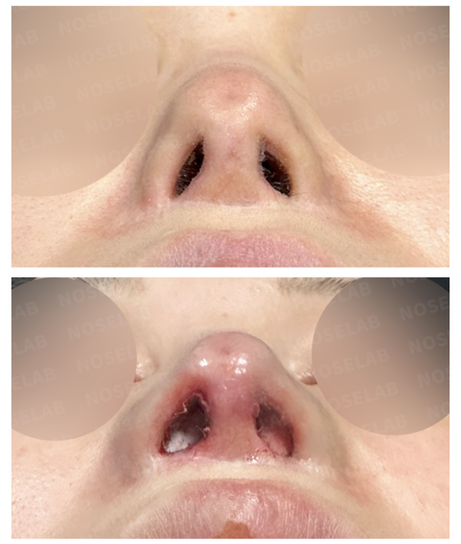
Case at a glance
- Concerns & goals
- Previous treatment
- Surgical plan
- Graft & material details
- Photo timing
These details are excerpts from the original article and captions. Follow a detail to read it in context.
This case reviews rib cartilage revision rhinoplasty Korea for a patient with contracted nose deformity after multiple previous nasal surgeries. Reconstruction focused on rebuilding the septum and alar cartilage, correcting columellar depression, improving pinched nostril shape, and addressing functional nasal obstruction.
Author: Dr. Cha-Young Kang
Clinic: NoseLab Clinic
Published: 2026
Last Updated: 2026
Introduction
Hello, this is Dr. Cha-Young Kang of NoseLab Clinic.
This case involves rib cartilage revision rhinoplasty Korea in a patient who developed contracted nose deformity after several previous nasal surgeries. The patient had difficulty with both nasal shape and breathing function due to structural collapse, scar contracture, columellar depression, and internal nasal obstruction.
The surgery was performed using a closed rhinoplasty / endonasal approach with autologous rib cartilage reconstruction. The goal was to rebuild the damaged internal framework, restore nasal support, improve nostril shape, and address functional airway problems.
Patient Background and Surgical History
The patient had undergone a total of six previous nasal surgeries. Repeated operations, inflammation, implant removal, and cartilage-based revision procedures led to progressive contracture and weakened nasal support.
Previous Surgical History
The surgical history included:
Approximately 17 years ago: Alar base reduction
Approximately 6 years ago: Rhinoplasty using an implant and autologous rib cartilage, followed by inflammation and implant removal
Six months later: Revision surgery using an implant and autologous rib cartilage, followed by redness after splint removal and implant removal again
Six months later: Reconstruction of the nasal bridge and tip using autologous rib cartilage only, followed by shortening and sharpening of the nasal tip
Approximately 3 years ago: Additional correction using newly harvested autologous rib cartilage
After repeated surgeries, wound healing around the columella became difficult, and the overall nasal structure gradually developed contracture. The nasal framework was shortened, the columella became depressed, and the nostril shape became pinched.

Patient Concerns Before Revision Surgery
The patient wanted improvement in both nasal appearance and breathing function. This was not a simple aesthetic revision case because the internal support structures had been severely compromised.
Main Concerns
The patient’s main concerns included:
Lowering the overly high nasal starting point
Improving the depressed columella
Correcting the pinched nostril appearance
Correcting nasal deviation
Improving alternating nasal obstruction on both sides
Restoring a more stable nasal framework after multiple surgeries
These concerns indicated that structural reconstruction and functional correction had to be planned together.

Preoperative Design and Structural Assessment
Preoperative design consultation photos were reviewed from the frontal, side, oblique, and nostril views.
The frontal view showed nasal deviation and irregularity of the nasal bridge. The side and oblique views showed an overly high radix, contracted nasal shape, and depressed columella. The nostril view showed pinched nostril shape and columellar deficiency.
Key Structural Findings
The key findings included:
Contracted nasal framework after multiple revision surgeries
Severe loss of septal cartilage
Significant loss of left alar cartilage
Depressed columella
Pinched nostril shape
Irregular nasal bridge contour
Nasal deviation
Functional nasal obstruction
Scar tissue and poor columellar skin condition
Because both cartilage support and soft tissue coverage were insufficient, the surgery required reconstruction of the internal framework and reinforcement of the columellar soft tissue.
Surgical Plan for Rib Cartilage Revision Rhinoplasty Korea
The surgical plan focused on rebuilding the damaged nasal support system. In complex revision cases with contracture, the priority is not simply changing the nasal line. The septum, alar cartilage, columella, nostrils, and airway must be evaluated together.
Septal Reconstruction with Autologous Rib Cartilage
The remaining septal cartilage was almost absent due to previous surgeries. Autologous rib cartilage was used to reconstruct the septum and restore the central support structure of the nose.
This step was essential because the septum functions as the main support for nasal length, tip position, and internal airway stability.
Left Alar Cartilage Reconstruction
The left alar cartilage was also nearly absent. Autologous rib cartilage was used to reconstruct the deficient alar cartilage and restore nasal tip support.
Alar cartilage reconstruction helped improve nostril stability, tip shape, and nasal base balance.
Correction of Pinched Nostril Shape and Columellar Depression
The depressed columella and pinched nostril shape required soft tissue reconstruction in addition to cartilage support.
To lower and rebuild the columella, postauricular skin was used for free skin grafting on both sides of the columella. Perichondrial grafting was also performed to improve graft support and tissue integration.
Functional Airway Correction
Septoplasty was performed to correct septal deviation, and rhinitis surgery was performed to improve nasal airflow.
A bacterial culture test was also performed to check for possible residual inflammation inside the nose. This was important because the patient had a history of inflammation after previous surgeries.
Controlled Reconstruction Within Tissue Limits
Because the patient had undergone several previous surgeries, the skin and soft tissue were already scarred and less flexible. The reconstruction was planned carefully to improve support and shape without placing excessive tension on compromised tissue.
Surgical Results
Frontal View
From the frontal view, the nasal bridge appeared more aligned, and the irregular dorsal contour became smoother. The overall nasal balance improved after septal and framework reconstruction.

Side View
From the side view, the nasal starting point appeared lower and more balanced. The depressed columella was improved, and the overall nasal profile appeared more stable after reconstruction.

Oblique View
The oblique view showed a smoother transition from the nasal bridge to the tip. The contracted and pinched appearance was reduced through structural support and soft tissue reconstruction.

Nostril View
From the nostril view, the pinched nostril shape improved, and columellar volume was reinforced through skin grafting. Nasal base balance improved after alar cartilage reconstruction.
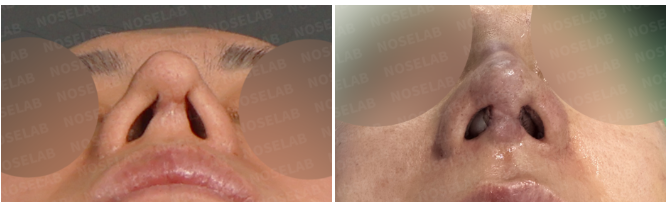
Functional Outcome
Alternating nasal obstruction improved after septal correction and rhinitis surgery. Functional correction was important because the patient had both structural deformity and breathing-related symptoms.
Surgeon’s Commentary
When nasal contracture progresses after multiple revision surgeries, the internal support structures are often severely weakened or nearly absent. In this case, both the septal cartilage and left alar cartilage were significantly deficient, so simple reshaping was not sufficient.
Autologous rib cartilage was needed to rebuild the structural foundation of the nose. The septum was reconstructed to restore central support, and the left alar cartilage was rebuilt to improve tip and nostril stability.
The columellar area was another important part of this case. Repeated surgery had affected wound healing and soft tissue coverage around the columella. For this reason, postauricular skin grafting was performed to reinforce the deficient columellar skin, and perichondrial grafting was added to support tissue integration.
Functional correction was also necessary. Septal deviation and rhinitis-related obstruction were addressed at the same time, and a bacterial culture test was performed to evaluate the possibility of residual inflammation.
This case shows that rib cartilage revision rhinoplasty Korea for contracted nose reconstruction should be planned as a combined structural, soft tissue, and functional procedure. The goal is to rebuild support, improve nasal shape, and support nasal breathing while respecting the limitations of previously operated tissue.
FAQ
Why is rib cartilage used in complex revision rhinoplasty?
Rib cartilage is often used when septal or ear cartilage is insufficient after previous surgeries. It can provide stronger support for septal reconstruction, nasal tip support, and contracted nose reconstruction.
Why does nasal contracture occur after repeated rhinoplasty?
Nasal contracture can occur when inflammation, scar tissue, implant removal, or repeated surgery weakens the nasal framework. As scar tissue contracts, the nose may become shorter, pinched, or distorted.
Can a depressed columella be reconstructed?
A depressed columella can be improved when both cartilage support and soft tissue coverage are addressed. In some revision cases, skin grafting may be needed when local skin is deficient.
Can breathing improve after revision rhinoplasty?
Breathing can improve when septal deviation, rhinitis-related obstruction, or nasal valve weakness is corrected. The degree of improvement depends on the patient’s internal nasal condition.
International Consultation
For international patients, a photo-based consultation may help clarify whether rib cartilage revision rhinoplasty, contracted nose reconstruction, columella reconstruction, or functional correction may be needed.

Read the author’s background and the original case context. About these articles
Source updated .