Case at a glance
- Surgical plan
- To address the wide and deviated areas, an outer osteotomy was performed to realign the nasal bone.
- For the droopy and blunt nose tip , autologous rib cartilage (self-rib) was used to lift and define the nose tip naturally.
- Since the patient’s original nasal bridge was already high , we avoided silicone implants. Instead, self-rib cartilage was used to fill the missing sections and create a smooth, natural nasal contour .
- Graft & material details
- For the droopy and blunt nose tip , autologous rib cartilage (self-rib) was used to lift and define the nose tip naturally.
- Since the patient’s original nasal bridge was already high , we avoided silicone implants. Instead, self-rib cartilage was used to fill the missing sections and create a smooth, natural nasal contour .
- Photo timing
These details are excerpts from the original article and captions. Follow a detail to read it in context.
Hello, this is Dr. Chayoung Kang, Director of Noselab Clinic, a specialist in closed rhinoplasty in Korea focusing on natural beauty and minimizing scars.
This case involves a droopy and deviated nose correction, where the patient presented with a droopy nasal tip, a wide bridge, and visible deviation from the front view. The nose also showed a hooked contour with asymmetrical nostrils. The main goal of this closed rhinoplasty was to correct the droopy, deviated, and hooked nasal shape while maintaining a natural facial balance.
Preoperative Design and Nasal Analysis
Before surgery, the patient’s nose appeared droopy and wide, with a hooked nasal bridge and visible deviation from the frontal view.
The nostrils were asymmetric, and the tip lacked projection and definition.
The primary goals were:
To correct nasal deviation and asymmetry,
To refine the wide bridge,
And to lift the droopy tip for a straighter, more balanced nasal line.
Surgical Plan for Droopy and Deviated Nose Correction
To address the wide and deviated areas, an outer osteotomy was performed to realign the nasal bone.
For the droopy and blunt nose tip, autologous rib cartilage (self-rib) was used to lift and define the nose tip naturally.
Since the patient’s original nasal bridge was already high, we avoided silicone implants. Instead, self-rib cartilage was used to fill the missing sections and create a smooth, natural nasal contour.
This approach allowed us to maintain the existing height while improving definition and straightness.
All procedures were performed through closed rhinoplasty, leaving no external scars.

Photos were taken immediately after the surgery with the consent of the patient. Before the surgery (below), After surgery (above). NOSELAB
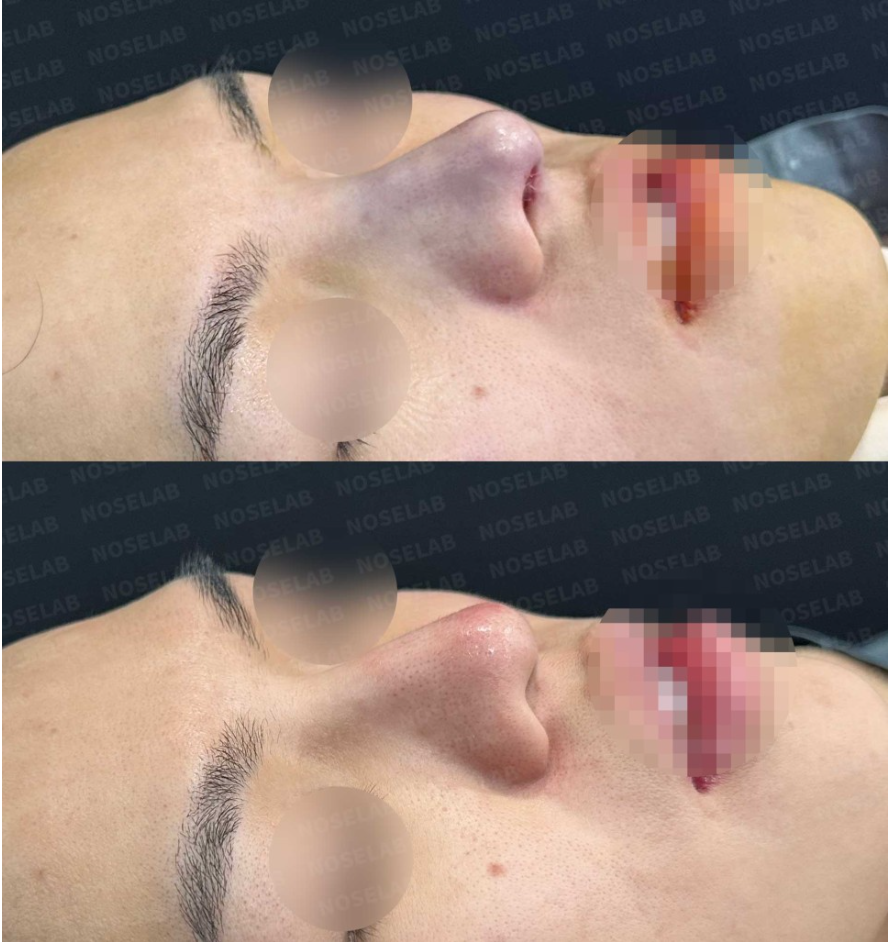
Photos were taken immediately after the surgery with the consent of the patient. Before the surgery (below), After surgery (above). NOSELAB

Photos were taken immediately after the surgery with the consent of the patient. . Before the surgery (left), After surgery (right). NOSELAB
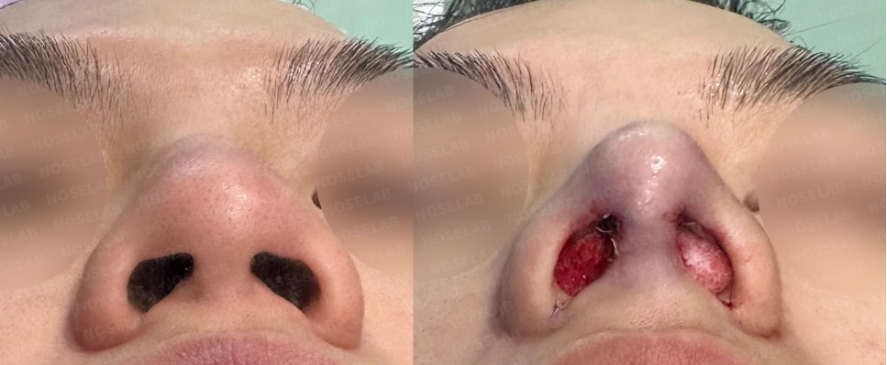
Photos were taken immediately after the surgery with the consent of the patient. . Before the surgery (left), After surgery (right). NOSELAB
Postoperative Results and Surgical Overview
Photos were taken immediately after surgery with the patient’s consent.
The nose now appears straighter and more refined, with improved symmetry and a naturally lifted tip.
In this case, although a silicone implant was initially considered, it was not necessary due to the thick skin and sufficient nasal height.
The final result shows how self-rib cartilage can be used to reconstruct and refine both the bridge and tip in a single, closed rhinoplasty procedure.
NOSELAB Plastic Surgery Clinic by Dr. Chayoung Kang
Read the author’s background and the original case context. About these articles
Source updated .


