Case at a glance
- Surgical plan
- This Mild Contracted Nose Correction aimed to re-establish the nasal tip support while gently lowering the upturned nose angle , resulting in improved nostril symmetry.
- By combining Upturned Nose Correction with cartilage reconstruction, the nasal contour was stabilized and reshaped into a more natural form.
- Photo timing
These details are excerpts from the original article and captions. Follow a detail to read it in context.
Pre-surgery Evaluation and Design for Mild Contracted Nose Correction
The patient presented with a mild contracted nose deformity and an upturned nasal tip following previous rhinoplasty using an implant.
The main goal of this Mild Contracted Nose Correction was to reduce nostril exposure, restore a natural nasal tip angle, and smooth out irregularities along the nasal bridge.Since the deformation was not severe, maintaining existing soft tissue while reconstructing the weakened framework was prioritized.
Surgical Plan for Contracted and Upturned Nose Correction
The operation was performed through a Closed Rhinoplasty approach to minimize incision and recovery time.
During surgery, the previously inserted implant and surrounding scar tissue were carefully removed.To restore support, autologous rib cartilage was used to reconstruct the damaged septal and alar cartilage, which is critical in preventing recurrence of nasal contracture.
This Mild Contracted Nose Correction aimed to re-establish the nasal tip support while gently lowering the upturned nose angle, resulting in improved nostril symmetry.
By combining Upturned Nose Correction with cartilage reconstruction, the nasal contour was stabilized and reshaped into a more natural form.
Post-surgery Results and Expert Review

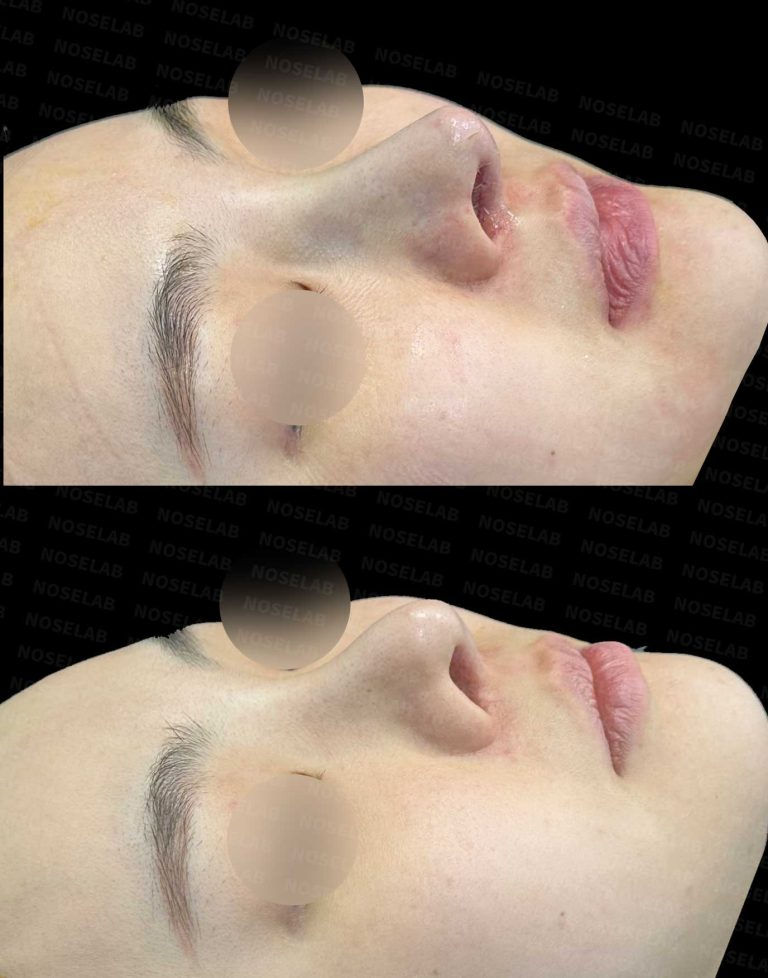

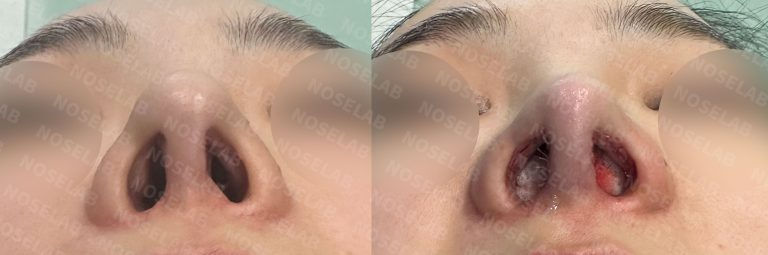
Photos were taken immediately after surgery with the patient’s consent.
Frontal view: Reduced nostril visibility and improved nasal axis alignment.
45-degree and side views: Softer dorsal line and restored nasal tip length.
Basal view: Improved nostril balance and decreased asymmetry.
After the Mild Contracted Nose Correction, the patient’s nasal projection became more natural, and nostril exposure decreased significantly.
In mild contracture cases, early cartilage reconstruction provides long-term stability and prevents secondary deformation.
This case highlights the importance of a Closed Rhinoplasty Korea approach for precise correction without external incisions.
Director Kang Cha-Young, NoseLab Clinic
Read the author’s background and the original case context. About these articles
Source updated .


