Reconstructive Revision Rhinoplasty Korea: Restoring Nasal Support and Correcting Nostril Asymmetry
- Dr. Chayoung Kang
- 2025년 12월 5일
- 2분 분량
Surgical Background: Septal Damage and Nostril Asymmetry
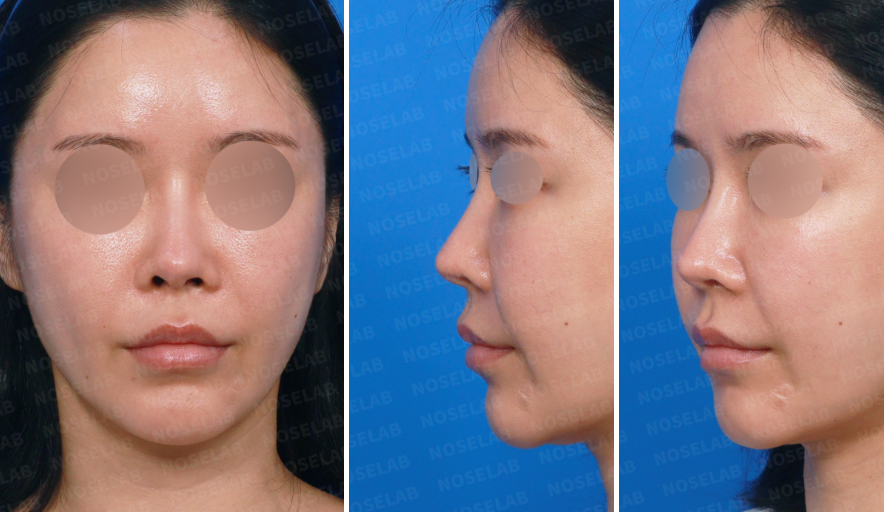
Why Reconstructive Revision Rhinoplasty Korea Was Required
The patient presented after multiple previous nasal surgeries that left her septum severely weakened or nearly removed. With almost no remaining central support, the nasal tip could not maintain projection. Nostril asymmetry had worsened over time, and chronic nasal obstruction occurred due to septal deviation and rhinitis.
This clinical situation demanded Reconstructive Revision Rhinoplasty Korea, focusing on restoring foundational support and creating functional stability.

Surgical Plan: Complete Framework Reconstruction
Rib Cartilage Rebuilding, Tip Projection, and Symmetry Correction
Because structural integrity had been lost, autologous rib cartilage was harvested to rebuild an entirely new central framework. This reconstructed foundation allowed safe and stable tip projection.
To correct nostril asymmetry, the alar cartilages were realigned and the central support repositioned. Dermal and cartilage grafts were added over the nasal tip to soften the contour and prevent a pointed or harsh appearance, especially important in thin-skinned patients.
Septoplasty and inferior turbinate reduction were also performed to resolve nasal obstruction and improve overall airflow.
Surgical Results: Stable Tip Support and Functional Improvement
Balanced Nostril Shape, Improved Airflow, and Natural Tip Definition
Following Reconstructive Revision Rhinoplasty Korea, the patient achieved:
• Rebuilt and strengthened septal support
• A naturally lifted nasal tip with long-term stability
• Corrected nostril asymmetry and improved alignment
• Softened tip contour without sharpness
• Improved airflow and reduction of chronic congestion
• Enhanced facial balance and symmetry


Surgeon’s Insight: Technical Principles Behind Reconstructive Revision Rhinoplasty Korea
Foundation Restoration, Tip Softening, and Structural Accuracy
Revision rhinoplasty with a severely damaged septum requires true reconstruction—not cosmetic adjustment. Without restoring the foundation, any implant or graft will fail over time. Autologous rib cartilage is the most reliable material due to its strength, availability, and long-term stability.
Nostril asymmetry must be corrected at the structural level. Surface-level manipulation is insufficient; only coordinated realignment of the septum and alar cartilages results in lasting symmetry.
Softening the nasal tip is equally critical. Reconstructed tips can appear too defined or sharp unless dermal and cartilage grafts are used to create a naturally rounded contour that harmonizes with facial anatomy.
At NOSELAB, reconstructive revision rhinoplasty prioritizes long-term support, functional improvement, and natural-looking refinement through careful analysis and precise execution.

Messenger(WhatsApp) : +82 1057360302
Home page : www.noselab.co.kr
Instagram : noselab_global
YouTube : Noselab
Email : noselab@naver.com


댓글