Case at a glance
- Surgical plan
- Graft & material details
- Photo timing
These details are excerpts from the original article and captions. Follow a detail to read it in context.
This case reviews severe contracted nose reconstruction in a patient with columella retraction, a short and upturned nasal tip, nasal deviation, nostril asymmetry, and compromised nasal lining after previous complications. The surgical plan focused on structural rebuilding, mucosal recovery, and functional airway stability using a closed rhinoplasty / endonasal approach.
Author: Dr. Cha-Young Kang
Clinic: NoseLab Clinic
Published: 2024
Last Updated: 2026
Introduction
Hello, this is Dr. Cha-Young Kang of NoseLab Clinic.
This case involves severe contracted nose reconstruction in a patient who developed significant nasal contracture after previous complications. The patient presented with severe columella retraction, a short and upturned nasal tip, nasal deviation, nostril asymmetry, and compromised nasal mucosa.
The surgery was performed using a closed rhinoplasty / endonasal approach. The goal was not only to improve the external nasal shape, but also to restore internal support, recover damaged mucosal lining, and improve long-term functional stability.
Patient Condition Before Severe Contracted Nose Reconstruction
The patient presented with a severe contracted nose following previous complications. Initial complications included hematoma after facelift surgery, followed by graft necrosis and structural damage.
As the nasal tissue healed with scarring and contraction, the nasal framework became shortened and distorted. The nasal tip was pulled upward, the columella became retracted, and the nostril shape became asymmetrical.
Main Structural Problems
The main structural problems included:
Severe columella retraction
Short and upturned nasal tip
Nasal deviation
Overall contracture of the nasal framework
Nostril asymmetry
High radix contributing to facial imbalance
Internal Mucosal Problems
The internal nasal lining was also compromised. The left septal mucosa showed thinning and contraction, which made this case more complex than a standard contracted nose revision.
In severe contracted nose cases, the condition of the internal lining is important. If the mucosa is thin, scarred, or contracted, structural reconstruction alone may not be enough.

Preoperative Structural Analysis
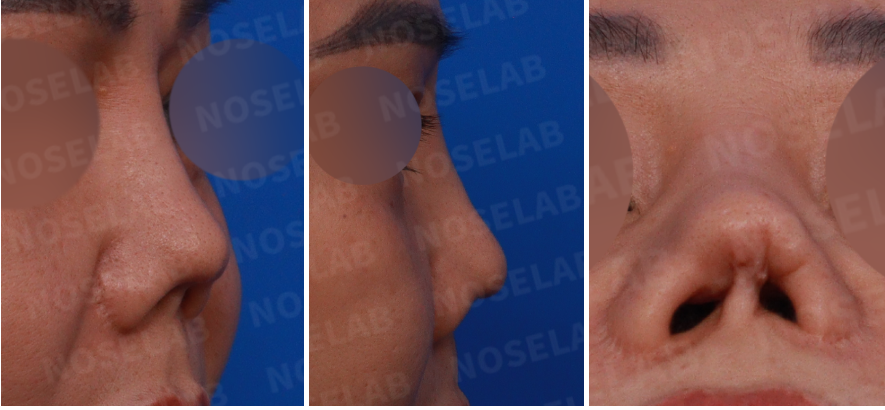
Preoperative design consultation photos were reviewed from the frontal, side, oblique, and nostril views.
The frontal view showed nasal deviation and asymmetry. The side and oblique views showed a short, over-rotated nasal tip and columella retraction. The nostril view showed nostril asymmetry and contracture-related distortion.
Key Findings
Detailed analysis revealed:
Severe columella retraction
Short and over-rotated nasal tip
Nasal deviation toward the left side
Nostril asymmetry
High radix and imbalanced facial profile
Contracted internal lining and weakened structural support
These findings confirmed that the patient required comprehensive structural and mucosal reconstruction rather than simple cosmetic correction.
Surgical Plan Using Closed Rhinoplasty Korea
A closed rhinoplasty Korea approach was selected to allow internal reconstruction without adding an external columellar incision. In a contracted nose case with damaged mucosa and scarring, minimizing additional external tissue trauma can be important.
The surgical plan focused on three priorities: rebuilding support, restoring internal lining, and improving nasal breathing.
Autologous Rib Cartilage Septal Reconstruction
Autologous rib cartilage was used to reconstruct the septal support structure. Rib cartilage provided the strength needed to lengthen and stabilize the contracted nasal framework.
Replacement of Silicone Implant with Autologous Cartilage
The previous silicone implant was replaced with autologous cartilage. In severe contracted nose reconstruction, using stable autologous tissue can help reduce long-term implant-related tension on scarred tissue.
Mucosal Reconstruction with Rotational Flap
A rotational flap using inferior turbinate mucosa was used to restore the compromised internal lining. This step was important because the left septal mucosa was thin and contracted.
Contracture Release and Tip Repositioning
Contracted tissue was released, and the nasal tip was repositioned downward. The goal was to reduce the short, upturned appearance and restore a more stable tip position.
Columella Support Reconstruction
Columellar support was reconstructed to improve the retracted columella and stabilize the relationship between the nasal tip and nasal base.
Tissue Recovery Support
Regenerative support was used to assist tissue recovery in areas affected by previous scarring and tissue compromise. In this type of case, tissue quality is an important part of surgical planning.
Surgical Outcomes and Functional Improvement
Side View
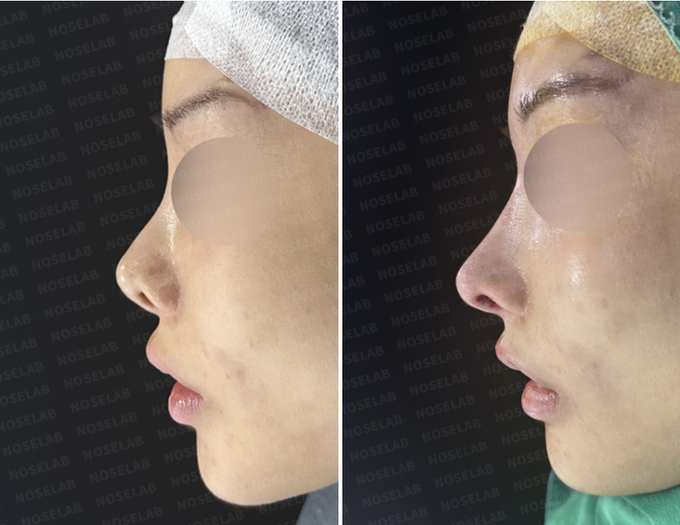
From the side view, the nasal tip was lengthened and repositioned downward. The columella position improved, and the short, upturned appearance was reduced.

Oblique View
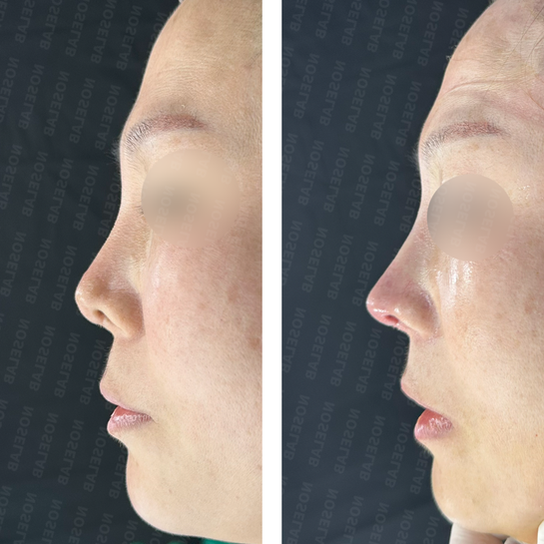
The oblique view showed improved nasal contour and better transition from the bridge to the tip. The reconstructed framework provided more stable support.

Frontal View
From the frontal view, nasal symmetry improved after reconstruction. The previously deviated and contracted nasal framework appeared more balanced.

Nostril View
The nostril view showed improvement in nostril shape and symmetry. Contracture-related distortion was reduced through structural grafting and mucosal reconstruction.

Functional Outcome
Functional airway space improved after reconstruction. Restoring the septal support and internal lining helped improve the stability of the nasal airway.
This case highlights the importance of combining structural grafting with mucosal reconstruction in severe contracted nose cases.
Surgeon’s Commentary
This was a highly complex case involving severe nasal contracture, columella retraction, short and upturned nasal tip deformity, nasal deviation, nostril asymmetry, and compromised septal mucosa.
In severe contracted nose reconstruction, the main challenge is not only external shape correction. The internal lining, scar tissue, cartilage support, and airway space must all be evaluated together.
Autologous rib cartilage was necessary because the nasal framework required strong structural support. However, cartilage reconstruction alone would not have been sufficient because the mucosal lining was also compromised.
For this reason, mucosal reconstruction using a rotational flap from the inferior turbinate mucosa was an important part of the operation. Restoring the internal lining helped support both functional recovery and long-term stability.
In severe contracted nose cases, complete correction may require staged planning depending on tissue quality, scarring, and healing response. The priority is to stabilize the nasal structure safely while improving breathing function and reducing visible contracture.
FAQ
Why is severe contracted nose reconstruction difficult?
Severe contracted nose reconstruction is difficult because the skin, mucosa, cartilage support, and scar tissue are all affected. Surgery must rebuild structure while protecting compromised tissue and airway function.
Can contracted nose surgery be performed with closed rhinoplasty Korea?
In selected cases, contracted nose surgery can be performed using a closed rhinoplasty Korea approach. The feasibility depends on the severity of contracture, mucosal condition, and the amount of reconstruction required.
Why is mucosal reconstruction important in contracted nose surgery?
Mucosal reconstruction is important when the internal nasal lining is thin, scarred, or contracted. Without restoring the lining, structural grafts may not remain stable, and airway function may remain compromised.
Is rib cartilage necessary in severe contracted nose reconstruction?
In many severe cases, autologous rib cartilage is needed to rebuild septal support and stabilize the nasal framework. It is especially useful when previous surgery or contracture has weakened the existing cartilage.
International Consultation
For international patients, a photo-based consultation may help clarify whether severe contracted nose reconstruction, mucosal reconstruction, rib cartilage support, or functional correction may be needed.

Read the author’s background and the original case context. About these articles
Source updated .