Case at a glance
- Concerns & goals
- Surgical plan
- Graft & material details
- Photo timing
These details are excerpts from the original article and captions. Follow a detail to read it in context.
This case demonstrates closed rhinoplasty Korea for correcting cartilage show-through and an over-projected nasal tip caused by multiple previous surgeries. Structural refinement combined with dermis grafting restored soft tissue thickness, improved nasal contour, and achieved long-term stability.
✅ Author / Published / Updated
Dr. Cha-Young Kang
NoseLab Clinic
Published: 2025
Last Updated: 2026
This patient presented for revision rhinoplasty after multiple prior procedures, including cartilage grafting, silicone implantation, and dermal graft use.
Over time, the patient developed thinning of the nasal tip skin, visible cartilage show-through, and an over-projected, sharp nasal tip.
In this closed rhinoplasty Korea case, the goal was not simply to reduce projection but to restore soft tissue balance and structural stability.
Key concerns included:
Cartilage show-through due to thin skin
Overly sharp and projected nasal tip
Narrow nasal structure creating imbalance
Excessive nostril exposure
Thin columella and unstable tip support
Chronic nasal congestion and airway issues
This case required a soft tissue–based reconstruction approach rather than aggressive cartilage reduction.
If you are experiencing similar issues after previous rhinoplasty, a detailed structural evaluation is important.
📩 International Consultation

✅ Surgical Background – Closed Rhinoplasty Korea
Closed rhinoplasty Korea allows precise internal correction without external scars.
In cases involving thin skin and cartilage visibility, preservation of structural support and augmentation of soft tissue are essential.
This approach enables controlled revision while minimizing further damage to already compromised tissues.

✅ Structural Problems Identified
Preoperative analysis revealed:
Extremely thin nasal tip skin
Visible cartilage due to inadequate soft tissue coverage
Over-projected nasal tip
Narrow nasal dorsum and tip
Mild nasal deviation
Weak structural balance due to multiple prior surgeries
Functional issues including airway obstruction and rhinitis
These findings indicated the need for combined structural and soft tissue reconstruction.
✅ Surgical Plan
1. Dermis Graft for Soft Tissue Reinforcement
Autologous dermis was harvested and placed over the nasal tip to increase thickness and mask cartilage visibility.
2. Structural Realignment
Lateral osteotomy was performed to correct nasal deviation and improve structural balance.
3. Nasal Tip Refinement
The over-projected tip was adjusted while maintaining adequate structural support.
4. Columella and Nasolabial Angle Adjustment
The columella was repositioned to improve nasal-lip harmony.
5. Proportion Adjustment
The nasal bridge and tip width were slightly adjusted to achieve a more natural balance.
6. Functional Correction
Airway obstruction and rhinitis-related issues were addressed to improve breathing.
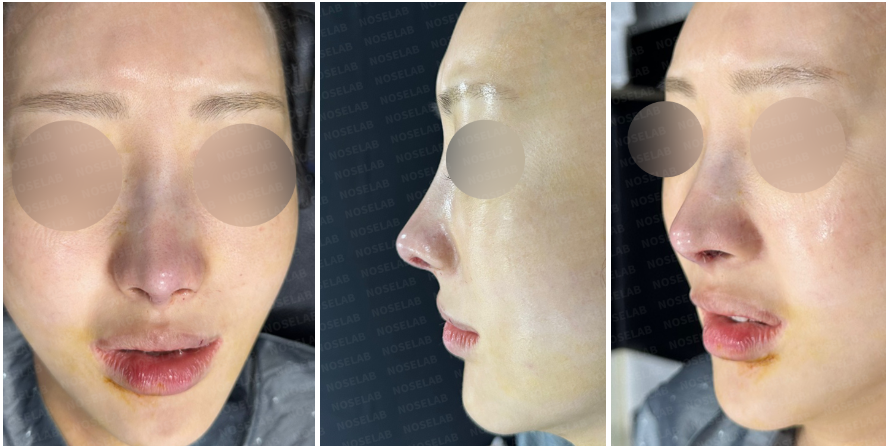
✅ Surgical Results

Frontal View
Cartilage show-through eliminated
Improved symmetry
Softer nasal contour

Lateral View
Reduced tip projection
Improved nasolabial angle
Natural profile restored

Oblique View
Balanced contour
Reduced sharpness of nasal tip

Functional Outcome
Improved airflow
Reduced nasal congestion
Stabilized nasal structure
✅ Surgeon’s Commentary
Cartilage show-through is not a simple aesthetic issue but a structural and soft tissue problem.
In many cases, reducing cartilage alone can worsen instability.
Instead, increasing soft tissue thickness using dermis grafting is a more effective and stable solution.
This case required balancing projection reduction with preservation of support.
Closed rhinoplasty Korea allows precise adjustments in these complex situations while minimizing additional trauma.
If you have thin skin or visible cartilage after rhinoplasty, a structural approach is essential.
📩 International Consultation
✅ FAQ
Q1. Why does cartilage show-through occur?
It occurs when the skin becomes too thin to conceal underlying cartilage, often after multiple surgeries.
Q2. Can trimming cartilage solve this issue?
No. Excessive trimming can weaken structure and worsen long-term results.
Q3. Why use dermis graft instead of implants?
Dermis graft integrates naturally with tissue and provides safe, stable soft tissue coverage.
🎥 YouTube Reference
If you’re curious about Dr. Cha-Young Kang’s closed rhinoplasty approach, click to watch the video.

This case is for educational purposes and represents a clinical example.
Results may vary depending on individual anatomy and surgical history.
All procedures were performed by a qualified specialist.
Read the author’s background and the original case context. About these articles
Source updated .


