Case at a glance
- Previous treatment
- Surgical plan
- Graft & material details
- Photo timing
These details are excerpts from the original article and captions. Follow a detail to read it in context.

Surgical Background – Closed Rhinoplasty Korea After Permanent Filler
This case involves a patient who presented with a bulbous and deviated nose caused by previous permanent filler injections. Over time, the filler led to distortion of the nasal shape, resulting in asymmetry and an unnaturally widened tip. The primary goal was complete filler removal, followed by structural reconstruction through closed rhinoplasty Korea, without external scars.
Surgical history:
History of permanent nasal filler injection
No prior surgical rhinoplasty
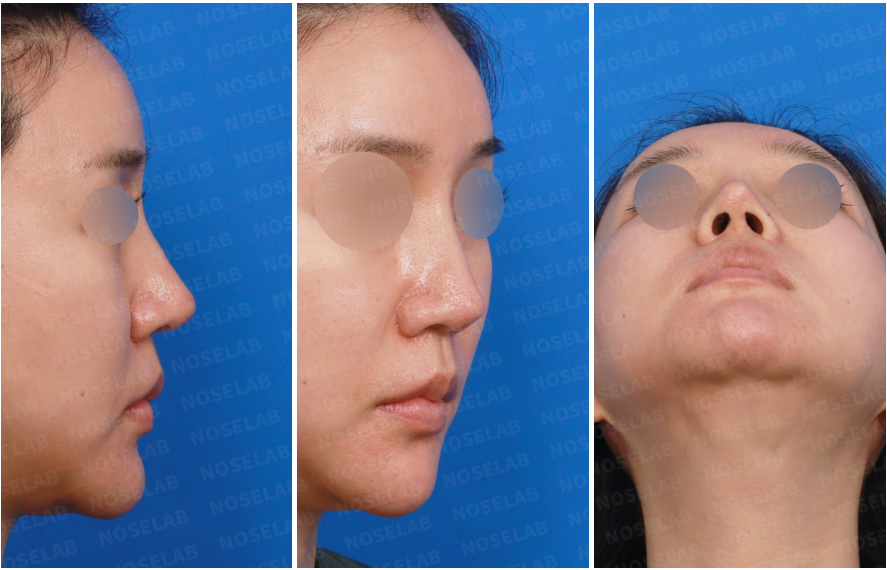
Surgical Plan – Permanent Filler Removal and Structural Reconstruction
The surgical plan focused on step-by-step correction, beginning with complete filler removal and followed by reconstruction of the nasal framework.
Key procedures included:
Thorough removal of permanent filler to eliminate foreign material
Reconstruction of the nasal tip using autologous rib cartilage
Correction of the bulbous, spread-out tip for improved definition
Lateral osteotomy to realign deviated nasal bones
Custom carving of a silicone implant to match the patient’s anatomy
This comprehensive approach restored both structure and balance.
Surgical Results – Restored Symmetry and Natural Contours
Postoperative evaluation demonstrated significant improvement in both frontal symmetry and nasal definition.

Frontal view: the deviated nose was straightened and aligned with the midline

Side profile: a smooth, natural bridge-to-tip contour was achieved
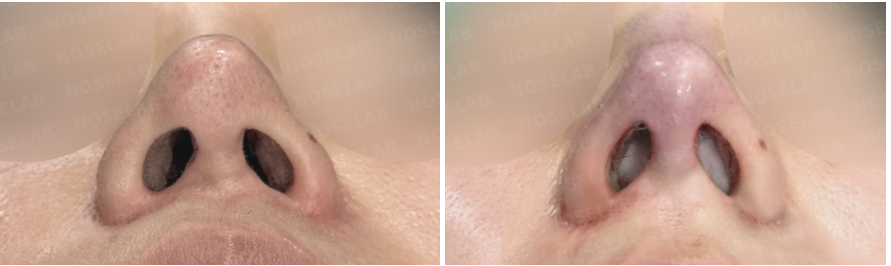
Nostril view: improved tip definition led to balanced and proportional nostrils

The nose now appears refined, stable, and harmonious with the face.
Surgeon’s Commentary – Why Reconstruction Matters After Filler Removal
Permanent fillers may cause long-term complications such as migration, inflammation, and structural distortion. Simply removing the filler is not enough. After removal, the weakened nasal framework must be reconstructed to achieve a stable and aesthetic outcome.
In this case, autologous rib cartilage provided strong tip support, while lateral osteotomy corrected the underlying bony deviation. A custom-shaped implant was used only after restoring a clean structural foundation.
This surgery was performed by Cha-Young Kang, Chief Director of NoseLab Clinic, following a structure-first, patient-centered approach.

Read the author’s background and the original case context. About these articles


