Case at a glance
- Surgical plan
- Graft & material details
- Photo timing
These details are excerpts from the original article and captions. Follow a detail to read it in context.
Full nose augmentation revision is required when previous surgeries fail to provide sufficient height, tip projection, and structural balance.
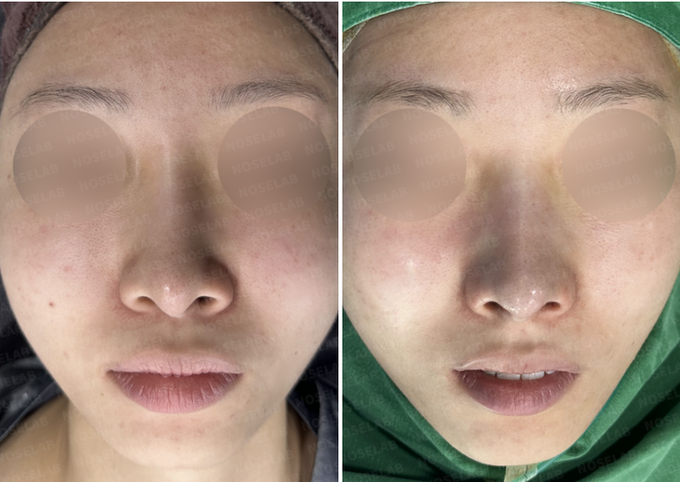
In this case, rib cartilage reconstruction, dermal graft reinforcement, and implant revision were performed to restore nasal height, improve tip projection, and achieve a stable and natural contour through a closed rhinoplasty approach.
Author: Dr. Cha-Young Kang, Director, NoseLab Clinic
✅ Case Background
This case involves a complex revision rhinoplasty patient who had undergone multiple previous nasal procedures but remained dissatisfied with insufficient nasal bridge height, inadequate tip projection, and overall imbalance.
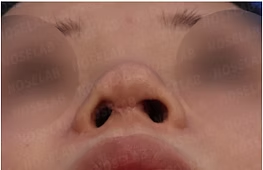
The patient had a long surgical history including filler injections, rib cartilage rhinoplasty with silicone implant, and tip revision using ear cartilage and AlloDerm. Despite these interventions, the nasal tip remained under-projected, and the dorsal height was not sufficient to achieve facial harmony.
Additionally, repeated surgeries led to thinning of the nasal tip skin, increasing the risk of implant visibility and structural instability. Structural reconstruction in this case was performed using closed rhinoplasty korea, focusing on full nasal augmentation, soft tissue reinforcement, and long-term stability.
If you are experiencing similar concerns such as insufficient nasal height, weak tip projection, or unsatisfactory results after multiple surgeries, a detailed structural evaluation is important.
📩 International Consultation

✅ Surgical Background – Closed Rhinoplasty Korea
Complex revision rhinoplasty involving full nose augmentation requires careful reconstruction of both structural support and soft tissue coverage.
For this reason, closed rhinoplasty korea was selected to allow precise internal structural reconstruction while preserving soft tissue integrity. This approach is particularly important in cases with thin skin and multiple prior surgeries, where minimizing additional trauma is critical.

✅ Structural Problems Identified
Preoperative structural analysis revealed:
Insufficient nasal bridge height
Weak nasal tip projection
Structural instability from multiple prior surgeries
Thinning of nasal tip skin
Risk of implant visibility
Irregular dorsal contour
Poor forehead-to-nose transition (glabellar step-off)
These issues required comprehensive reconstruction of both structural framework and soft tissue envelope.
✅ Surgical Plan – Full Nose Structural Reconstruction and Soft Tissue Reinforcement
Removal of Previous Materials
Removal of previously placed ear cartilage graft
Removal of AlloDerm
Assessment of scar tissue and structural condition
Nasal Tip Reconstruction with Rib Cartilage
Reconstruction of nasal tip using autologous rib cartilage
Reinforcement of tip support
Improvement of tip projection and stability
Dermal Graft for Soft Tissue Reinforcement
Use of autologous dermis to reinforce thin nasal tip skin
Increased soft tissue coverage over structural grafts
Reduction of implant visibility risk
Implant Revision and Dorsal Augmentation
Removal of previous silicone implant
Replacement with custom-carved implant
Controlled dorsal augmentation to achieve balanced height
Glabellar Step-Off Correction
Fat grafting to smooth the transition from forehead to nasal bridge
Improvement of overall facial harmony
Nasolabial Angle Adjustment
Refinement of tip rotation and side profile balance
✅ Surgical Results
Frontal View
Improved nasal symmetry
Enhanced tip definition
Balanced nasal proportions

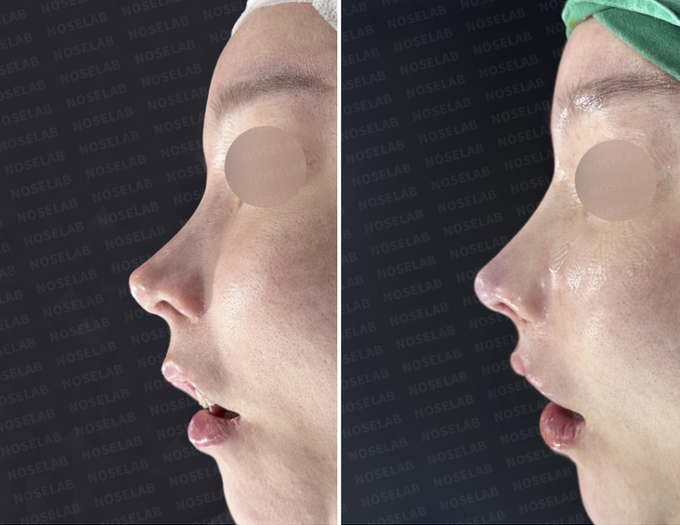
Lateral View
Increased nasal bridge height
Improved tip projection
Smooth forehead-to-nose transition

Oblique (45°) View
Harmonized nasal contour
Balanced bridge-to-tip relationship

Overall Outcome
Natural and refined full nose augmentation
Stable structural support
Improved facial harmony

✅ Surgeon’s Commentary – Comprehensive Approach in Full Nose Augmentation Revision
Revision rhinoplasty following multiple prior procedures requires careful assessment of both structural integrity and soft tissue condition.
When the nasal tip skin becomes thin, there is an increased risk of implant visibility and complications. In this case, autologous dermis was used to reinforce the soft tissue envelope, providing additional coverage and long-term safety.
Autologous rib cartilage was used to reconstruct the nasal framework, offering strong and reliable support for tip projection and stability.
In addition, glabellar step-off correction through fat grafting played an important role in achieving a smooth and continuous transition from the forehead to the nasal bridge—an often overlooked but critical factor in aesthetic outcomes.
A comprehensive structural approach is essential in complex revision rhinoplasty to achieve both natural aesthetics and long-term stability.
Full nose augmentation revision requires simultaneous management of structure, soft tissue, and facial balance.
📩 International Consultation
✅ FAQ
Q1. Why is dermis used in revision rhinoplasty?
It reinforces thin soft tissue and helps prevent implant visibility.
Q2. Why is rib cartilage preferred in multiple revision cases?
It provides strong and stable structural support when native cartilage is insufficient.
Q3. Can nasal height and tip projection be increased safely after multiple surgeries?
Yes. With proper structural reconstruction and soft tissue management, safe and stable augmentation is possible.
✅ Mandatory Disclosure
This case is for educational purposes only.
Results may vary depending on individual anatomy.
Read the author’s background and the original case context. About these articles