Case at a glance
- Surgical plan
- Graft & material details
- Photo timing
These details are excerpts from the original article and captions. Follow a detail to read it in context.
(Revision Rhinoplasty Case)
A long and drooping nose combined with nasal deviation and persistent obstruction can cause both functional and aesthetic problems.
In this revision case, rib cartilage reconstruction, osteotomy, septal correction, and tip support reinforcement were performed to restore structural stability and improve nasal airflow using a closed rhinoplasty approach.
Author: Dr. Cha-Young Kang, Director, NoseLab Clinic
This case involves a revision rhinoplasty patient presenting with a long, drooping nasal tip, deviated nasal axis, and persistent nasal obstruction despite prior functional surgery.
Although the patient had previously undergone surgery to improve breathing, nasal obstruction remained unresolved. Aesthetically, the nose appeared elongated and droopy, and facial asymmetry caused by deviation was still present.
The patient sought both functional recovery and correction of the long and drooping nasal appearance, with improvement in overall facial balance. Structural reconstruction in this case was performed using closed rhinoplasty korea, focusing on restoring tip support, correcting deviation, and improving airflow.
If you are experiencing similar problems such as a long drooping nose, nasal deviation, or persistent nasal obstruction after previous surgery, a structural evaluation is important.
📩 International Consultation
Surgical Background – Closed Rhinoplasty Korea
Revision cases involving a long and drooping nose usually result from structural weakness, septal instability, and deviation of the nasal framework.
For this reason, closed rhinoplasty korea was selected to allow precise internal structural reconstruction while minimizing additional soft tissue trauma. This approach enables accurate correction of deviation, reconstruction of structural support, and functional nasal surgery without external incisions.

Structural Problems Identified
Preoperative structural analysis revealed:
Long and drooping nasal tip
Weak nasal tip support
Deviated nasal bones
Septal deviation
Persistent nasal obstruction
Columella deviation
Elongated facial appearance due to tip ptosis
These structural issues required simultaneous correction of support, alignment, and airway function.

Surgical Plan – Structural Reconstruction and Deviation Correction
Nasal Tip Reconstruction with Rib Cartilage
Reconstruction of nasal tip support using autologous rib cartilage
Elevation and stabilization of the drooping nasal tip
Adjustment of tip projection and rotation
Improvement of nasolabial angle
Septal Reconstruction and Septoplasty
Partial septal reconstruction
Septoplasty to correct septal deviation
Restoration of central nasal support
Lateral Osteotomy for Crooked Nasal Bones
Correction of deviated nasal bones
Restoration of nasal symmetry
Realignment of nasal axis
Columella Repositioning
Correction of columella deviation
Improvement of nasal base symmetry
Better alignment between nasal tip and nasal base
Surgical Results

Frontal View
Straightened nasal bridge
Improved facial symmetry
Balanced nasal base

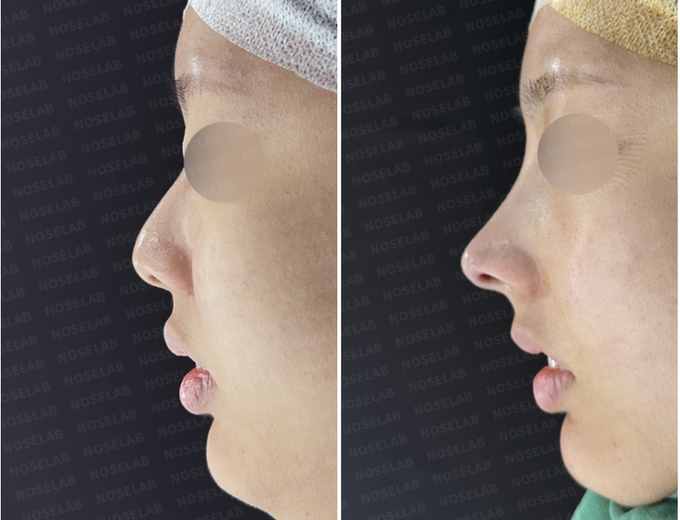
Lateral View
Elevated drooping nasal tip
Improved nasolabial angle
Reduced appearance of nasal length

Oblique (45°) View
Smooth nasal contour
Improved tip projection and balance

Functional Outcome
Significant improvement in nasal airflow
Relief of nasal obstruction
Surgeon’s Commentary – Revision Rhinoplasty for Long Drooping Nose
Correction of a long and drooping nose requires more than simple elevation of the nasal tip. The underlying structural support must be carefully evaluated and reconstructed.
In revision cases, previous surgery often compromises the integrity of the septum and surrounding structures. In this case, autologous rib cartilage was used to rebuild the structural framework, providing strong and reliable support.
Deviation of the nasal bones and septum must be corrected simultaneously to achieve both aesthetic symmetry and functional improvement. Lateral osteotomy and septoplasty were therefore essential components of the surgical plan.
Additionally, correction of columella deviation and adjustment of the nasolabial angle contributed significantly to improving the side profile and reducing the appearance of midface elongation.
Revision rhinoplasty requires precise planning and structural understanding to achieve stable and natural long-term results.
Structural reconstruction is the key principle in revision rhinoplasty involving long nose deformity and deviation.
📩 International Consultation
Frequently Asked Questions (FAQ)
Q1 . Why does the nose appear long and droopy after surgery?
Weak structural support or improper tip positioning can cause elongation and tip ptosis.
Q2 . Why is rib cartilage used in revision rhinoplasty?
It provides strong and stable support when native cartilage is insufficient.
Q3 . Can nasal obstruction improve after revision surgery?
Yes. Septoplasty and structural correction can significantly improve airflow.
🎥 YouTube Reference
If you’re curious about Dr. Cha-Young Kang’s closed rhinoplasty approach, click to watch the video.

Read the author’s background and the original case context. About these articles