Case at a glance
- Surgical plan
- Graft & material details
- Photo timing
These details are excerpts from the original article and captions. Follow a detail to read it in context.
Severe nostril asymmetry after rhinoplasty is often caused by imbalance of alar cartilage, septal instability, and internal lining deficiency rather than simple external deformity.
In this case, cartilage reconstruction, septal repositioning, and composite grafting restored nostril symmetry, improved airway function, and achieved stable structural balance through a closed rhinoplasty approach.
Author: Dr. Cha-Young Kang, Director, NoseLab Clinic
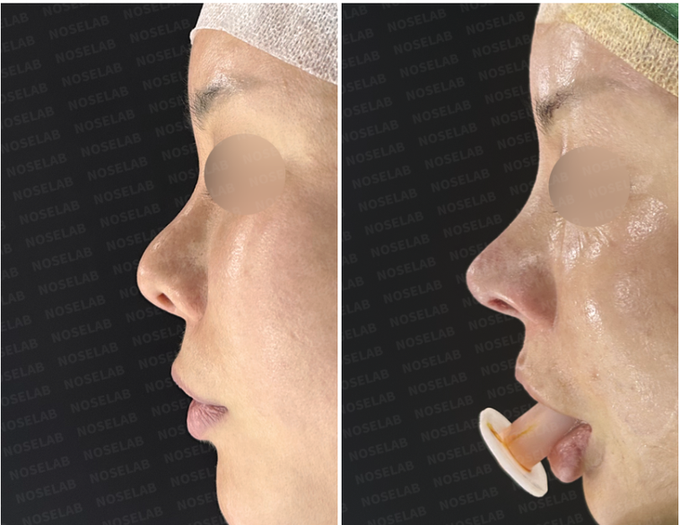
This case involves a patient who developed severe nostril asymmetry, a deviated nose, and persistent nasal obstruction after rhinoplasty performed at another clinic.
The patient presented with marked nostril asymmetry accompanied by nasal deviation and chronic breathing difficulty.
Evaluation revealed asymmetric alar cartilages, unstable septal support, and internal lining deficiency contributing to both functional and aesthetic problems.
In this case, structural correction was achieved through closed rhinoplasty korea, focusing on restoring alar cartilage balance, septal stability, and internal lining support.
Severe nostril asymmetry requires reconstruction of both cartilage framework and internal lining rather than simple surface-level correction.
If you are experiencing nostril asymmetry, nasal deviation, or breathing discomfort after previous rhinoplasty, a detailed structural evaluation is essential before determining the appropriate surgical plan.
📩 International Consultation
→ LINE Consultation (Japan only)

Surgical Background – Closed Rhinoplasty Korea
Revision rhinoplasty for nostril asymmetry requires precise internal structural correction and lining reconstruction.
For this reason, closed rhinoplasty korea was selected to allow septal reconstruction, alar cartilage repair, and nostril reshaping through an internal approach without external incisions.

Structural Problems Identified
Preoperative evaluation revealed multiple contributing factors:
Asymmetric alar cartilages
Septal instability and deviation
Internal lining deficiency
Nasal deviation
Airway obstruction
These issues required combined structural and functional correction.
Surgical Plan – Structural and Lining Reconstruction
Alar Cartilage Reconstruction
Trimming and suturing of asymmetric cartilage
Reconstruction to restore bilateral symmetry
Septal Reconstruction and Repositioning
Correction toward midline
Restoration of stable tip support
Composite Grafting and Internal Lining Repair
Chondrocutaneous flap
Internal skin grafting
Adjustment of nostril size and shape
Implant Revision
Removal of previous implant
Placement of customized implant
Functional Nasal Surgery
Septal deviation correction
Rhinitis surgery
Airway improvement
Surgical Results
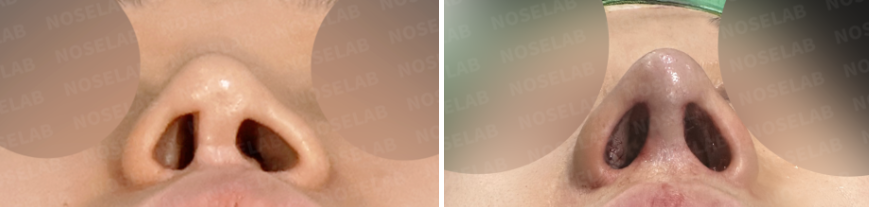
Frontal View
Significant improvement in nostril symmetry

Nasal Alignment
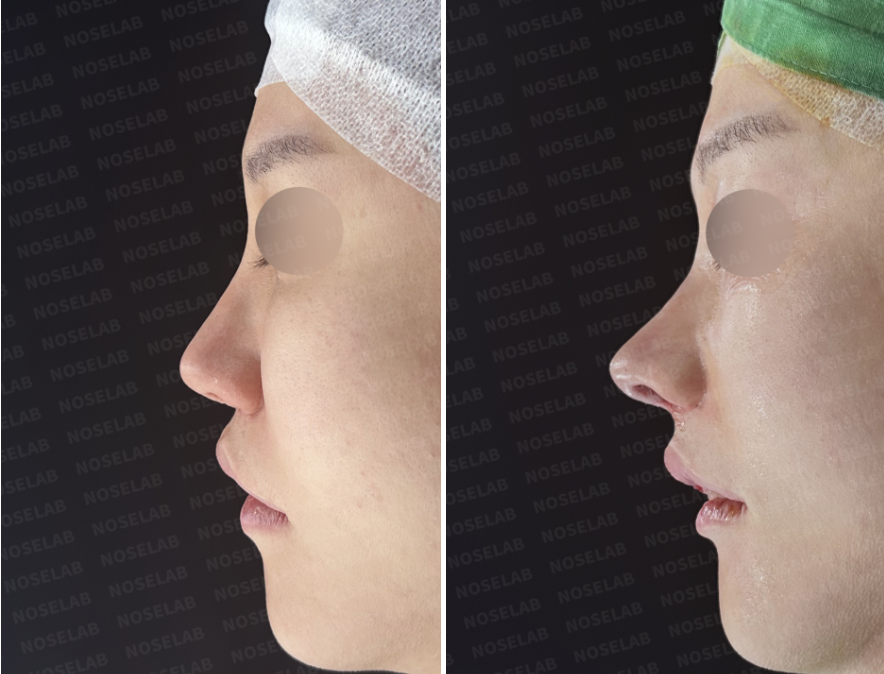
Correction of deviated nose
Restoration of midline balance
Tip Stability
Strong structural support
Stable nasal tip position

Functional Outcome
Relief of nasal obstruction
Improved airflow
Surgeon’s Commentary
Nostril asymmetry is one of the most technically demanding problems in revision rhinoplasty.
When cartilage imbalance is severe, simple suturing is insufficient. Structural reconstruction and internal lining repair must be performed together.
In this case, alar cartilage reconstruction, composite grafting, and septal repositioning were combined to restore both structure and symmetry.
Septal reconstruction also played a critical role in correcting nasal deviation and stabilizing the nasal tip.
A structure-first approach is essential to achieve both functional improvement and long-term stability in complex revision cases.
Because nostril asymmetry involves both cartilage structure and internal lining conditions, surgical planning must be based on precise anatomical analysis rather than a standardized approach.
If you are considering revision rhinoplasty for asymmetry or breathing problems, a comprehensive evaluation is essential to determine the most appropriate reconstruction strategy.
📩 International Consultation
→ LINE Consultation (Japan only)
FAQ
Q1. Can closed rhinoplasty correct severe nostril asymmetry?
Yes. Structural reconstruction and internal lining repair can significantly improve nostril symmetry.
Q2. When is composite grafting necessary?
When internal nostril lining is deficient or size adjustment is required.
Q3. Can breathing problems be treated at the same time?
Yes. Functional correction can be performed simultaneously with structural reconstruction.
🎥 YouTube Reference
If you’re curious about Dr. Cha-Young Kang’s closed rhinoplasty approach, click to watch the video.

Read the author’s background and the original case context. About these articles
Source updated .