Case at a glance
- Photo timing
These details are excerpts from the original article and captions. Follow a detail to read it in context.
Severe septal deviation can cause both nasal obstruction and visible nasal asymmetry. When the septum deviates significantly, the internal airway narrows and the nose may appear crooked externally.
In this case, structural reconstruction using autologous rib cartilage corrected the septal deviation, improved nasal airflow, and restored balanced nasal alignment through a closed rhinoplasty approach.
This case involves a patient with severe septal deviation accompanied by nasal obstruction and multiple aesthetic nasal concerns.
The septum had deviated markedly toward the left side, causing significant breathing difficulty and visible nasal asymmetry. In addition to functional problems, the patient also presented with a crooked nose, dorsal hump, drooping nasal tip, and maxillary protrusion affecting the overall facial profile.
Because both functional and aesthetic issues were present, comprehensive structural correction was required.
In this case, structural correction was achieved through closed rhinoplasty korea, focusing on septal reconstruction and restoration of both nasal airway function and external alignment.
Severe septal deviation requires structural reconstruction rather than simple cosmetic correction to achieve both functional and aesthetic improvement.
If you are experiencing nasal obstruction, breathing difficulty, or visible nasal asymmetry, a detailed structural evaluation is essential before determining the appropriate surgical plan.
📩 International Consultation
→ LINE Consultation (Japan only)

Surgical Background – Closed Rhinoplasty Korea
Correction of severe septal deviation requires reconstruction of the internal nasal framework as well as external nasal alignment.
For this reason, closed rhinoplasty korea was selected to allow structural reconstruction and airway correction through an endonasal approach without external incisions.

Structural Problems Identified
Clinical examination revealed several anatomical problems contributing to both nasal obstruction and facial imbalance:
Severe septal deviation toward the left side
Crooked nasal alignment caused by asymmetric nasal bones
Prominent dorsal hump
Drooping nasal tip
Maxillary protrusion affecting the nasolabial angle
Because these structural issues were interrelated, they were addressed simultaneously during surgery.
Surgical Plan – Functional Reconstruction and Nasal Realignment
Septal Reconstruction with Autologous Rib Cartilage
The septum was severely deviated and structurally unstable.
Procedures performed:
Septal reconstruction using autologous rib cartilage
Restoration of stable midline nasal support
Re-expansion of the nasal airway
Because the septum forms the central structural pillar of the nose, reconstruction was essential for restoring both breathing and nasal stability.
Crooked Nose Correction and Lateral Osteotomy
The nasal bones were asymmetrically positioned, resulting in visible nasal deviation.
Procedures performed:
Lateral osteotomy to reposition the nasal bones
Realignment of the nasal framework to the midline
This correction restored a straight nasal appearance when viewed from the front.
Dorsal Hump Reduction
The dorsal hump was carefully reduced and smoothed to create a clean and natural nasal bridge line.
Nasolabial Angle Adjustment for Maxillary Protrusion
Maxillary protrusion influenced the relationship between the nose and upper lip.
Through controlled adjustment of the nasolabial angle:
The facial profile became more balanced
The transition between nose and upper lip appeared more harmonious
Correction of a Drooping Nasal Tip
The nasal tip was elevated and stabilized using autologous rib cartilage.
This provided strong structural support while maintaining a natural contour.
Surgical Results
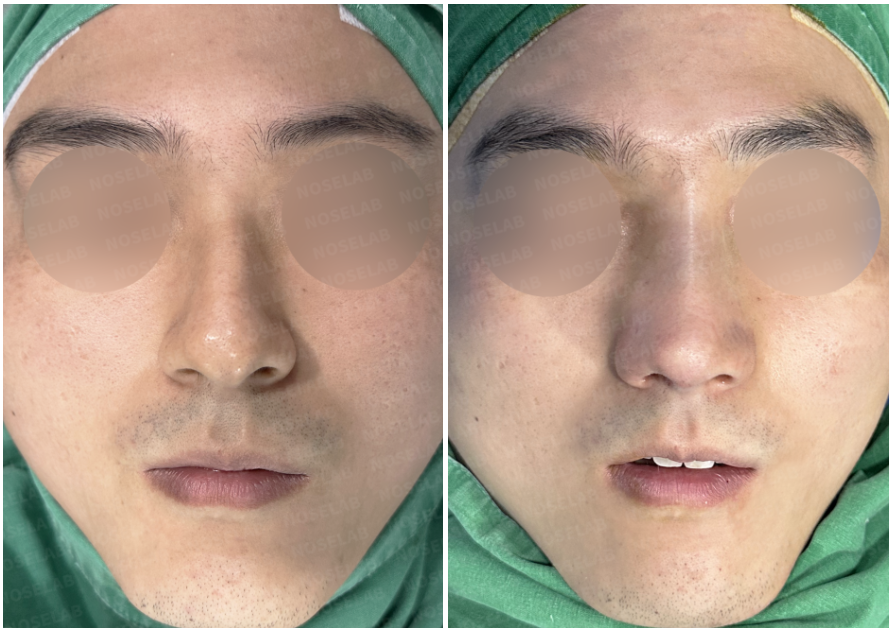
Functional Improvement
Breathing function improved significantly following septal reconstruction.
Nasal obstruction was relieved
Airflow through the nasal passage became clearer

Aesthetic Improvement
Structural correction also improved nasal appearance.
The crooked nose was straightened
The dorsal hump was reduced
The drooping nasal tip was refined and elevated

Overall Outcome
The nose achieved a balanced, natural appearance that harmonized with the patient’s facial structure while restoring comfortable breathing.
Surgeon’s Commentary – Importance of Septal Reconstruction
When septal deviation is severe, correcting only the external appearance of the nose cannot resolve the underlying functional problem.
Septal reconstruction is essential for restoring both:
Proper nasal airflow
A stable structural nasal framework
Autologous rib cartilage provides strong and reliable support, making it particularly useful in cases requiring durable reconstruction.
After nasolabial angle adjustment for maxillary protrusion, slight temporary overcorrection may be observed during the early healing phase. Patients may experience mild tightness around the upper lip for several months as swelling subsides and tissues adapt. Over time, the angle gradually settles into a natural and stable position.
Successful rhinoplasty requires careful balance between function and aesthetics. When airway obstruction and structural deformities are corrected together, patients often experience improvements in both breathing comfort and facial harmony.
Because severe septal deviation affects both internal airway function and external nasal structure, surgical planning must be based on precise anatomical analysis rather than a standardized approach.
If you are considering rhinoplasty for both functional improvement and structural correction, a comprehensive evaluation is essential to determine the most appropriate surgical strategy.
📩 International Consultation
→ LINE Consultation (Japan only)
(FAQ)
Q1. Can septal deviation cause breathing problems?
Yes. Severe septal deviation can narrow the nasal airway and significantly impair breathing.
Q2. Why is rib cartilage used for septal reconstruction?
Rib cartilage provides strong and durable structural support when significant septal reconstruction is required.
Q3. Can crooked nose correction and breathing improvement be performed together?
Yes. Functional correction and aesthetic rhinoplasty can be performed simultaneously when properly planned.
🎥 YouTube Reference
If you’re curious about Dr. Cha-Young Kang’s closed rhinoplasty approach, click to watch the video.

Read the author’s background and the original case context. About these articles
Source updated .


