Case at a glance
- Surgical plan
- Graft & material details
- Photo timing
These details are excerpts from the original article and captions. Follow a detail to read it in context.
This case reviews complete nasal reconstruction rhinoplasty in a patient with severe internal structural damage after multiple previous rhinoplasty procedures, including near-total septal cartilage loss, severe alar cartilage damage, nasal deviation, nostril asymmetry, reduced dorsal height, implant-related abnormal findings on CT imaging, suspected chronic foreign body reaction, fibrotic capsule formation, weakened soft tissue, and unstable nasal framework. Surgery focused on implant and capsule management, infection assessment, full septal reconstruction, bilateral alar cartilage reconstruction, autologous rib cartilage framework rebuilding, dorsal height restoration within tissue limits, nostril asymmetry correction, internal skin grafting, columella and nasal base stabilization, and closed rhinoplasty structural reconstruction.
Author: Dr. Cha-Young Kang
Clinic: NoseLab Clinic
Published: 2026
Last Updated: 2026
Introduction
Hello, this is Dr. Cha-Young Kang of NoseLab Clinic.
This case involves complete nasal reconstruction rhinoplasty in a patient who developed severe nasal deformity and internal structural loss after multiple previous rhinoplasty procedures.
The patient presented with nasal deviation, nostril asymmetry, reduced dorsal height, weakened nasal framework, and instability caused by extensive damage to the internal support structures.
Preoperative CT imaging showed abnormal findings around the existing implant, raising concern for chronic foreign body reaction and capsule formation.
Because the septal and alar structures were severely damaged, the surgical plan required reconstruction of the internal framework rather than isolated correction or simple implant replacement.
The surgery was performed using a closed rhinoplasty / endonasal approach. The goal was to rebuild central support, reconstruct the alar framework, improve nasal deviation, address nostril asymmetry, and restore structural support within the limits of the patient’s tissue condition.
Surgical Background Before Complete Nasal Reconstruction Rhinoplasty
Complete nasal reconstruction may be needed when repeated rhinoplasty procedures have caused severe damage to the septal cartilage, alar cartilage, nasal tip support, and dorsal framework.
In this case, the patient had significant internal structural loss after multiple previous surgeries.
The remaining native cartilage was not sufficient for stable support, and CT imaging suggested implant-related tissue changes.
For this reason, the surgical plan required full structural reconstruction using autologous rib cartilage.
Because the patient had weakened tissue and possible foreign body reaction around the implant, tissue condition and infection risk needed to be evaluated carefully during surgery.

Preoperative Assessment Before Complete Nasal Reconstruction Rhinoplasty
Preoperative design consultation photos and CT findings were reviewed together.
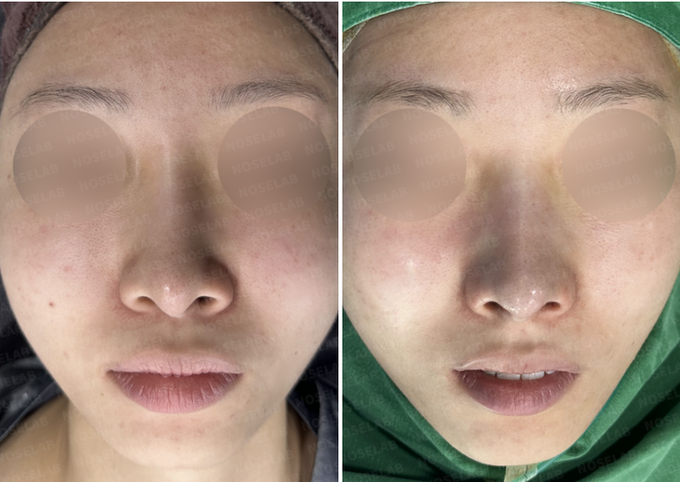
Frontal View: Nasal Deviation and Asymmetry
From the frontal view, nasal deviation and asymmetry were visible.
The nasal axis was not well aligned, and the external shape suggested underlying structural imbalance.
In complex revision cases, deviation may involve the nasal bones, septum, dorsal framework, implant position, scar tissue, and lower nasal cartilage support.
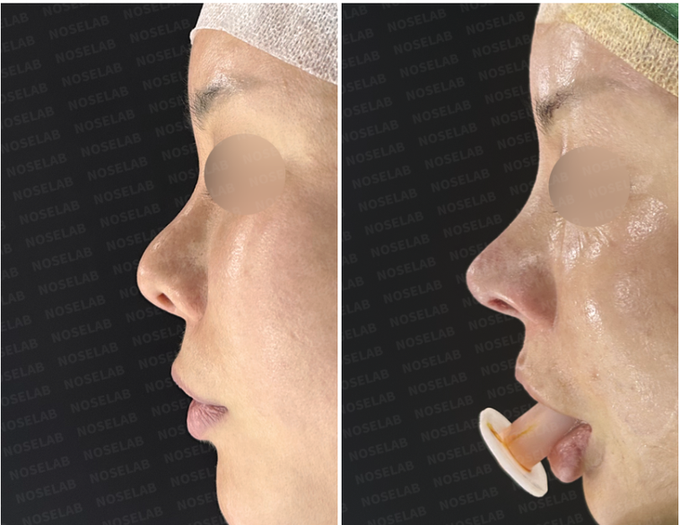
Side View: Reduced Dorsal Height and Structural Weakness
From the side profile, dorsal height appeared reduced.
The nasal contour did not appear well supported because of internal framework weakness.
Restoring height in this type of case requires conservative planning because weakened tissue may not tolerate excessive augmentation.
Oblique View: Implant-Related Contour and Tissue Changes
From the oblique view, the nasal contour was assessed together with implant-related tissue changes.
CT imaging suggested abnormal findings around the existing implant, so intraoperative evaluation was needed to assess capsule formation, fluid, inflammation, and surrounding tissue condition.
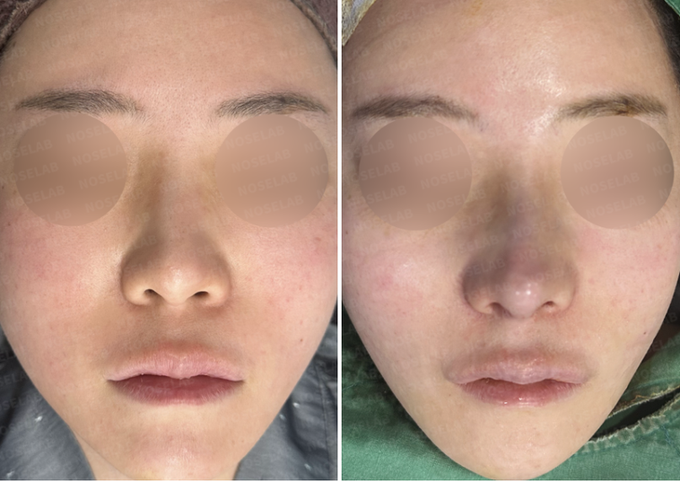
Nostril View: Nostril Asymmetry and Base Instability
From the nostril view, nostril asymmetry was observed.
The columella and nasal base required stabilization because lower nasal support was weakened.
Nostril correction was planned together with septal reconstruction, alar cartilage reconstruction, internal skin grafting, and lower nasal framework support.

Structural Problems Identified
Preoperative evaluation revealed multiple structural deficiencies.
These included:
Near-total loss of septal cartilage
Severe alar cartilage damage
Nasal deviation
Nostril asymmetry
Reduced dorsal height
Implant-related foreign body reaction concerns
Fibrotic capsule formation around previous material
Weakened soft tissue and unstable internal support
Because these problems were connected, the surgical plan required complete structural reconstruction rather than partial correction.
Surgical Plan for Complete Nasal Reconstruction Rhinoplasty
The surgical plan focused on structural and functional reconstruction using autologous rib cartilage.
1. Previous Material and Capsule Management
The previous implant and surrounding fibrotic capsule were removed and managed according to intraoperative findings.
The tissue condition was assessed carefully to check for signs of infection, inflammation, or weakened soft tissue.
Because foreign body reaction can affect healing and reconstruction planning, this step was important before rebuilding the nasal framework.
2. Full Septal Reconstruction
The septum was reconstructed using autologous rib cartilage.
This step was needed because the patient had near-total loss of septal cartilage.
Rebuilding central support was important for nasal axis control, nasal tip support, and overall framework stability.
3. Bilateral Alar Cartilage Reconstruction
Both alar cartilage structures were reconstructed using autologous rib cartilage.
This helped rebuild the lower nasal framework and support the nasal tip.
Alar reconstruction was also related to nostril balance, columella position, and nasal base stabilization.
4. Dorsal Height Restoration Within Tissue Limits
Dorsal height was restored conservatively within the patient’s biological and soft tissue limits.
The goal was not maximal height, but a more stable and balanced dorsal contour.
Overcorrection was avoided because weakened tissue can increase the risk of visibility, tension, contour irregularity, or delayed healing.
5. Nostril Asymmetry Correction
Nostril asymmetry was addressed using internal structural correction and internal skin grafting where needed.
The columella and nasal base were stabilized as part of the lower nasal reconstruction.
Because nostril shape can change during healing, final nostril balance should be evaluated over time.
6. Infection Assessment and Tissue Management
Serous fluid and surrounding tissue were evaluated during surgery.
Antibiotic irrigation and careful tissue management were performed according to intraoperative findings.
In complex revision cases with implant-related abnormal findings, reconstruction planning should be adjusted according to tissue condition.
Surgical Results After Complete Nasal Reconstruction Rhinoplasty
Frontal View: Nasal Deviation and Symmetry
From the frontal view, nasal deviation appeared improved after framework reconstruction and nasal axis correction.
Overall symmetry appeared more balanced within the patient’s anatomical limits.

Side View: Dorsal Height and Nasal Contour
From the side profile, dorsal height appeared improved after conservative reconstruction.
The nasal contour appeared smoother after central support and dorsal framework correction.

Basal View: Nostril Symmetry and Columella Position
From the basal view, nostril symmetry appeared improved after lower nasal framework reconstruction.
The columella position appeared more stable after septal and alar support reconstruction.

Structural Outcome After Rib Cartilage Reconstruction
The internal framework was rebuilt using autologous rib cartilage.
Central septal support, alar support, nasal tip support, and base stabilization were addressed together.
Because this was a complex reconstruction case, tissue response and structural stability should be monitored over time.

Surgeon’s Commentary on Complete Nasal Reconstruction
In patients with multiple previous rhinoplasty procedures, native cartilage may be severely damaged, weakened, or absent.
In this case, the patient had near-total septal cartilage loss and severe alar cartilage damage.
Autologous rib cartilage was selected because a large amount of structural graft material was needed to rebuild the internal nasal framework.
CT imaging showed abnormal findings around the previous implant, so intraoperative evaluation was performed to assess capsule, fluid, and tissue condition.
After implant and capsule management, weakened tissue required a conservative reconstruction plan to reduce excessive tension and avoid overcorrection.
Complete nasal reconstruction is not focused on maximal cosmetic change. The priority is to rebuild support, improve structural balance, and address functional and anatomical problems within safe tissue limits.
This case shows that complete nasal reconstruction rhinoplasty may require septal reconstruction, bilateral alar cartilage reconstruction, autologous rib cartilage framework rebuilding, nostril asymmetry correction, infection assessment, and careful tissue management.
All surgical planning should be individualized based on previous surgery history, CT findings, cartilage loss, implant condition, tissue quality, airway structure, and healing response.
FAQ
Can closed rhinoplasty be used for complete nasal reconstruction?
Closed rhinoplasty / endonasal approach may be used for complete nasal reconstruction depending on the degree of structural damage, cartilage availability, scar tissue, implant condition, and surgical goals.
Why is rib cartilage used for complete nasal reconstruction?
Autologous rib cartilage may be used when native septal or alar cartilage is insufficient, severely damaged, or absent. It can provide enough graft material for structural reconstruction in complex revision cases.
Why is a conservative approach important in complete nasal reconstruction?
A conservative approach is important when tissue is weakened, scarred, thin, or inflamed. Excessive augmentation or tension may increase the risk of contour irregularity, visibility, delayed healing, or tissue problems.
Can nostril asymmetry improve after complete reconstruction?
Nostril asymmetry may improve when septal support, alar cartilage structure, columella position, nasal base stability, and soft tissue balance are addressed together. The degree of improvement varies by patient.
Why is CT imaging useful before complex revision rhinoplasty?
CT imaging may help evaluate implant position, septal condition, nasal structure, airway anatomy, and possible abnormal findings around previous materials before planning reconstruction.
International Consultation
For international patients, a photo-based consultation may help clarify whether complete nasal reconstruction rhinoplasty, autologous rib cartilage reconstruction, septal reconstruction, alar cartilage reconstruction, nostril asymmetry correction, implant removal, or closed rhinoplasty Korea may be needed.

Read the author’s background and the original case context. About these articles