Case at a glance
- Concerns & goals
- Previous treatment
- Surgical plan
- Graft & material details
- Photo timing
These details are excerpts from the original article and captions. Follow a detail to read it in context.
This case reviews 5th revision rhinoplasty in a patient with a long history of nasal filler, thread lift, donated rib cartilage, septal cartilage grafting, silicone implant use and removal, autologous rib cartilage reuse, auricular cartilage grafting, autologous dermal grafting, alar lifting, nostril lowering, upturned nasal tip, deviated nasal axis, excessive nostril exposure, blunt nasal tip, severe nostril asymmetry, high nasal bridge starting point, retracted nasolabial angle, long philtrum impression, foreign body material, damaged septal cartilage, nasal congestion, and scar tissue. Surgery focused on autologous rib cartilage reconstruction, septal extension grafting, septal correction, inferior turbinate reduction, nasolabial angle correction, foreign body removal, tip refinement, nostril asymmetry correction, scar tissue removal, and closed rhinoplasty structural correction.
Author: Dr. Cha-Young Kang
Clinic: NoseLab Clinic
Published: 2024
Last Updated: 2026
Introduction
Hello, this is Dr. Cha-Young Kang of NoseLab Clinic.
This case involves 5th revision rhinoplasty in a patient who had undergone multiple previous nasal procedures, including filler, thread lifting, silicone implant surgery, rib cartilage surgery, ear cartilage grafting, dermal grafting, and several revision operations.
Despite these previous procedures, the patient continued to be concerned about an upturned nasal tip, deviated nasal axis, excessive nostril exposure, severe nostril asymmetry, blunt nasal tip, and nasal congestion.
Because this was a multiple revision case with damaged septal cartilage and scar tissue, the surgical plan required both structural reconstruction and functional correction.
The surgery was performed using a closed rhinoplasty / endonasal approach. The goal was to reconstruct nasal support with autologous rib cartilage, correct the upturned nasal tip, improve nasal deviation, address nostril asymmetry, remove existing foreign material, and improve nasal obstruction factors within the limits of the patient’s tissue condition.
Surgical History Before 5th Revision Rhinoplasty
The patient had a complex history of nasal procedures beginning in 2015.
Previous Nasal Procedures
The patient’s surgical and procedural history included:
2015: nasal filler
2018: thread lift, rhinoplasty using donated rib cartilage and septal cartilage, and filler removal
Early 2022: rhinoplasty using silicone and autologous rib cartilage
2 weeks later in 2022: silicone removal
2 months later in 2022: rhinoplasty using reused autologous rib cartilage, auricular cartilage, and silicone insertion
February 2023: surgery using reused autologous rib cartilage, donated rib cartilage, autologous dermal grafting, alar lifting, and nostril lowering
Because the patient had undergone multiple previous surgeries, the revision plan needed to consider limited cartilage availability, scar tissue, altered nasal lining, foreign material, and weakened structural support.
Preoperative Analysis Before 5th Revision Rhinoplasty
Preoperative consultation photos were reviewed from the frontal, side, oblique, and nostril views.
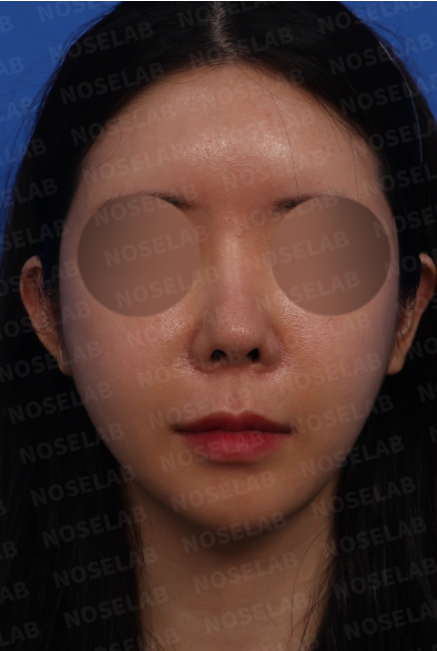
Frontal View: Excessive Nostril Exposure and Deviated Nose
From the frontal view, the nostrils appeared excessively exposed.
The nasal tip appeared wide and blunt, and distinct nostril asymmetry was observed.
The nasal axis also appeared deviated to one side, creating an imbalanced frontal appearance.
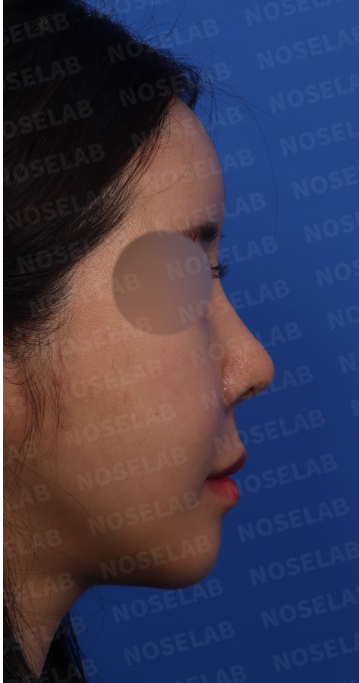
Side View: High Starting Point and Retracted Nasolabial Angle
From the side profile, the nasal bridge starting point appeared high.
The nasolabial angle appeared retracted, and the nasal tip showed mild drooping despite the upturned nasal appearance from other views.
This suggested that nasal tip position, columella support, and nasolabial angle needed to be corrected together.
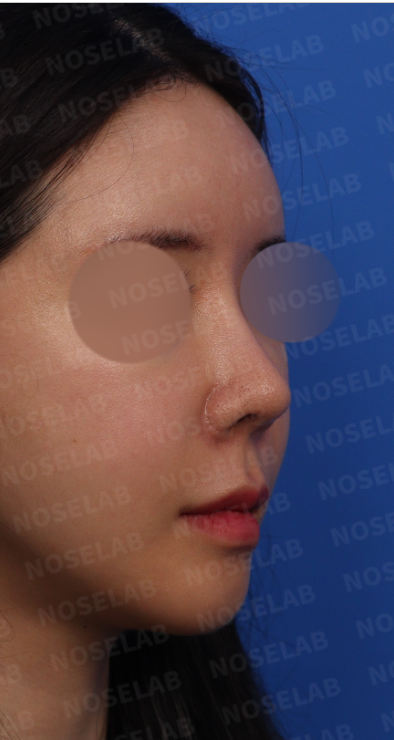
Oblique View: Upturned Tip and Long Philtrum Impression
From the oblique view, the nasal tip appeared upturned.
The philtrum appeared long in relation to the nasal tip and columella position.
Because nasal tip position can affect the impression of midface and upper lip length, the nasolabial angle was evaluated as part of the surgical plan.
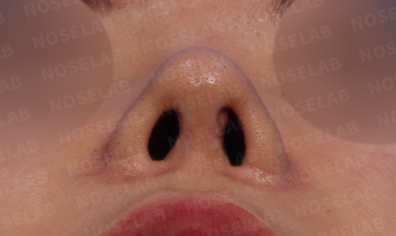
Nostril View: Severe Nostril Asymmetry and Columella Imbalance
From the nostril view, severe nostril asymmetry was visible.
The cartilage near the left nostril and columella appeared tilted, and scar tissue was suspected around the lower nasal framework.
Because nostril shape depends on septal support, columella position, alar cartilage, scar tissue, and previous graft material, correction was planned within realistic anatomical limits.
Surgical Plan for 5th Revision Rhinoplasty
The surgery was planned using a closed rhinoplasty / endonasal approach.
Autologous Rib Cartilage Harvesting and Reconstruction
Because the septal cartilage used in previous surgeries was severely damaged, autologous rib cartilage was used as the main structural material.
The lower nasal framework was reinforced with rib cartilage to support the nasal tip and improve structural balance.
In multiple revision cases, rib cartilage may be considered when the septal cartilage is damaged, insufficient, or no longer reliable for support.
Septal Correction and Septal Extension Grafting
Septal correction was performed to address deviation and improve central nasal support.
A septal extension graft was used to support the nasal tip and help reduce the upturned nasal appearance.
This step was also related to nasal congestion because septal deviation can contribute to airway narrowing.
Inferior Turbinate Reduction for Nasal Congestion
Inferior turbinate reduction was performed to address turbinate-related airway narrowing.
Submucosal tissue was reduced using radiofrequency.
Breathing changes should be evaluated over time because turbinate response, mucosal swelling, scar tissue, and healing response can influence nasal airflow after surgery.
Nasolabial Angle Correction
The angle between the nasal tip, columella, and philtrum was adjusted to improve side profile balance.
This helped address the retracted nasolabial angle and long philtrum impression.
Foreign Body Removal
Existing foreign material from previous procedures was removed.
In revision rhinoplasty, remaining foreign material can affect contour, scar tissue, inflammation risk, and reconstruction planning.
Tip Refinement for Blunt Nasal Tip
The blunt nasal tip was refined through careful cartilage adjustment and structural support.
The goal was to improve tip definition without creating an overly sharp or artificial-looking tip.
Nostril Asymmetry Correction and Scar Tissue Removal
Nostril asymmetry correction was performed together with lower nasal framework adjustment.
Tilted cartilage near the columella and scar tissue were addressed to improve lower nasal balance.
Because this was a multiple revision case, nostril correction was planned within the limits of scar tissue, skin condition, cartilage condition, and healing response.
Surgical Results After 5th Revision Rhinoplasty
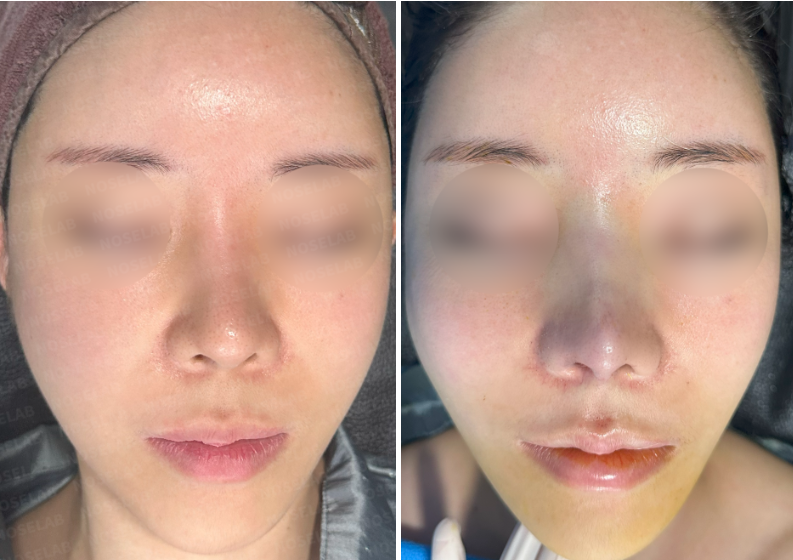
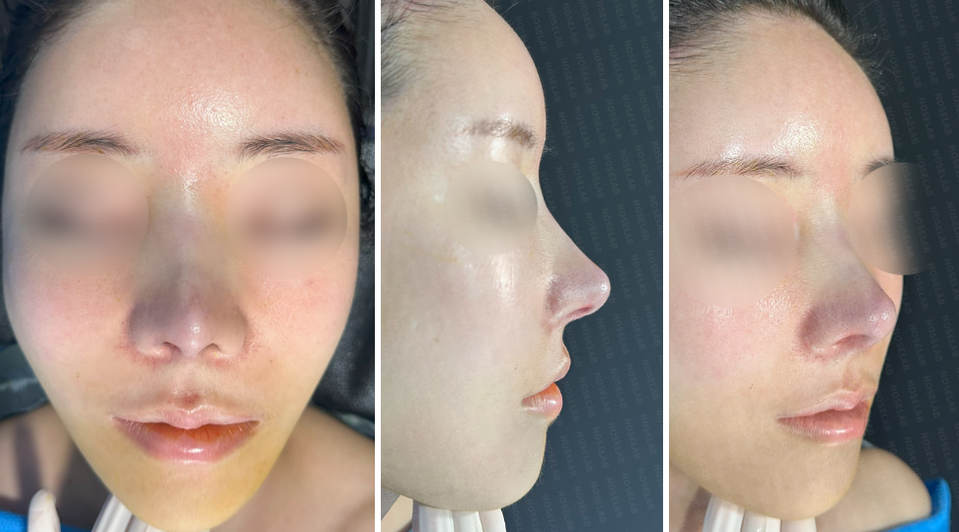
Frontal View: Nostril Exposure and Nasal Deviation
From the frontal view, excessive nostril exposure appeared reduced after nasal tip support and nostril correction.
The wide and blunt nasal tip appeared more refined after tip adjustment and structural support.
The deviated nasal appearance appeared more balanced after septal correction and framework reconstruction.
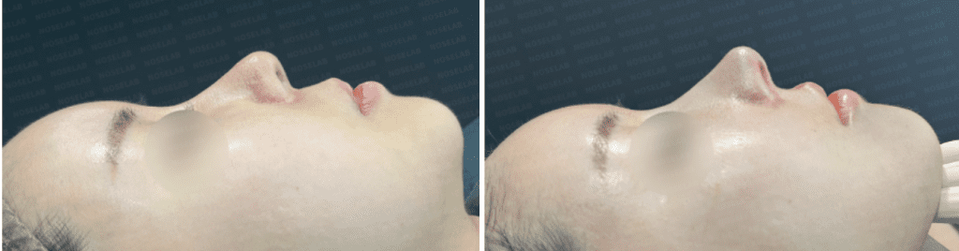
Side View: Bridge Height, Columella, and Profile Balance
From the side profile, the nasal bridge height appeared more balanced.
The retracted columella appeared improved and the nasolabial angle appeared more natural-looking after angle adjustment.
The side profile appeared more balanced after nasal tip support and columella correction.
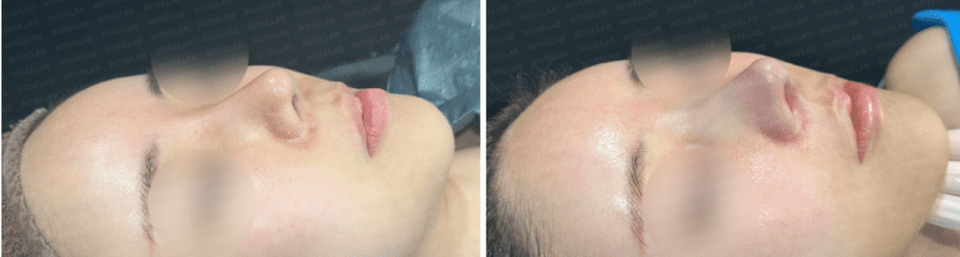
Oblique View: Upturned Tip and Philtrum Impression
From the oblique view, the upturned nasal tip appeared lower and better supported after septal extension grafting.
The philtrum impression appeared shorter in relation to the revised nasal tip and columella position.
The nasal contour appeared more three-dimensional after structural reconstruction.
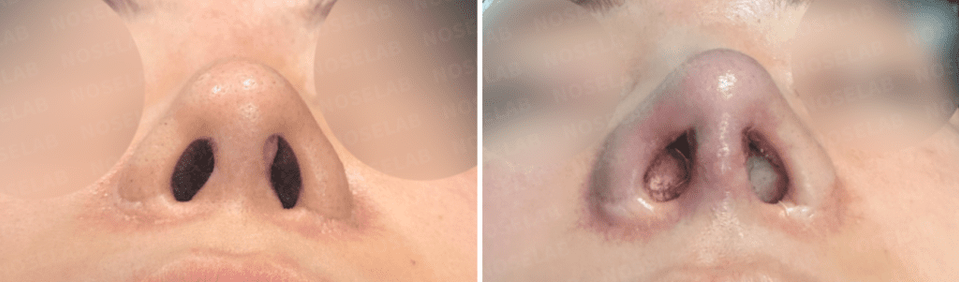
Nostril View: Severe Nostril Asymmetry
From the nostril view, severe nostril asymmetry appeared improved after scar tissue removal, tilted cartilage adjustment, and nostril correction.
The lower nasal framework appeared more balanced after reconstruction with autologous rib cartilage.
Because nostril shape can change during healing, the final result should be evaluated over time.
Functional Outcome After Septal Correction and Turbinate Reduction
Nasal congestion factors were addressed through septal correction and inferior turbinate reduction.
Functional improvement should be evaluated over time because swelling, mucosal condition, turbinate response, and scar tissue can affect nasal breathing during recovery.
Surgeon’s Commentary
This 5th revision rhinoplasty case was complex because the patient had undergone multiple previous nasal procedures involving filler, threads, silicone, donated rib cartilage, autologous rib cartilage, ear cartilage, and dermal grafting.
The most important issue was severe damage to the septal cartilage and lower nasal support.
When the septal cartilage is damaged or depleted, the nasal tip can become unstable, upturned, asymmetric, or difficult to support.
For this reason, autologous rib cartilage was used as the main structural material for reconstruction.
Septal correction and septal extension grafting were used to support the nasal tip and improve the deviated nasal structure.
Inferior turbinate reduction was also included because the patient had nasal congestion symptoms.
Existing foreign material, tilted cartilage near the columella, and scar tissue were addressed because they contributed to contour irregularity and nostril asymmetry.
This case shows that 5th revision rhinoplasty may require combined correction of septal damage, rib cartilage reconstruction, upturned nasal tip, nasal deviation, nostril asymmetry, foreign body material, scar tissue, and functional nasal obstruction.
FAQ
What makes 5th revision rhinoplasty difficult?
5th revision rhinoplasty is difficult because previous surgeries can leave scar tissue, altered nasal lining, damaged cartilage, limited graft material, and unpredictable tissue response. Careful evaluation is needed before planning additional surgery.
Why was autologous rib cartilage used in this case?
Autologous rib cartilage may be used when septal cartilage is severely damaged, insufficient, or no longer able to provide support. It can be considered for structural reconstruction in complex revision cases.
Can upturned nose and deviated nose be corrected together?
Upturned nose and nasal deviation may be corrected together when the surgical plan includes septal support, tip repositioning, nasal axis correction, and lower nasal framework reconstruction.
Can nostril asymmetry improve after multiple revision surgeries?
Nostril asymmetry may be improved by correcting septal support, columella position, alar cartilage balance, scar tissue, and tilted cartilage. Complete symmetry cannot be guaranteed because scar tissue and healing response vary.
Can nasal congestion be treated during revision rhinoplasty?
Nasal congestion may be addressed when structural causes such as septal deviation, turbinate hypertrophy, or nasal valve narrowing are present. Functional changes should be evaluated over time after surgery.
International Consultation
For international patients, a photo-based consultation may help clarify whether 5th revision rhinoplasty, autologous rib cartilage reconstruction, septal extension grafting, upturned nose correction, deviated nose correction, nostril asymmetry correction, foreign body removal, or functional airway surgery may be needed.
Read the author’s background and the original case context. About these articles


