
Case at a glance
- Concerns & goals
- Previous treatment
- Surgical plan
- Graft & material details
- Photo timing
These details are excerpts from the original article and captions. Follow a detail to read it in context.
This case reviews functional rhinoplasty with rib cartilage in a patient with recurrent nasal obstruction after prior septoplasty and turbinate surgery, crooked nasal bridge, wide and asymmetric nasal shape, uneven nostrils, mild dorsal hump, drooping nasal tip, low nasal projection, columella deviation, mucosal adhesion, turbinate hypertrophy, and nostril asymmetry. Surgery focused on revision septoplasty, turbinate reduction, mucosal repair, adhesion release, nasal bone osteotomy, rib cartilage septal extension, nostril asymmetry correction, tip refinement, and closed rhinoplasty structural correction.
Author: Dr. Cha-Young Kang
Clinic: NoseLab Clinic
Published: 2025
Last Updated: 2026
Introduction
Hello, this is Dr. Cha-Young Kang of NoseLab Clinic.
This case involves functional rhinoplasty with rib cartilage in a patient who had previously undergone septoplasty and turbinate surgery but later experienced recurrent nasal obstruction and persistent structural deviation.
The patient presented with both functional and aesthetic concerns, including a crooked nasal bridge, nostril asymmetry, columella deviation, turbinate hypertrophy, mucosal adhesion, mild dorsal hump, drooping nasal tip, and low nasal projection.
Because the case involved recurrent nasal obstruction after previous functional surgery, the surgical plan required both airway correction and structural nasal support.
The surgery was performed using a closed rhinoplasty / endonasal approach. The goal was to address recurrent nasal obstruction factors, improve nasal alignment, reinforce the weakened nasal framework, refine the nasal tip, and improve overall nasal balance.
Surgical History Before Functional Rhinoplasty with Rib Cartilage
The patient had a history of prior nasal functional surgery.
Previous Functional Surgery
The patient had previously undergone:
Septoplasty
Turbinate surgery
Despite these procedures, nasal obstruction later recurred, and structural deviation remained.
In revision functional rhinoplasty, it is important to evaluate not only the septum and turbinates, but also mucosal adhesion, nasal valve area, tip support, and overall nasal axis.
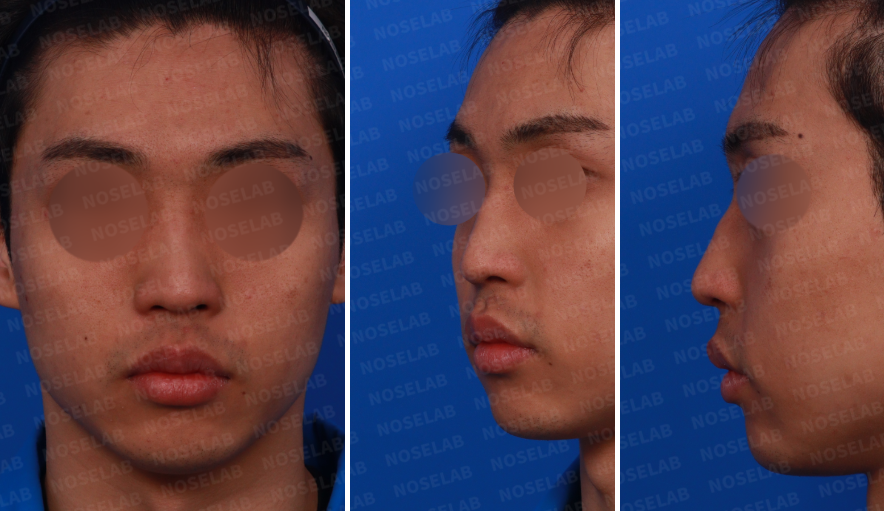
Initial Evaluation Before Functional Rhinoplasty with Rib Cartilage
Design consultation photos and nasal endoscopy findings were reviewed before surgery.
Frontal View: Crooked Nasal Bridge and Asymmetry
From the frontal view, the nasal bridge appeared crooked.
The overall nasal shape appeared wide and asymmetric, and the nostrils appeared uneven.
These findings suggested that both bony deviation and lower nasal framework imbalance needed to be considered.
Side Profile: Mild Hump, Drooping Tip, and Low Projection
From the side profile, a mild dorsal hump was observed.
The nasal tip appeared drooping, and nasal projection was relatively low.
Because tip support can influence both side profile and nasal airway structure, rib cartilage support was included in the surgical plan.
Nostril View: Columella Deviation and Nostril Asymmetry
From the nostril view, columella deviation and nostril asymmetry were observed.
The nostril imbalance was related to septal position, columella alignment, lower nasal framework support, and scar tissue from previous surgery.

Endoscopic Findings: Adhesion and Turbinate Hypertrophy
Nasal endoscopy showed mucosal adhesion and turbinate hypertrophy.
These findings were important because persistent nasal obstruction may result from multiple factors, including septal deviation, turbinate enlargement, mucosal adhesion, nasal valve narrowing, and postoperative scarring.

Patient Goals for Rib Cartilage Functional Rhinoplasty
The patient wanted improvement in nasal structure, symmetry, and breathing comfort.
Main Goals
The goals included:
Improve nasal symmetry and structure
Address recurrent nasal obstruction
Improve the crooked nasal appearance
Refine the drooping nasal tip
Improve nostril balance
Create a natural-looking nasal contour
Because the patient had already undergone previous functional nasal surgery, the revision plan needed to be individualized according to the remaining septal structure, mucosal condition, and turbinate status.
Surgical Plan for Functional Rhinoplasty with Rib Cartilage
Revision Septoplasty
Revision septoplasty was planned to address residual or recurrent septal deviation.
This was an important part of the functional correction because septal deviation can contribute to nasal obstruction and nasal axis imbalance.
Turbinate Reduction for Rhinitis-Related Narrowing
Turbinate reduction was planned to address hypertrophic inferior turbinates.
Because turbinate size may change depending on mucosal condition and inflammation, functional improvement should be evaluated over time after surgery.
Mucosal Repair and Adhesion Release
Mucosal repair and adhesion release were performed to address intranasal scarring.
Adhesions can narrow the nasal airway and may contribute to persistent obstruction after previous nasal surgery.
Nasal Bone Osteotomy for Crooked Nose Correction
Nasal bone osteotomy was performed to address the crooked nasal bridge.
This step was planned to improve nasal alignment and frontal balance.
Rib Cartilage Septal Extension for Tip Support
Autologous rib cartilage was used for septal extension and structural support.
This helped support the drooping nasal tip and reinforce the lower nasal framework.
In revision cases, rib cartilage may be considered when additional support is needed or when septal cartilage is insufficient.
Nostril Asymmetry Correction
Nostril asymmetry correction was planned together with septal support and columella alignment.
Because nostril symmetry depends on septal position, alar cartilage, columella support, scar tissue, and healing response, correction was planned within the patient’s anatomical limits.
Tip Refinement and Nasolabial Angle Balance
Tip refinement was performed to improve the drooping nasal tip and overall side profile.
The nasolabial angle was considered together with tip support, columella position, and facial balance.
Surgical Results After Functional Rhinoplasty with Rib Cartilage
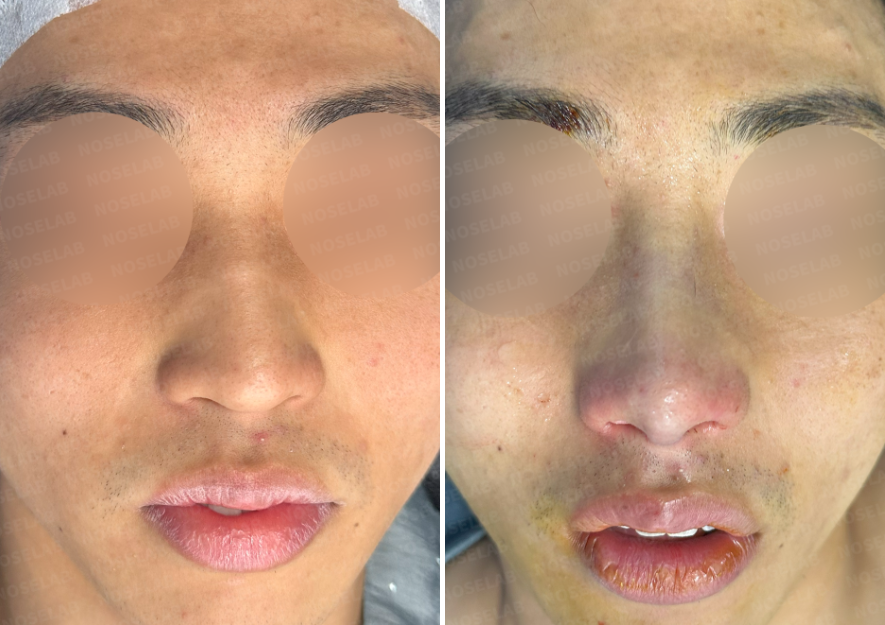
Frontal View: Straighter Nasal Bridge and Improved Balance
From the frontal view, the nasal bridge appeared straighter after osteotomy and structural correction.
The nasal contour and nostril balance appeared more even after septal support and lower nasal framework correction.

Side View: Tip Support and Projection
From the side view, nasal projection appeared improved after rib cartilage support.
The drooping nasal tip appeared better supported, and the mild hump appeared less prominent in relation to the revised dorsal and tip contour.

Nostril View: Columella and Nostril Balance
From the nostril view, the columella position and nostril balance appeared improved after lower nasal framework correction.
Because nostril shape can be affected by scar tissue, septal position, alar cartilage condition, and healing response, the result should be evaluated over time.

Functional Outcome After Revision Septoplasty and Turbinate Reduction
Nasal obstruction factors were addressed through revision septoplasty, turbinate reduction, mucosal repair, and adhesion release.
Breathing changes should be assessed over time because mucosal swelling, turbinate response, postoperative healing, and intranasal scarring can influence airway symptoms.
Surgeon’s Commentary
This functional rhinoplasty with rib cartilage case required both structural and functional planning.
The patient had previously undergone septoplasty and turbinate surgery, but nasal obstruction recurred and structural deviation remained.
Endoscopy showed mucosal adhesion and turbinate hypertrophy, which suggested that airway narrowing was not caused by a single factor.
For this reason, the surgical plan included revision septoplasty, turbinate reduction, mucosal repair, and adhesion release.
At the same time, the patient had a crooked nasal bridge, columella deviation, nostril asymmetry, drooping tip, and low projection.
Autologous rib cartilage was used to provide structural support through septal extension, while nasal bone osteotomy was used to address the crooked bridge.
This case shows that recurrent nasal obstruction after previous functional surgery may require combined evaluation of septal deviation, turbinate condition, mucosal adhesion, nasal framework support, and external nasal alignment.
FAQ
Why can nasal obstruction recur after septoplasty or turbinate surgery?
Nasal obstruction may recur due to residual or recurrent septal deviation, turbinate hypertrophy, mucosal swelling, nasal valve narrowing, scar tissue, or intranasal adhesions. A detailed examination is needed to identify the cause.
Why was rib cartilage used in this functional rhinoplasty case?
Rib cartilage may be used when stronger support is needed for septal extension, tip support, or structural reinforcement, especially in revision cases where septal cartilage may be limited.
What is adhesion release in functional rhinoplasty?
Adhesion release is a procedure used to separate scarred mucosal surfaces inside the nose. It may help address airway narrowing caused by intranasal scarring.
Can crooked nose correction and nasal obstruction correction be performed together?
Yes. When nasal deviation and airway obstruction are related, functional and structural correction may be planned together. The surgical plan depends on the septum, nasal bones, turbinates, mucosa, and nasal framework.
Can this surgery be done with a closed approach?
A closed rhinoplasty / endonasal approach may be used depending on the patient’s previous surgery history, scar tissue, nasal structure, airway findings, and surgical goals.
International Consultation
For international patients, a photo-based consultation may help clarify whether functional rhinoplasty with rib cartilage, crooked nose correction, revision septoplasty, turbinate reduction, mucosal adhesion release, nasal bone osteotomy, or nostril asymmetry correction may be needed.

Read the author’s background and the original case context. About these articles