Case at a glance
- Concerns & goals
- Surgical plan
- Graft & material details
- Photo timing
These details are excerpts from the original article and captions. Follow a detail to read it in context.
This case reviews silicone implant complications rhinoplasty in a patient with nasal tip redness, swelling, thin nasal tip skin, implant malposition, septal deviation, hypertrophic rhinitis, and nasal obstruction after previous rhinoplasty. Surgery focused on silicone implant removal, rib cartilage reconstruction, soft tissue stabilization, septoplasty, turbinate reduction, and functional airway correction.
Author: Dr. Cha-Young Kang
Clinic: NoseLab Clinic
Published: 2024
Last Updated: 2026
Introduction
Hello, this is Dr. Cha-Young Kang of NoseLab Clinic.
This case involves silicone implant complications rhinoplasty in a patient who developed redness, swelling, nasal obstruction, and thin nasal tip skin after previous silicone implant rhinoplasty.
The surgery was performed using a closed rhinoplasty / endonasal approach. The goal was to remove the malpositioned silicone implant, reduce implant-related tissue stress, reconstruct the nasal framework with rib cartilage, and address functional airway problems including septal deviation and turbinate hypertrophy.
Case Background
The patient presented with redness, swelling, and nasal obstruction related to a silicone implant placed during a previous rhinoplasty.
Over time, the implant had migrated toward the nasal tip. This created chronic inflammatory changes and increased pressure on the already thin nasal tip skin. The implant position also raised concern for possible future extrusion or skin breakdown if left untreated.
Key Concerns
The key concerns included:
Redness and swelling at the nasal tip
Chronic inflammatory reaction around the implant
Silicone implant positioned too close to the skin
Thin nasal tip skin
Nasal obstruction
Septal deviation
Hypertrophic rhinitis
Possible implant extrusion risk
This case required implant removal and structural reconstruction rather than simple external reshaping because the skin, implant position, nasal support, and airway were all involved.

Preoperative Design and Functional Assessment
Preoperative design consultation photos and internal nasal evaluation were reviewed to understand both external deformity and airway-related symptoms.
External Findings
The nasal tip showed redness and swelling, suggesting chronic irritation around the implant. The silicone implant extended toward the nasal tip, where the skin was thin and vulnerable.

The nostril and nasal base views were also reviewed to assess nasal tip condition, nostril balance, and lower nasal support.

Internal Nasal Findings
Internal evaluation showed septal deviation and hypertrophy of both inferior turbinates. These findings were consistent with the patient’s nasal obstruction and rhinitis-related symptoms.
The right and left nasal endoscopic findings helped confirm that functional correction needed to be included in the surgical plan.


Surgical Background – Silicone Implant Complications
Silicone implant complications can occur when the implant is positioned too close to the nasal tip or when long-term pressure causes soft tissue thinning.
In some patients, chronic pressure from the implant may contribute to redness, swelling, skin discoloration, inflammatory reaction, or extrusion risk. For this reason, the implant position, skin thickness, and surrounding tissue condition must be evaluated carefully.
A closed rhinoplasty Korea approach was selected to allow internal correction without adding an external columellar incision. The surgical plan focused on implant removal, structural reconstruction, and airway correction.
Structural Problems Identified
Preoperative findings showed both implant-related problems and functional airway problems.
Main Findings
The main findings included:
Silicone implant malposition
Implant extension toward the nasal tip
Chronic inflammatory reaction
Thinned nasal tip skin
Septal deviation
Bilateral inferior turbinate hypertrophy
Functional airway obstruction
Soft tissue vulnerability around the nasal tip
These findings confirmed that the surgery needed to address both the external implant-related problem and internal airway obstruction.
Surgical Plan
Silicone Implant Removal
The silicone implant was removed to reduce implant-related pressure on the nasal tip skin and eliminate a source of chronic tissue irritation.
Inflamed tissue around the implant was carefully managed to create a cleaner foundation for reconstruction.
Structural Reconstruction with Rib Cartilage
Autologous rib cartilage was used to reconstruct and reinforce the nasal framework. Rib cartilage provided structural support after implant removal and helped stabilize the nasal tip and septal support.
Controlled Dorsal Implant Placement
A new implant was limited to the nasal bridge area rather than extending toward the nasal tip. This helped reduce direct pressure on the thin nasal tip skin.
The nasal tip was supported structurally with cartilage rather than relying on implant extension.
Septoplasty for Airway Correction
Septoplasty was performed to correct septal deviation and improve the internal nasal passage.
Turbinate Reduction for Hypertrophic Rhinitis
Turbinate reduction was performed to address inferior turbinate hypertrophy and rhinitis-related obstruction.
Soft Tissue Stabilization
Soft tissue stabilization was performed to improve nasal tip coverage and reduce direct stress on the thin skin. This step was important because the nasal tip skin had already been compromised by the implant position.
Surgical Results
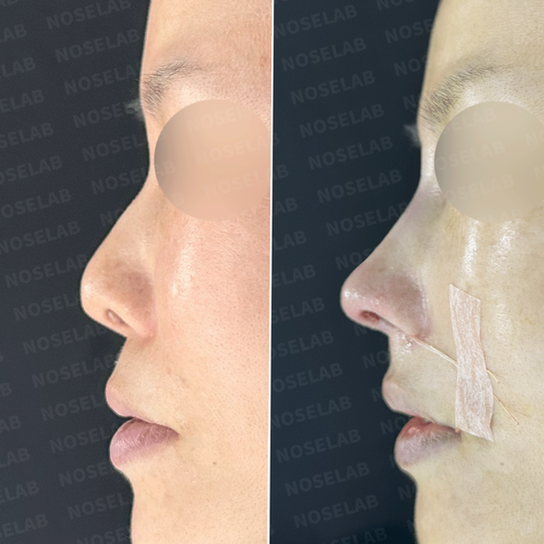
Side View
From the side view, the nasal bridge line appeared more balanced, and the implant position was limited to the bridge rather than extending toward the nasal tip.

Oblique View
The oblique view showed improved nasal contour and reduced visible signs of implant-related irritation around the nasal tip.

Frontal View
From the frontal view, redness and swelling at the nasal tip were reduced, and nasal symmetry appeared more balanced after reconstruction.

Nasal Base View
From the nasal base view, the nostrils appeared more balanced, and the nasal tip condition improved after implant removal and soft tissue stabilization.

Functional Outcome
Nasal obstruction improved after septoplasty and turbinate reduction. Airflow support also improved after structural reconstruction of the nasal framework.
Surgeon’s Commentary
Silicone implant complications are often related to implant position, soft tissue thickness, and long-term pressure on the nasal tip.
When an implant extends too far toward the nasal tip, it can place pressure on thin skin and contribute to redness, swelling, inflammation, or extrusion risk. In these cases, simply reshaping the external contour is not enough.
In this case, implant removal was necessary to reduce pressure on the nasal tip and allow structural reconstruction. Rib cartilage was used to rebuild support, while the new dorsal implant was limited to the nasal bridge to reduce direct tip pressure.
Functional correction was also important because the patient had septal deviation, inferior turbinate hypertrophy, and nasal obstruction. Septoplasty and turbinate reduction were performed together with revision reconstruction.
This case shows that silicone implant complications rhinoplasty should be planned as a combined implant removal, structural reconstruction, soft tissue stabilization, and functional airway correction procedure.

FAQ
What are signs of silicone implant complications after rhinoplasty?
Possible signs include redness, swelling, pain, skin thinning, implant visibility, nasal tip tenderness, or nasal obstruction. If the implant is close to the skin, the nasal tip may become more vulnerable over time.
Can silicone implants cause extrusion?
Silicone implant extrusion can occur when long-term pressure thins the skin or when inflammation weakens the surrounding tissue. The risk depends on implant position, skin thickness, surgical history, and tissue condition.
How are silicone implant complications treated?
Treatment may involve implant removal, management of inflamed tissue, soft tissue reinforcement, and structural reconstruction. If nasal obstruction is present, septoplasty or turbinate reduction may also be needed.
Why is rib cartilage used after implant removal?
Rib cartilage may be used when stronger structural support is needed after implant removal. It can help rebuild septal support, stabilize the nasal tip, and reduce reliance on implant pressure near thin skin.
International Consultation
For international patients, a photo-based consultation may help clarify whether silicone implant removal, rib cartilage reconstruction, soft tissue stabilization, or functional airway correction may be needed.

Read the author’s background and the original case context. About these articles