Case at a glance
- Concerns & goals
- Surgical plan
- Graft & material details
- Photo timing
These details are excerpts from the original article and captions. Follow a detail to read it in context.
This case reviews upturned nasal tip correction rhinoplasty in a patient with a short and upturned nasal tip, excessive nostril exposure from the frontal view, pinched right nostril, nostril asymmetry, weak and deformed septal cartilage, wide nasal bridge, mild nasal deviation, and lower nasal framework imbalance. Surgery focused on rib cartilage septal reconstruction, nasal tip lengthening, alar cartilage reconstruction, nostril lowering, nostril asymmetry correction, lateral osteotomy, and closed rhinoplasty structural correction.
Author: Dr. Cha-Young Kang
Clinic: NoseLab Clinic
Published: 2026
Last Updated: 2026
Introduction
Hello, this is Dr. Cha-Young Kang of NoseLab Clinic.
This case involves upturned nasal tip correction rhinoplasty in a patient who was concerned about a short and lifted nasal tip, excessive nostril exposure, pinched right nostril, and asymmetrical nostril shape.
Although this was the patient’s first rhinoplasty, the septal cartilage was weak and structurally deformed. Because the central nasal support was insufficient, the surgical plan required septal reconstruction using autologous rib cartilage.
The surgery was performed using a closed rhinoplasty / endonasal approach. The goal was to reconstruct the septal support, lengthen the nasal tip, lower the nostril rim, correct the pinched right nostril, improve nostril symmetry, and refine the wide and mildly deviated nasal bridge.
Preoperative Condition
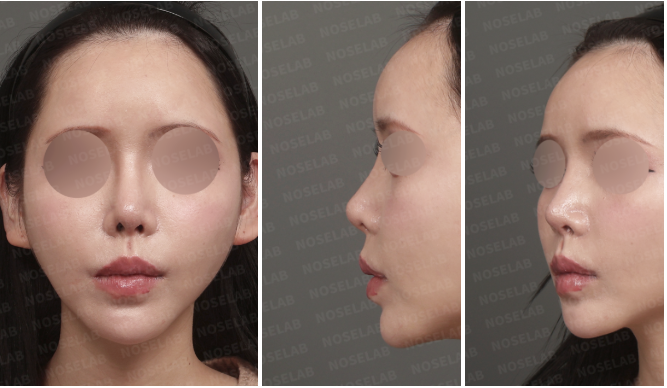
Before surgery, the patient showed a short and upturned nasal tip. From the frontal view, the nostrils were excessively visible, and the right nostril appeared pinched due to inward collapse of the alar structure.
The nostrils were also asymmetric in size and position. The nasal bridge appeared wide and slightly deviated.
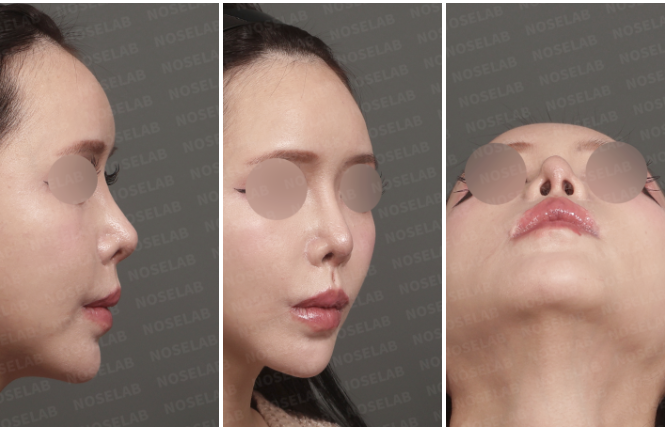
Preoperative design consultation photos were reviewed from the frontal, side, oblique, and nostril views.
Main Concerns Before Surgery
The main concerns included:
Short and upturned nasal tip
Excessive nostril exposure from the frontal view
Pinched right nostril
Inward collapse of the right alar structure
Nostril asymmetry in size and position
Weak and deformed septal cartilage
Wide nasal bridge
Mildly deviated nasal bridge
Lower nasal framework imbalance
These findings suggested that simple tip grafting would not be enough. The central septal support and alar cartilage structure needed to be reconstructed together.
Patient Goals
The patient wanted the lifted nasal tip to be lowered for a calmer and more balanced impression.
The patient also wanted the pinched right nostril and asymmetrical nostril shape to be corrected in a natural-looking way.
In addition, the patient wanted the wide nasal bridge to be refined so that the overall nasal line would appear more balanced from the frontal and side views.
Main Goals
The surgical goals included:
Lower the upturned nasal tip
Reduce excessive nostril exposure
Correct the pinched right nostril
Improve nostril symmetry
Reconstruct weak septal support
Reconstruct the right alar cartilage
Refine the wide nasal bridge
Improve mild nasal deviation
Maintain a balanced and understated nasal appearance
Surgical Plan and Procedure
The surgical plan was built around septal reconstruction and lower nasal framework support. Because the septal cartilage was weaker and more deformed than expected during surgery, autologous rib cartilage was used to rebuild the central support structure.
1. Autologous Rib Cartilage Harvest
Autologous rib cartilage was harvested because the septal cartilage was not strong enough to provide stable central support.
Rib cartilage was selected to provide enough material for septal reconstruction, nasal tip lengthening, and alar cartilage reconstruction.
2. Rib Cartilage Septal Reconstruction
The weakened septal support was reinforced and reconstructed using autologous rib cartilage.
This step was important for rebuilding the central nasal framework and supporting tip lengthening.
3. Nasal Tip Lengthening and Shape Correction
The nasal tip framework was reconstructed using rib cartilage over the reconstructed septal support.
The upturned nasal tip was lowered in a controlled way to improve nasal length and reduce nostril exposure.
The goal was to improve tip position without excessive lengthening or an artificial appearance.
4. Right Alar Cartilage Reconstruction and Nostril Lowering
The right alar cartilage, which contributed to the pinched nostril shape, was reconstructed using rib cartilage.
The lifted nostril rim was lowered to improve symmetry between both nostrils.
Because alar cartilage shape influences nostril contour, nostril rim position, and nasal base balance, alar reconstruction was planned together with septal reconstruction.
5. Lateral Osteotomy for Bridge Refinement
Lateral osteotomy was performed to refine the wide nasal bridge and improve mild deviation.
This helped narrow the nasal bridge and improve the relationship between the bridge and nasal tip.
Surgical Results
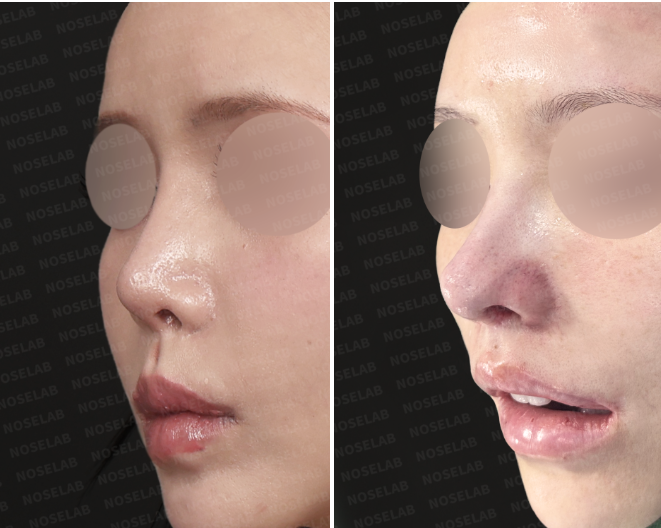
Frontal View
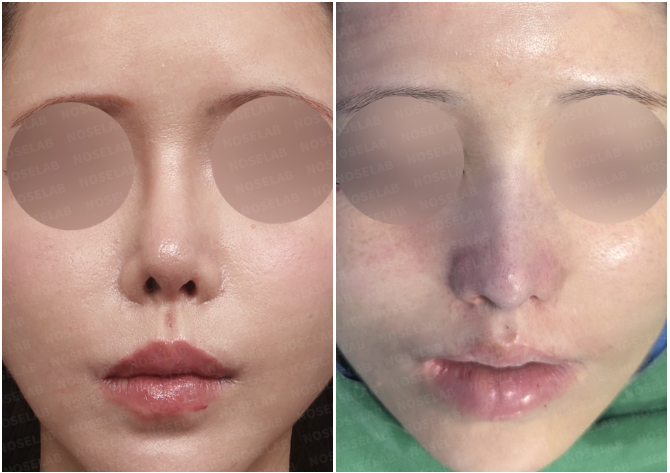
From the frontal view, excessive nostril exposure was reduced after nasal tip lengthening and nostril lowering.
The nasal bridge appeared narrower after lateral osteotomy, and the overall frontal impression appeared more balanced.
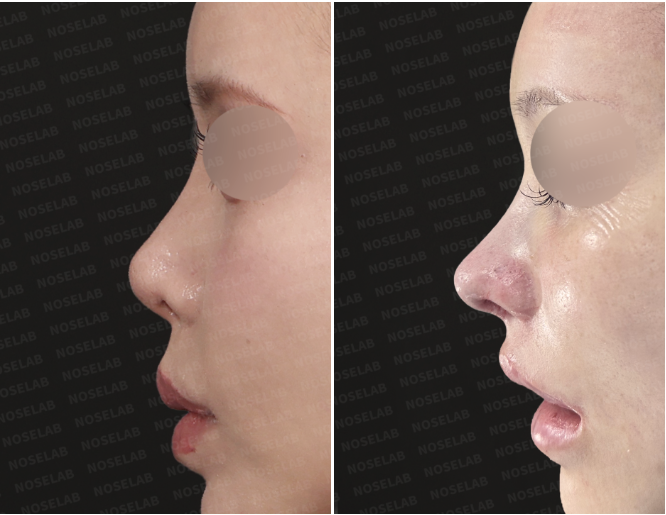
Side View
From the side view, the short and upturned nasal tip appeared lowered after septal reconstruction and tip support.
The nasal line appeared longer and more supported, with improved tip position.
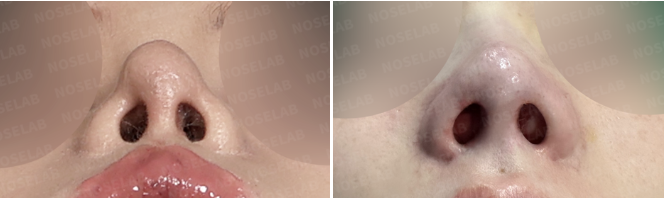
Nostril View
From the nostril view, the pinched right nostril improved after alar cartilage reconstruction and nostril rim lowering.
The nostril shape and size appeared more balanced after lower nasal framework correction.
Structural Outcome
The weak septal structure, upturned nasal tip, pinched right nostril, nostril asymmetry, wide nasal bridge, and mild nasal deviation were corrected together.
Because this case involved weak septal cartilage and alar cartilage imbalance even without previous rhinoplasty, the outcome was planned within the limits of cartilage strength, tissue condition, nostril shape, nasal bone width, and healing response.
Surgeon’s Commentary
When an upturned nasal tip and pinched nostril are present together, simple cartilage placement on the nasal tip may not be enough.
The septum is the central support structure of the nose. If the septal cartilage is weak or deformed, the nasal tip may remain lifted, become unstable, or appear asymmetric over time.
In this case, the septal cartilage was weaker than expected during surgery. For that reason, autologous rib cartilage was used to reconstruct the septal support.
The right alar cartilage was also reconstructed because the right nostril was pinched and pulled inward. This helped lower the nostril rim and improve nostril balance.
The nasal bridge was also refined with lateral osteotomy because the bridge appeared wide and slightly deviated. When the bridge is wide or deviated, correcting only the tip may leave the overall nasal balance incomplete.
This case shows that upturned nasal tip correction rhinoplasty may require combined correction of the septum, nasal tip, alar cartilage, nostril rim, nasal bridge width, and nasal axis.
FAQ
What is upturned nasal tip correction rhinoplasty?
Upturned nasal tip correction rhinoplasty is surgery planned to lower a short or lifted nasal tip and reduce excessive nostril exposure. The method depends on septal support, tip cartilage shape, nostril rim position, and skin condition.
Why is rib cartilage used for septal reconstruction?
Rib cartilage may be used when the septal cartilage is weak, deformed, insufficient, or unable to provide enough support for tip lengthening and nasal framework reconstruction.
Can a pinched nostril be corrected during rhinoplasty?
A pinched nostril can improve when the alar cartilage, nostril rim, columella, and lower nasal framework are corrected together. The degree of improvement depends on cartilage condition, tissue flexibility, and healing response.
Can nostril exposure be reduced?
Nostril exposure may be reduced by lowering the nasal tip, supporting the septum, adjusting the nostril rim, and correcting lower nasal framework imbalance.
Is closed rhinoplasty possible for upturned nasal tip correction?
A closed rhinoplasty / endonasal approach may be used in selected cases to reconstruct septal support, correct the nasal tip, adjust nostril shape, and refine the nasal bridge through internal incisions.
International Consultation
For international patients, a photo-based consultation may help clarify whether upturned nasal tip correction rhinoplasty, rib cartilage septal reconstruction, alar cartilage reconstruction, nostril lowering, nostril asymmetry correction, lateral osteotomy, or closed rhinoplasty structural correction may be needed.
Medical Disclosure
Surgical before-and-after photos show individual patient cases, and results may vary depending on each patient’s anatomy, cartilage strength, septal condition, alar cartilage structure, nostril shape, nasal bone width, tissue condition, and healing process. Please consult your doctor for an individualized assessment.
After surgery, complications may occur, including infection, bleeding, allergic reaction, asymmetry, limited aesthetic or functional improvement, excessive scarring, skin problems, necrosis, graft visibility, cartilage warping, persistent nostril asymmetry, recurrent nostril exposure, persistent pinching, contour irregularity, or other complications.
Read the author’s background and the original case context. About these articles


