Case at a glance
- Concerns & goals
These details are excerpts from the original article and captions. Follow a detail to read it in context.
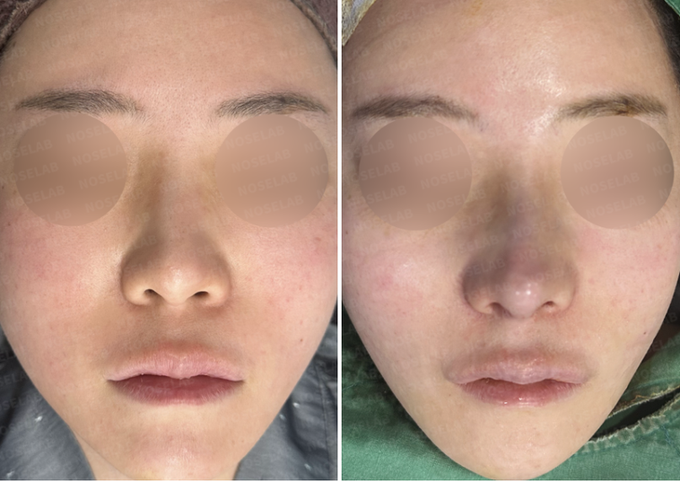
This case reviews upturned nose correction Korea in a patient with unilateral nasal congestion, short and wide nasal shape, visible nostril asymmetry, upturned nasal tip with insufficient support, flat and wide dorsum, alar flaring when smiling, and a preference for a defined but natural-looking nasal contour. Surgery focused on septal extension grafting, nasal axis correction, nasal tip support, unilateral nasal airflow evaluation, nostril asymmetry correction, alar flare reduction, dorsal line refinement, and closed rhinoplasty structural correction.
Author: Dr. Cha-Young Kang
Clinic: NoseLab Clinic
Published: 2024
Last Updated: 2026
Introduction
Hello, this is Dr. Cha-Young Kang of NoseLab Clinic.
This case involves upturned nose correction Korea in a patient who had unilateral nasal congestion and a short, wide nasal appearance.
The patient had previously undergone several nonsurgical procedures, but continued to experience concerns related to breathing, nasal tip rotation, nostril asymmetry, and overall nasal balance.
The patient wanted a slightly more defined nasal contour while avoiding an exaggerated appearance.
The surgery was performed using a closed rhinoplasty / endonasal approach. The goal was to improve tip support, reduce the upturned appearance, address unilateral nasal congestion factors, refine the bridge and tip, reduce alar flaring when smiling, and improve nostril balance.
Why This Patient Needed Upturned Nose Correction Korea
The patient presented with both aesthetic and functional concerns.
The nose appeared short and wide, and the nasal tip was rotated upward with insufficient structural support.
The patient also had chronic unilateral nasal congestion, which required functional evaluation in addition to cosmetic planning.
Main Concerns
The patient’s main concerns included:
Short and wide nasal shape
Visible nostril asymmetry
Upturned nasal tip with insufficient support
Flat and wide dorsum
Alar flaring when smiling
Unilateral nasal congestion
Desire for a non-exaggerated straight bridge
Preference for a shorter midface appearance
Slightly more refined but natural-looking contour
Because the patient had both nasal shape concerns and breathing symptoms, the surgical plan needed to address structural support and nasal airflow together.
Preoperative Analysis Before Upturned Nose Correction Korea
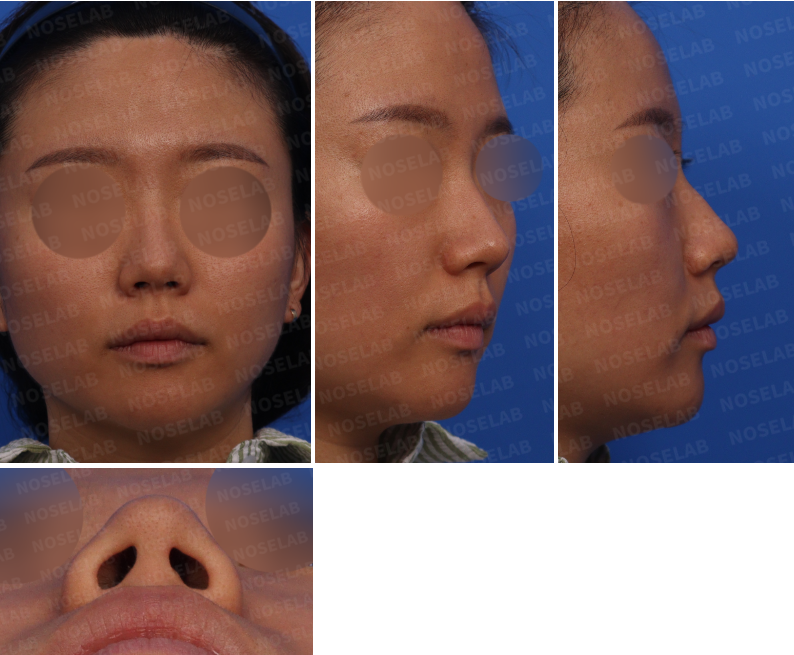
Frontal View: Short Wide Nose and Nostril Asymmetry
From the frontal view, the nose appeared short and wide.
Visible nostril asymmetry was present, and the lower nasal structure appeared imbalanced.
The patient also noticed alar flaring when smiling, which affected the frontal appearance.
Side View: Upturned Nasal Tip and Tip Support
From the side view, the nasal tip appeared upturned and under-supported.
The nasolabial angle and tip rotation were evaluated because they influence how short or lifted the nose appears.
Oblique View: Flat and Wide Dorsum
From the oblique view, the dorsum appeared flat and wide.
The patient wanted a more defined nasal bridge, but preferred to avoid an overly high or artificial-looking line.
Nostril View: Lower Nasal Balance
From the nostril view, nostril asymmetry was visible.
Because nostril shape can be affected by septal support, tip rotation, alar cartilage, scar tissue, and healing response, nostril correction was planned within the patient’s anatomical limits.
Surgical Plan for Upturned Nose Correction Korea and Functional Improvement
Septal Extension Graft for Tip Rotation Control
A septal extension graft was planned to support the nasal tip and help control upward rotation.
This step was important because the upturned nasal tip was related to insufficient lower nasal support.
The goal was to improve tip position while maintaining a natural-looking contour.
Nasal Axis Correction and Lower Nasal Support
The nasal axis was realigned to improve structural balance.
Lower nasal support was planned together with tip correction because nostril symmetry, columella position, and tip rotation are closely related.
Functional Correction for Unilateral Nasal Congestion
The patient’s unilateral nasal congestion was evaluated as part of the surgical plan.
Functional improvement depends on septal alignment, turbinate condition, mucosal swelling, nasal valve structure, and healing response.
Breathing changes should be evaluated over time after surgery.
Dorsal Line Refinement
The bridge was refined to create a straighter and more defined nasal line.
The plan was to improve three-dimensional definition without excessive projection.
Alar Flare Reduction and Nostril Balance
Alar flare reduction was planned to address nasal widening when smiling.
Nostril balance was also considered together with tip support and lower nasal framework correction.
Surgical Results After Upturned Nose Correction Korea
Frontal View:
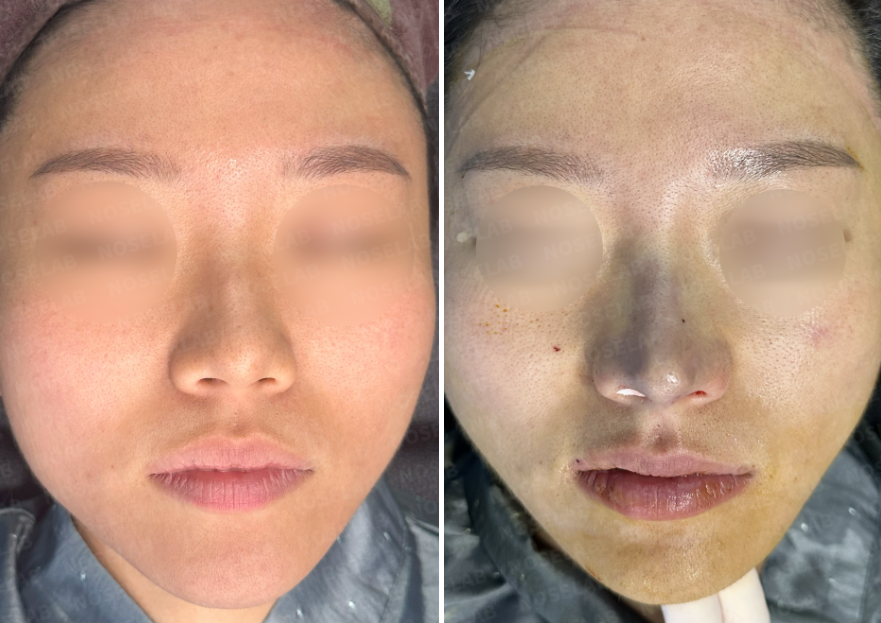
From the frontal view, the nasal proportions appeared more balanced after structural correction.
The short and wide appearance appeared improved while maintaining a natural-looking overall contour.

Oblique View:
From the oblique view, the flat and wide dorsal appearance appeared more defined.
The nasal bridge and tip appeared more three-dimensional while avoiding an exaggerated contour.

Side Profile:
From the side profile, the upturned nasal tip appeared better supported after septal extension grafting.
The nasolabial angle appeared more balanced in relation to the revised tip position.
Because postoperative swelling can make the tip appear higher during the early recovery period, the final contour should be evaluated over time.
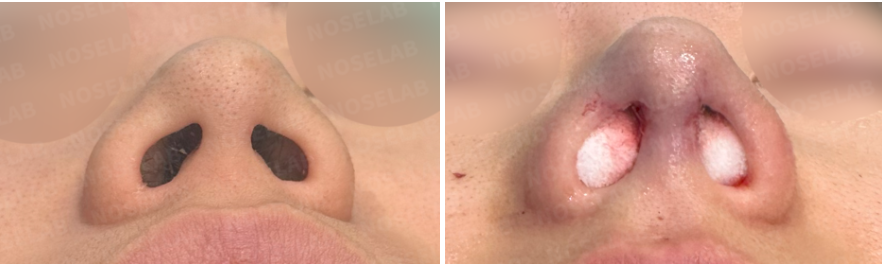
Nostril View:
From the nostril view, nostril balance appeared improved after lower nasal framework correction.
The nostril shape appeared more even while remaining within the limits of the patient’s anatomy, tissue condition, and healing response.
Surgeon’s Commentary
This upturned nose correction Korea case required both aesthetic design and functional planning.
The patient initially wanted a very natural change, but shortly before surgery requested a slightly more noticeable and refined contour.
For this reason, the plan was adjusted to improve bridge definition and tip support without excessive projection.
A septal extension graft was used to support the nasal tip and help reduce the upturned appearance.
Because the patient also had unilateral nasal congestion, the functional structure of the nose was evaluated and addressed together with the aesthetic correction.
Alar flare when smiling and nostril asymmetry were also considered because the lower nasal framework affects both resting appearance and dynamic facial expression.
During the first several months after surgery, the nasal tip may appear slightly higher due to swelling and tissue tension. The nasal contour should be evaluated gradually as healing progresses.
This case shows that upturned nose correction Korea may require combined correction of tip rotation, nasal support, dorsal definition, nostril asymmetry, alar flare, and functional nasal airflow factors.
FAQ
What is upturned nose correction Korea?
Upturned nose correction Korea refers to rhinoplasty that addresses an upward-rotated nasal tip, excessive nostril exposure, or a short-looking nose. The surgical plan may include septal extension grafting, tip support, nostril correction, and lower nasal framework adjustment.
Can upturned nose correction also help with nasal congestion?
It may help when nasal congestion is related to structural factors such as septal deviation, nasal valve narrowing, turbinate-related narrowing, or lower nasal framework imbalance. Functional improvement depends on the specific cause of obstruction.
Why was septal extension grafting used?
Septal extension grafting may be used to support the nasal tip, control tip rotation, and improve lower nasal stability. It is often considered when the nasal tip is upturned or under-supported.
Can alar flaring when smiling be corrected?
Alar flaring may be improved by adjusting lower nasal support, alar base balance, and tip structure. The degree of change depends on anatomy, muscle movement, skin thickness, and healing response.
Can this surgery be performed with a closed approach?
A closed rhinoplasty / endonasal approach may be used depending on nasal structure, tip support needs, septal condition, scar tissue, and surgical goals.
International Consultation
For international patients, a photo-based consultation may help clarify whether upturned nose correction Korea, septal extension grafting, unilateral nasal congestion correction, alar flare reduction, nostril asymmetry correction, dorsal refinement, or closed rhinoplasty structural correction may be needed.
Read the author’s background and the original case context. About these articles