Case at a glance
- Concerns & goals
- Previous treatment
- Surgical plan
- Graft & material details
- Photo timing
These details are excerpts from the original article and captions. Follow a detail to read it in context.
This case reviews bulbous tip correction rhinoplasty in a patient who had previously undergone non-surgical Hiko thread lift and dermal filler treatment. One year later, the patient presented with a bulbous and poorly defined nasal tip, wide nasal base, low nasal bridge, protruded columella, deviated septum, rhinitis symptoms, and chronic nasal congestion. Surgery focused on thread and filler removal, autologous rib cartilage tip support, columella repositioning, septoplasty, inferior turbinate reduction, and closed rhinoplasty structural correction.
Author: Dr. Cha-Young Kang
Clinic: NoseLab Clinic
Published: 2025
Last Updated: 2026
Introduction
Hello, this is Dr. Cha-Young Kang of NoseLab Clinic.
This case involves bulbous tip correction rhinoplasty in a patient who had previously undergone non-surgical rhinoplasty using Hiko threads and filler.
One year after the procedure, the patient wanted a more refined nasal tip, subtle height improvement, and a natural contour. The patient also reported nasal congestion and functional discomfort.
The surgery was performed using a closed rhinoplasty / endonasal approach. The goal was to remove visible foreign material, refine the bulbous tip, improve nasal tip support with autologous rib cartilage, reposition the columella, and address nasal obstruction through functional correction.
Treatment History
The patient had undergone non-surgical nasal treatment one year earlier.
Previous Procedure
The previous treatment included:
Hiko nose thread lift
Dermal filler injection
Although non-surgical procedures can temporarily change contour, they may not directly correct structural problems of the nasal tip, nasal base, or internal nasal airway.

Patient Evaluation
Preoperative design consultation photos were reviewed from the frontal, side, oblique, and nostril views. Nasal endoscopy was also reviewed to assess the internal airway condition.
Frontal View
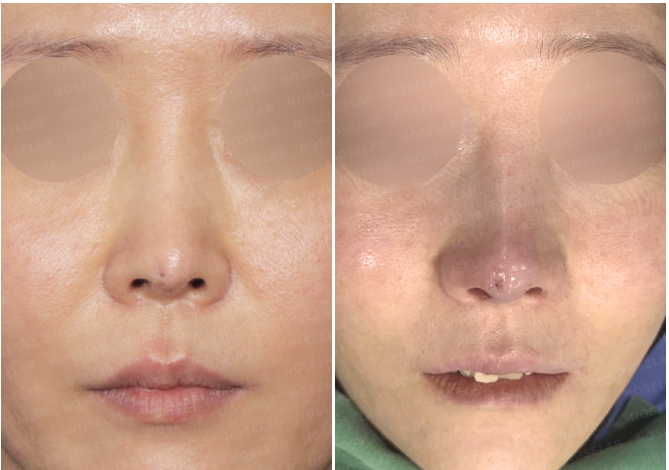
The frontal view showed a bulbous and poorly defined nasal tip, a wide nasal base, and a relatively low nasal bridge.
Side Profile
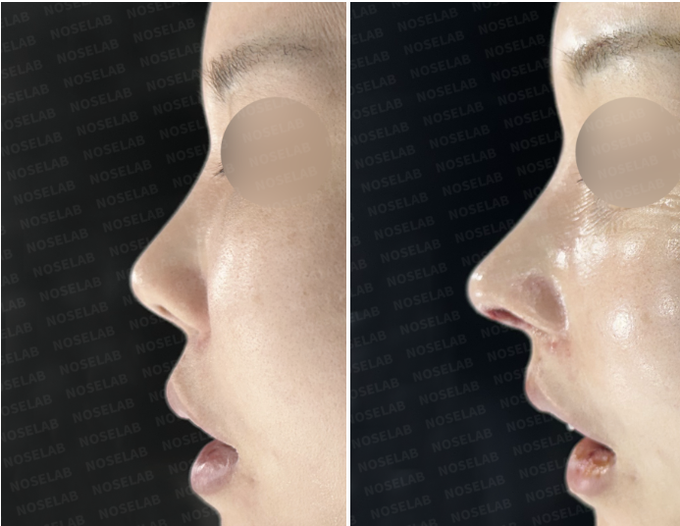
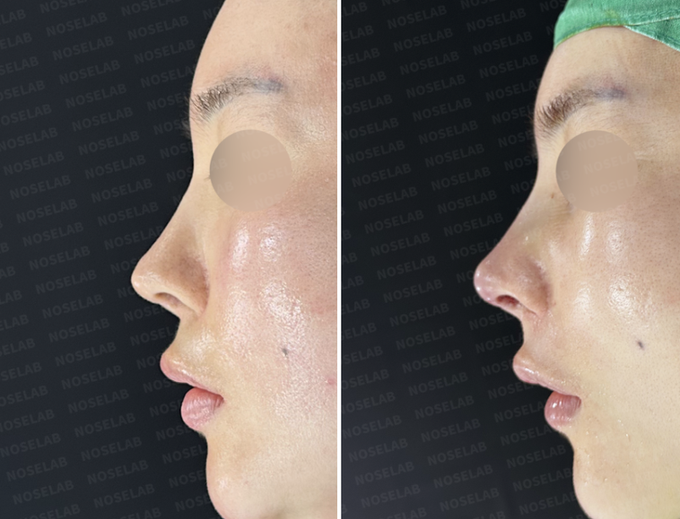
The side view showed limited tip definition, a relatively flat nasolabial angle, and a protruded columella.

Functional Findings
Functional evaluation showed septal deviation, chronic nasal congestion, and rhinitis-related symptoms.
Because the patient had both external contour concerns and internal airway symptoms, the treatment plan included both aesthetic and functional correction.

Patient Goals for Bulbous Tip Correction
The patient’s main goals were as follows:
Refine and slim the bulbous nasal tip
Increase tip height slightly, about 1–2 mm
Maintain a natural contour without an overly sharp appearance
Improve breathing and reduce nasal obstruction
Preserve softness of the nasal shape rather than creating excessive projection
These goals required structural support and foreign material removal rather than repeated additive treatment.
Surgical Plan
The surgical plan focused on foreign material removal, structural tip refinement, and functional airway correction.
1. Foreign Material Removal
Visible Hiko threads were identified and removed.

Residual filler and other visible foreign material were also addressed where identified.

In revision cases after non-surgical treatment, removal depends on the location of the material, surrounding scar tissue, and integration with adjacent tissue.
2. Bulbous Tip Correction and Tip Support
Autologous rib cartilage was used to support and refine the nasal tip.
The tip was reshaped in a balanced way to improve definition without creating excessive sharpness or over-projection.
Because the patient wanted a natural appearance, the amount of tip height increase was planned conservatively.
3. Columella Repositioning
The columella was repositioned to improve structural harmony between the nasal tip, nostril view, and upper lip.
This step also helped improve the nasolabial angle and overall lower nasal balance.
4. Functional Correction
Septoplasty was performed to address septal deviation.
Submucosal inferior turbinate reduction using radiofrequency was also performed to address turbinate enlargement and chronic nasal obstruction.
Because the patient had long-term nasal congestion and rhinitis symptoms, functional correction was planned together with the structural revision.
Postoperative Results

Frontal View
From the frontal view, the nasal tip appeared more refined after foreign material removal and rib cartilage tip support.
The nasal bridge and lower nasal contour also appeared more balanced after structural correction.

Side Profile
From the side view, nasal tip projection increased slightly within the planned range.
The nasolabial angle appeared more balanced, and the columella position was improved after structural repositioning.

Functional Outcome
Breathing function was addressed through septoplasty and inferior turbinate reduction.
Because functional improvement depends on airway anatomy, swelling, rhinitis condition, and healing response, postoperative breathing changes should be evaluated over time.

Structural Outcome
The bulbous nasal tip was refined through removal of visible foreign material, rib cartilage support, and controlled reshaping of the lower nasal framework.
Because this case involved previous thread lift, filler use, septal deviation, rhinitis, and nasal obstruction, the outcome was planned within the limits of tissue condition, skin thickness, scar tissue, and healing response.
Surgeon’s Commentary

This case shows an important pattern seen after minor non-surgical nasal procedures such as thread lift or filler injection.
Although these treatments can temporarily alter contour, they may not correct underlying structural problems of a bulbous nasal tip, wide base, or poor tip support.
In this patient, visible foreign material was addressed first, and autologous rib cartilage was used to reinforce the nasal tip structure.
The tip was refined carefully to maintain a soft and natural contour. The amount of projection increase was kept conservative because the patient wanted subtle change rather than an overly sharp shape.
The columella was repositioned to improve structural balance, and functional correction was also included because the patient had septal deviation, chronic nasal congestion, and rhinitis symptoms.
This case shows that bulbous tip correction after thread lift or filler treatment should be planned as a structural and functional revision when both contour and breathing are involved.
FAQ
Can Hiko threads or filler cause problems before later rhinoplasty?
Previous threads or filler can affect tissue planes, scar formation, tip contour, and revision planning. Their effect depends on the amount of material, location, and tissue response.
Why is rib cartilage used for bulbous tip correction?
Rib cartilage may be used when stronger support is needed to refine and support the nasal tip, especially in revision cases or when more stable internal support is required.
Can a bulbous tip be corrected after non-surgical rhinoplasty?
A bulbous tip may be corrected after non-surgical treatment when the underlying structure is addressed. This may include thread or filler removal, cartilage support, and reshaping of the lower nasal framework.
Can breathing improve during this type of revision rhinoplasty?
Breathing may improve when septal deviation, turbinate enlargement, or internal narrowing is corrected. The degree of improvement depends on the patient’s airway anatomy and healing process.
Does bulbous tip correction always require a large change in height?
Not always. In some patients, only a subtle increase in tip projection is planned. The amount of change depends on the patient’s anatomy, skin condition, and aesthetic goals.
International Consultation
For international patients, a photo-based consultation may help clarify whether bulbous tip correction rhinoplasty, Hiko thread lift revision, filler removal, rib cartilage tip support, septoplasty, or inferior turbinate reduction may be needed.
Read the author’s background and the original case context. About these articles