Case at a glance
- Concerns & goals
- Surgical plan
- Graft & material details
- Photo timing
These details are excerpts from the original article and captions. Follow a detail to read it in context.
This case reviews silicone implant revision rhinoplasty in a patient with an irregular nasal bridge, residual HA filler, previous silicone implant rhinoplasty, septal cartilage damage, septal deviation, rhinitis symptoms, and nasal obstruction. Surgery focused on implant removal, filler removal, rib cartilage septal reconstruction, customized silicone implant replacement, nasal tip support, nasolabial angle correction, lateral osteotomy, septoplasty, inferior turbinate reduction, and closed rhinoplasty structural correction.
Author: Dr. Cha-Young Kang
Clinic: NoseLab Clinic
Published: 2026
Last Updated: 2026
Introduction
Hello, this is Dr. Cha-Young Kang of NoseLab Clinic.
This case involves silicone implant revision rhinoplasty in a patient who had previously undergone rhinoplasty using a silicone implant.
After the previous surgery, the patient had an irregular and uneven nasal bridge. Residual HA filler remained in the dorsal area, and the septal cartilage had been significantly damaged from previous cartilage harvesting. The patient also had nasal obstruction related to septal deviation and rhinitis symptoms.
The surgery was performed using a closed rhinoplasty / endonasal approach. The goal was to remove the previous implant, remove visible residual filler, reconstruct the damaged septal support with autologous rib cartilage, refine the nasal bridge, improve nasal tip support, and address nasal obstruction through functional correction.

Case Background After Silicone Implant Revision Rhinoplasty
The patient had undergone previous rhinoplasty using a silicone implant. However, the nasal bridge did not appear smooth after surgery, and the patient felt irregularity along the dorsum.
Residual HA filler was also present in the nasal bridge area. In addition, previous septal cartilage harvesting had caused significant septal cartilage damage.
Because the patient had both external contour concerns and functional nasal obstruction, the revision plan needed to address the nasal framework and airway together.
Main Preoperative Problems
The main findings included:
Irregular and uneven nasal bridge
Previous silicone implant
Residual HA filler in the nasal bridge area
Significant septal cartilage damage after previous surgery
Septal deviation
Rhinitis symptoms
Nasal obstruction
Need for nasal tip support
Need for dorsal contour refinement
These findings suggested that simple implant exchange would not be enough. Structural reconstruction, filler removal, implant adjustment, and functional airway correction were all considered in the surgical plan.

Patient Goals
The patient had three main goals.
1. Smoother Nasal Bridge
The patient wanted to improve the irregular and uneven nasal bridge contour after previous silicone implant surgery.
2. More Defined Nasal Tip
The patient wanted the nasal tip to appear slightly more defined and supported, while avoiding excessive change beyond the limits of the skin and tissue condition.
3. Improvement of Nasal Obstruction
The patient had long-term nasal obstruction related to septal deviation and rhinitis. Functional correction was planned together with the aesthetic revision.
Because both shape and breathing function were involved, the surgery was planned as a combined structural and functional revision rhinoplasty.
Surgical Plan and Procedure
The surgery focused on septal support reconstruction, implant removal, filler removal, nasal bridge refinement, nasal tip correction, osteotomy, and functional airway correction.
1. Rib Cartilage Septal Reconstruction
Autologous rib cartilage was used to reinforce and reconstruct the damaged septal support.
Because the septal cartilage had been significantly damaged during previous surgery, rib cartilage was used to rebuild the central support structure of the nose.
This step was important for supporting the nasal tip and improving the internal nasal framework.
2. Previous Silicone Implant Removal and Dorsal Refinement
The previous silicone implant was removed.
The irregular nasal bridge was refined, and visible residual HA filler was removed where it was identified.
This allowed the dorsal contour to be reassessed before placing a new implant.
3. Customized Silicone Implant Replacement
A new silicone implant was carefully shaped according to the patient’s nasal bone structure.
The implant was adjusted to create a smoother dorsal line and better transition with the nasal tip.
In revision rhinoplasty, implant shape should be planned according to the patient’s bone contour, skin thickness, scar tissue, and previous surgical changes.
4. Nasal Tip Correction and Nasolabial Angle Adjustment
The nasal tip was corrected within the limits of the patient’s tissue condition.
Because the skin was firm and not very flexible, tip elevation was planned conservatively. The goal was to improve tip support and definition without applying excessive tension to the skin.
The nasolabial angle was also adjusted to improve the relationship between the nasal tip, columella, and upper lip.
5. Lateral Osteotomy
Lateral osteotomy was performed to improve nasal bone asymmetry and refine the bridge width.
This step helped improve the balance of the nasal bridge and dorsal contour.
6. Septoplasty and Inferior Turbinate Reduction
Septoplasty was performed to correct septal deviation.
Inferior turbinate reduction was also performed to address turbinate enlargement and nasal obstruction.
Functional correction was included because the patient had nasal obstruction related to septal deviation and rhinitis symptoms.
Postoperative Results

Frontal View
From the frontal view, the irregular nasal bridge appeared smoother after implant removal, filler removal, dorsal refinement, and customized implant replacement.
The asymmetry of the nasal bridge also improved after osteotomy and dorsal contour correction.

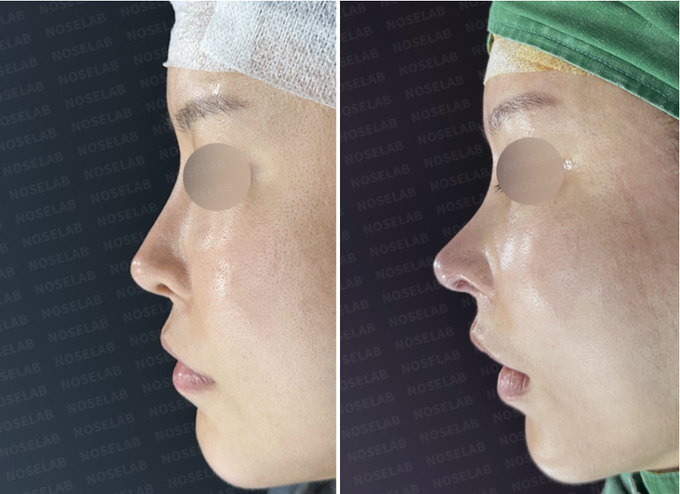
Side View
From the side view, the nasal tip appeared more supported after rib cartilage septal reconstruction and tip correction.
The nasolabial angle appeared more balanced after tip support and columella-related adjustment.

Nasal Bridge Contour
The dorsal line appeared smoother after the previous implant was removed, residual filler was addressed, and the new implant was shaped according to the patient’s nasal structure.

Functional Outcome
Nasal obstruction was addressed through septoplasty and inferior turbinate reduction.
Because functional improvement depends on internal anatomy, rhinitis status, swelling, and healing response, postoperative breathing changes should be evaluated over time.
Structural Outcome
The damaged septal support was reconstructed using autologous rib cartilage, and the nasal bridge was refined with implant replacement and dorsal contour adjustment.
Because this case involved previous surgery, septal cartilage damage, residual filler, firm skin, and nasal obstruction, the outcome was planned within the limits of tissue flexibility, scar tissue, internal airway condition, and healing response.
Surgeon’s Commentary
Silicone implant revision rhinoplasty requires careful evaluation of the previous implant, nasal bridge contour, skin condition, scar tissue, and remaining cartilage support.
In this case, the nasal bridge was irregular after previous silicone implant surgery, and residual HA filler remained in the dorsal area. The septal cartilage had also been significantly damaged from previous cartilage harvesting.
When septal support is weakened, the nasal tip may not have enough structural foundation. For this reason, autologous rib cartilage was used to reconstruct the damaged septal framework.
The previous implant was removed, the visible residual filler was addressed, and a new silicone implant was shaped according to the patient’s nasal bone structure.
Because the patient’s skin was firm and not very flexible, the nasal tip was corrected conservatively. In revision rhinoplasty, excessive tension can increase the risk of contour irregularity, skin problems, or limited healing.
Functional correction was also important. Septoplasty and inferior turbinate reduction were performed to address nasal obstruction related to septal deviation and rhinitis symptoms.
This case shows that silicone implant revision rhinoplasty should be planned as a combined implant, septal support, nasal tip, dorsal contour, and functional airway procedure when previous surgery has caused structural and functional changes.
FAQ
What is silicone implant revision rhinoplasty?
Silicone implant revision rhinoplasty is revision nasal surgery performed after previous silicone implant rhinoplasty. It may involve implant removal, implant replacement, dorsal contour refinement, cartilage reconstruction, and functional correction when needed.
Why can the nasal bridge become uneven after silicone implant rhinoplasty?
The nasal bridge may appear uneven due to implant shape, implant position, scar tissue, bone contour irregularity, thin skin, residual filler, or changes from previous surgery.
Why is rib cartilage used in silicone implant revision rhinoplasty?
Rib cartilage may be used when septal cartilage is damaged or insufficient. It can help rebuild the central support structure and provide additional support for the nasal tip.
Can residual HA filler be removed during revision rhinoplasty?
Residual HA filler may be removed when it is identified during surgery. The amount that can be removed depends on its location, tissue condition, and degree of integration with surrounding tissue.
Can nasal obstruction be corrected during implant revision rhinoplasty?
Nasal obstruction may improve when septal deviation, turbinate enlargement, or internal narrowing is corrected. Septoplasty and inferior turbinate reduction may be included when functional problems are present.
International Consultation
For international patients, a photo-based consultation may help clarify whether silicone implant revision rhinoplasty, rib cartilage septal reconstruction, filler removal, implant replacement, septoplasty, or inferior turbinate reduction may be needed.
Medical Disclosure
Surgical before-and-after photos show individual patient cases, and results may vary depending on each patient’s anatomy, skin thickness, tissue condition, scar tissue, septal cartilage damage, implant history, filler history, airway condition, and healing process. Please consult your doctor for an individualized assessment.
After surgery, complications may occur, including infection, bleeding, allergic reaction, asymmetry, limited aesthetic or functional improvement, excessive scarring, skin problems, necrosis, implant visibility, graft visibility, cartilage warping, persistent contour irregularity, persistent nasal obstruction, or other complications.
Read the author’s background and the original case context. About these articles