Case at a glance
- Concerns & goals
- Surgical plan
- Graft & material details
- Photo timing
These details are excerpts from the original article and captions. Follow a detail to read it in context.
This case reviews closed bulbous tip correction Korea in a patient with a bulbous nasal tip, deviated nasal axis, broad nasal appearance, enlarged alar cartilages, residual HA filler from previous injection treatment, nasal obstruction, difficulty breathing, and nasal asymmetry. Surgery focused on filler residue removal, removal of remaining injection-related material, septorhinoplasty with autologous rib cartilage, lateral osteotomy, alar cartilage trimming, septoplasty, radiofrequency turbinate reduction, and closed rhinoplasty structural correction.
Author: Dr. Cha-Young Kang
Clinic: NoseLab Clinic
Published: 2025
Last Updated: 2026
Introduction
Hello, this is Dr. Cha-Young Kang of NoseLab Clinic.
This case involves closed bulbous tip correction Korea in a patient with a bulbous nasal tip, nasal deviation, residual HA filler, broad nasal appearance, and nasal obstruction.
The patient had received HA filler injections approximately five years earlier. Although a filler-dissolving treatment had been attempted later, residual filler remained in the nasal tissue and contributed to fullness, asymmetry, and tip irregularity.
The patient was also concerned about nasal obstruction and difficulty breathing, so the surgical plan needed to address both nasal shape and functional airway factors.
The surgery was performed using a closed rhinoplasty / endonasal approach. The goal was to remove residual filler-related material where possible, refine the enlarged alar cartilage, correct nasal deviation, reduce the bulbous tip appearance, and address nasal obstruction factors.
Patient Concerns Before Closed Bulbous Tip Correction Korea
The patient’s concerns included both functional and aesthetic issues.
Functional Concerns
The patient reported nasal obstruction and difficulty breathing.
Because nasal obstruction may be related to septal deviation, turbinate hypertrophy, mucosal condition, or structural narrowing, functional evaluation was included in the surgical plan.
Aesthetic Concerns
The patient’s aesthetic concerns included:
Deviated nasal axis
Bulbous nasal tip
Broad nasal appearance
Enlarged alar cartilages
Residual HA filler from previous injection treatment
Asymmetry and fullness around the nasal tip
These issues required combined treatment rather than simple surface contour adjustment.

Preoperative Analysis Before Closed Bulbous Tip Correction Korea
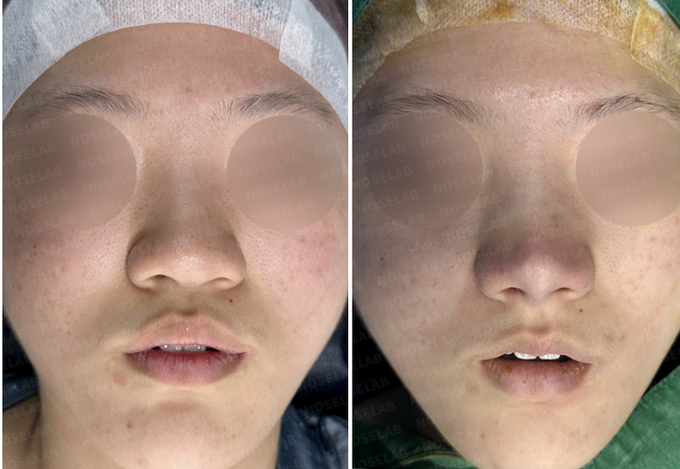
Preoperative design consultation photos were reviewed from the frontal, side, oblique, and nostril views.
Frontal View: Deviated Axis and Bulbous Tip
From the frontal view, the nasal axis appeared deviated.
The nasal tip appeared broad and bulbous, and the lower nasal width was affected by prominent alar cartilage.
Residual filler-related fullness was also considered as a possible contributor to the tip shape and asymmetry.
Side View: Tip Fullness and Nasal Balance
From the side profile, the nasal tip fullness and bridge-to-tip relationship were evaluated.
The surgical plan needed to refine the nasal tip without creating an overly narrow or pinched appearance.
Oblique View: Filler-Related Fullness and Contour
From the oblique view, fullness around the tip and lower nasal contour was evaluated.
Because filler may remain in deeper soft tissue planes, contour irregularity can persist even after dissolution treatment in some patients.
Nostril View: Alar Cartilage and Lower Nasal Balance
From the nostril view, the alar cartilage structure and lower nasal balance were reviewed.
The alar cartilages appeared prominent, and cartilage trimming was planned carefully to reduce width while maintaining structural support.
Nostril balance was evaluated together with septal position, tip support, alar cartilage shape, and healing response.

Surgical Plan for Closed Bulbous Tip Correction Korea
1. Filler Residue and Injection Material Removal
Residual HA filler and injection-related material were removed where identifiable.
Because filler may become embedded in tissue or remain in pockets, removal requires careful dissection.
The goal was to reduce filler-related fullness and improve the foundation for tip correction.
2. Septorhinoplasty with Autologous Rib Cartilage
Septorhinoplasty was performed using autologous rib cartilage.
Rib cartilage was used to provide structural support for nasal framework correction.
In cases involving deviation, weak support, or combined functional concerns, stronger graft material may be considered depending on the patient’s anatomy.
3. Lateral Osteotomy for Nasal Deviation
Lateral osteotomy was performed to address the deviated nasal axis.
This step was planned to improve overall nasal alignment and frontal balance.
4. Alar Cartilage Trimming for Bulbous Tip Refinement
The enlarged alar cartilages were carefully trimmed to refine the bulbous nasal tip.
Cartilage trimming must be performed conservatively because excessive removal can increase the risk of collapse, pinching, nostril distortion, or unnatural contour.
The goal was to reduce the broad tip appearance while preserving lower nasal support.
5. Septoplasty and Turbinate Reduction
Septoplasty was performed to address septal deviation.
Submucosal turbinate reduction was performed using radiofrequency to address turbinate-related narrowing.
Breathing changes should be evaluated over time because nasal airflow can be influenced by septal alignment, turbinate response, mucosal swelling, scar tissue, and healing response.
Surgical Results After Closed Bulbous Tip Correction Korea
Functional Changes
Nasal obstruction factors were addressed through septoplasty and turbinate reduction.
Functional changes should be monitored during recovery because swelling, mucosal condition, septal position, and turbinate response can affect breathing over time.
Frontal View: Nasal Axis and Tip Width
From the frontal view, the nasal axis appeared more balanced after deviation correction.
The nasal tip and lower nasal width appeared more refined after filler residue management and alar cartilage trimming.
The overall nasal contour appeared better organized within the patient’s anatomical limits.

Side View: Tip and Bridge Contour
From the side profile, the nasal profile appeared more balanced after tip refinement and structural support.
The nasal tip appeared less bulky while maintaining a natural-looking contour.

Oblique View: Tip Fullness and Lower Nasal Shape
From the oblique view, the lower nasal contour appeared smoother after residual filler management and cartilage refinement.
The tip appeared more defined without being overly narrowed.

Nostril View: Alar Cartilage and Tip Balance
From the nostril view, the lower nasal framework appeared more balanced after alar cartilage trimming and structural support.
Because nostril shape can change during healing, the final balance should be evaluated over time.

Surgeon’s Commentary on Filler Residue and Bulbous Tip Correction
This case involved both aesthetic and functional issues after previous nonsurgical injection treatment.
The patient had received HA filler injections five years earlier and later underwent an attempt to dissolve the filler. However, residual material remained within the tissue and contributed to fullness and asymmetry around the nasal tip.
Although HA fillers are often expected to decrease over time, their duration can vary depending on product type, injection depth, tissue plane, amount injected, and individual tissue response.
In some cases, filler may remain longer than expected or become surrounded by tissue changes. When this contributes to nasal shape concerns, surgical removal may be considered.
The patient also had a history of an injection intended to reduce fat or cartilage in the alar region. Because such procedures may affect important nasal structures, treatment history should be reviewed carefully before surgery.
Intraoperatively, the alar cartilages were found to be enlarged, which contributed to the bulbous nasal tip. Alar cartilage trimming was performed carefully to reduce width while maintaining support.
Septoplasty and turbinate reduction were performed together to address nasal obstruction factors.
This case shows that closed bulbous tip correction Korea may require combined management of residual filler, enlarged alar cartilage, nasal deviation, structural support, and functional airway concerns.
All surgical planning should be individualized based on filler history, cartilage size, nasal skin thickness, septal condition, airway structure, and healing response.
FAQ
Can HA filler remain in the nose for several years?
HA filler may remain longer than expected in some patients depending on product type, injection depth, amount injected, tissue response, and whether the filler becomes surrounded by tissue changes.
Why is filler residue removal needed during rhinoplasty?
Filler residue may contribute to fullness, asymmetry, contour irregularity, or unpredictable tissue behavior. Removal may be considered when residual material affects surgical planning or nasal shape.
What is alar cartilage trimming?
Alar cartilage trimming is a technique used to reduce enlarged or prominent alar cartilage. It must be performed carefully because excessive trimming can weaken nasal support or create an unnatural contour.
Can bulbous tip correction improve nasal width?
Bulbous tip correction may reduce the appearance of nasal width when the width is related to enlarged alar cartilage, soft tissue thickness, filler residue, or weak tip definition.
Can nasal obstruction be treated during bulbous tip correction?
Nasal obstruction factors may be addressed when septal deviation, turbinate hypertrophy, or structural narrowing is present. Functional changes should be evaluated over time after surgery.
International Consultation
For international patients, a photo-based consultation may help clarify whether closed bulbous tip correction Korea, filler residue removal rhinoplasty, alar cartilage trimming, septoplasty, turbinate reduction, deviated nose correction, or functional rhinoplasty may be needed.

Read the author’s background and the original case context. About these articles