Case at a glance
- Surgical plan
- Educational Note – Why Rib Cartilage Was Required
- This revision required complete removal of integrated implants followed by staged reconstruction of the nasal framework.
- The surgical plan focused on careful extraction of the porous implant from surrounding tissue, removal of the dorsal implant, and restoration of a stable nasal foundation.
These details are excerpts from the original article and captions. Follow a detail to read it in context.
Medpor removal rhinoplasty is a revision procedure required when a porous implant integrates with surrounding tissue and causes irreversible structural damage, making safe removal and reconstruction essential for restoring nasal stability and breathing.
In this case, implant-related damage resulted in near-total loss of the anterior septal cartilage, leading to nasal deviation, tip collapse, and airway obstruction. Structural reconstruction using autologous rib cartilage restored internal support, functional airflow, and overall facial balance through a closed surgical approach.
Author: Dr. Cha-Young Kang, Chief Director, NoseLab Clinic
Published: January 18, 2026
Hello, this is Dr. Cha-Young Kang from NoseLab Clinic.
This case presents a complex revision surgery in which previous implant-based rhinoplasty caused collapse of the nasal framework and significant breathing difficulty, requiring a structure-first reconstructive strategy rather than cosmetic reshaping.
Patient Condition and Key Problems
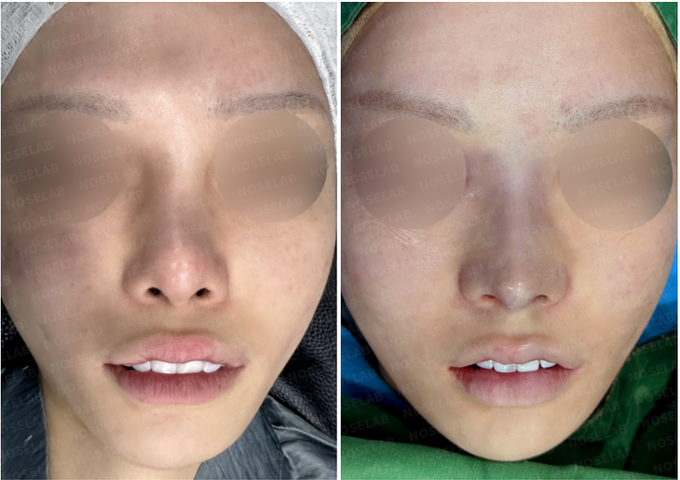
The patient presented with a severely deviated, drooping nose accompanied by marked nasal obstruction following prior implant-based surgery.
Clinical assessment revealed loss of septal support, distortion of the nasal axis, and compromised airflow. Facial imbalance was further aggravated by a recessed chin, indicating that correction would need to address both nasal structure and overall facial proportion.

Surgical Background
The patient had previously undergone rhinoplasty using Medpor and Gore-Tex implants at another clinic.
Intraoperative findings confirmed near-total destruction of the anterior septal cartilage, leaving the nasal tip without structural support and directly contributing to both aesthetic deformity and functional airway compromise.

Surgical Plan – Closed Rhinoplasty Korea for Implant Removal
This revision required complete removal of integrated implants followed by staged reconstruction of the nasal framework.
The surgical plan focused on careful extraction of the porous implant from surrounding tissue, removal of the dorsal implant, and restoration of a stable nasal foundation. A closed approach was used to minimize external scarring while allowing precise internal reconstruction consistent with closed rhinoplasty korea principles.
Structural Reconstruction and Functional Correction
Rebuilding the septum was essential to restore stability, airway function, and long-term support.
Total septal reconstruction was performed using autologous rib cartilage to recreate a rigid and durable internal framework. The reconstructed septum enabled accurate repositioning of the nasal tip, correction of nostril asymmetry, and restoration of balanced airflow. Additional airway procedures were performed to relieve obstruction, and chin augmentation was carried out to improve facial harmony.
Results – Structural Stability and Functional Recovery
Postoperative evaluation demonstrated restoration of nasal alignment, improved symmetry, and meaningful recovery of breathing function.
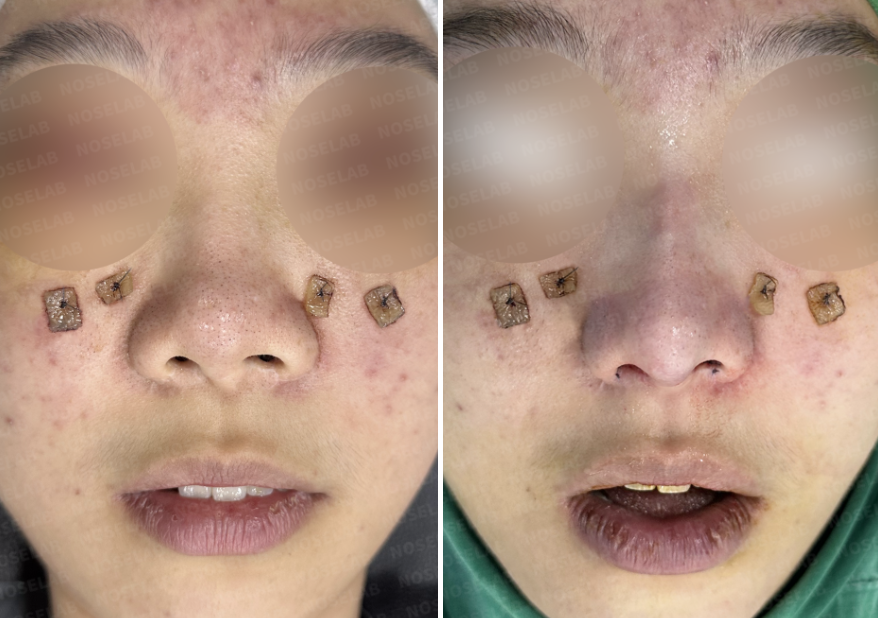
From the frontal view, the nasal axis was straightened and nostril asymmetry was corrected. Side profile assessment showed improved tip support and a more balanced nose-to-chin relationship. Evaluation of the nasal base confirmed stabilized nostril proportions. The patient reported clear improvement in nasal breathing.


Educational Note – Why Rib Cartilage Was Required
When implant-related damage results in near-total loss of native septal support, removal alone cannot restore nasal integrity.
In this case, the absence of functional septal cartilage made long-term stability impossible without reconstruction. Autologous rib cartilage provided sufficient strength and volume to rebuild the nasal framework and prevent recurrent collapse, ensuring durable structural support.
Final Thoughts
Severe implant-related nasal damage must be addressed through reconstruction of the underlying framework rather than surface-level correction.
By removing the integrated implant, rebuilding the septum with autologous tissue, and correcting airway and facial balance simultaneously, this approach achieved stable nasal structure, functional recovery, and improved facial proportion.
FAQ
Q1. What is Medpor removal rhinoplasty?
A. It is revision surgery performed to remove porous implants that have integrated with tissue and caused structural damage to the nose.
Q2. Why is septal reconstruction necessary in severe revision cases?
A. Loss of septal support leads to tip collapse and airway narrowing, making reconstruction essential for stability and breathing.
Q3. Why is rib cartilage used in complex nasal reconstruction?
A. Rib cartilage provides sufficient strength and volume to rebuild a severely damaged nasal framework and maintain long-term stability.
🎥 YouTube Reference

Read the author’s background and the original case context. About these articles