Case at a glance
These details are excerpts from the original article and captions. Follow a detail to read it in context.
This case demonstrates Closed Rhinoplasty Korea for bulbous nose rhinoplasty with thick skin and weak cartilage. Structural tip refinement and cartilage support improved definition, symmetry, and long-term stability.
Author: Dr. Cha-Young Kang, Director, NoseLab Clinic
✅ Case Background
This patient presented with a bulbous nasal tip characterized by thick skin, weak cartilage support, and a wide nasal structure.
In many Asian patients, bulbous noses are commonly associated with underdeveloped cartilage and thick soft tissue, making simple reduction techniques ineffective for long-term results.
In this Closed Rhinoplasty Korea case, the goal was to refine the nasal tip, improve structural support, and create a balanced three-dimensional nasal contour.
Key concerns included:
Wide and blunt nasal tip
Thick nasal skin
Weak alar cartilage support
Asymmetrical nasal tip
Drooping nasal tip
Wide nasal base appearance
This case required structural refinement rather than simple reduction.
If you are concerned about a wide or blunt nose tip, a structural evaluation is essential for achieving a natural result.
📩 International Consultation


✅ Surgical Approach – Bulbous Nose Correction Using Closed Rhinoplasty Korea
Bulbous nose deformities are primarily caused by thick skin and insufficient cartilage support rather than excess tissue alone.
Simply removing tissue without reinforcing structure often leads to recurrence or unnatural results.
Closed Rhinoplasty Korea allows precise internal modification of cartilage and soft tissue while maintaining structural integrity.
✅ Structural Problems Identified
Thick nasal skin
Weak alar cartilage
Wide nasal tip
Poor tip definition
Drooping nasal tip
Nostril asymmetry
✅ Surgical Plan
1. Tip Structural Reinforcement
Strengthening of alar cartilage
Creation of stable tip support
2. Subcutaneous Tissue Reduction
Controlled reduction of soft tissue thickness
Improvement of tip definition
3. Tip Refinement
Cartilage suturing technique
Narrowing and shaping of nasal tip
4. Balance Adjustment
Harmonizing tip and bridge height
Creating natural three-dimensional contour
✅ Surgical Results
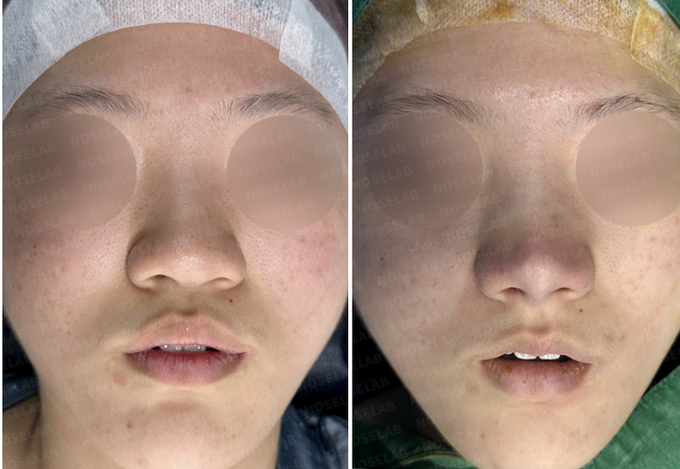
In the photo before the surgery, the nose tip did not look slim, and in the photos after surgery, we can observe the nose tip is higher, which makes the nasolabial angle look wider, and compared to the pre-surgery appearance, the nose has become more refined.

In the 45-degree angle photo, we can see that the nose has become slimmer.

From the front, the bent-looking nose has improved in appearance. Before the surgery, the highest point of the nose was not specific, however, after the surgery, the highest point of the nose is differentiated. Also, the shape of the nostrils has become more natural-looking.

In the nostril photo, we can see that the asymmetry of the nostrils was improved, and that the skin proportion has also improved as the nose tip width was reduced.

✅ Surgeon’s Commentary
Bulbous nose rhinoplasty requires a structural approach rather than simple tissue reduction.
In patients with thick skin, removing soft tissue alone is insufficient to achieve long-term definition.
In this case, strengthening the underlying cartilage structure was essential to support the nasal tip and maintain its refined shape over time.
Closed Rhinoplasty Korea allows precise control of cartilage shaping and soft tissue management while minimizing external scarring.
Long-term success depends on balancing structural support with soft tissue thickness.

✅ FAQ
Q1. Why does the nose look bulbous?
Due to thick skin and weak cartilage support.
Q2. Can a bulbous nose be permanently corrected?
Yes, with proper structural reinforcement.
Q3. Is tissue removal alone enough?
No, structural support must be strengthened.

Read the author’s background and the original case context. About these articles
Source updated .