Case at a glance
- Surgical plan
- Graft & material details
- Photo timing
These details are excerpts from the original article and captions. Follow a detail to read it in context.
(Primary Rhinoplasty Case)
A dorsal hump combined with a drooping nasal tip can create an elongated and unbalanced nasal appearance.
In this case, hump reduction, osteotomy, and rib cartilage tip reconstruction were performed to create a smooth dorsal line and stable nasal tip support through a closed rhinoplasty approach.
Author: Dr. Cha-Young Kang, Director, NoseLab Clinic
This case involves a primary rhinoplasty patient presenting with a prominent dorsal hump and a drooping nasal tip, resulting in an elongated and less refined nasal appearance.
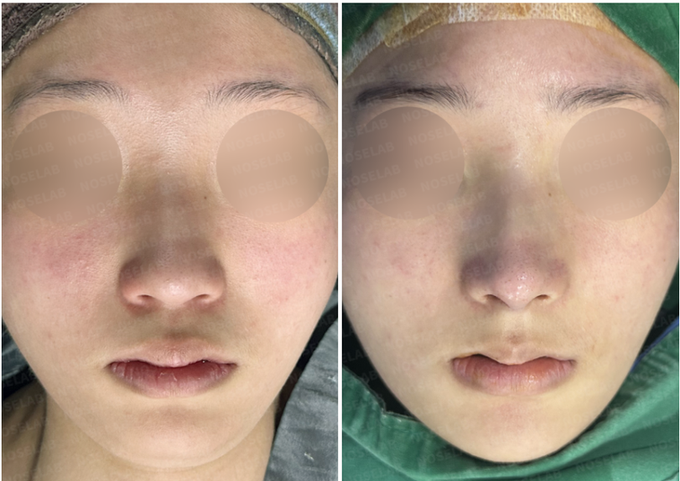
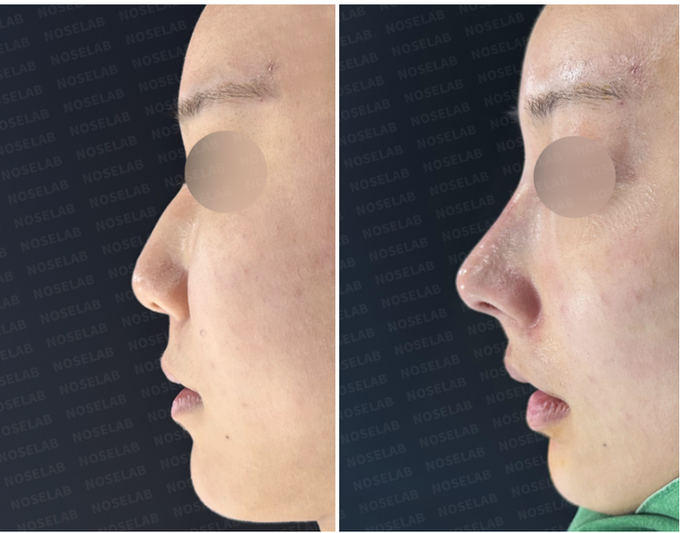
From the lateral view, the dorsal hump created a convex profile, while the drooping nasal tip contributed to an overall longer-looking nose. From the frontal view, the nasal tip appeared bulky with insufficient definition.
The patient did not have functional breathing issues but sought aesthetic improvement with a natural and refined outcome. In this case, structural correction was performed through closed rhinoplasty korea, focusing on hump correction, osteotomy, and structural tip support.
If you are experiencing similar concerns such as a hump nose or a drooping nasal tip, a structural evaluation is important to determine the most appropriate surgical plan.
📩 International Consultation
Surgical Background – Closed Rhinoplasty Korea
Correction of a hump nose combined with a drooping nasal tip requires both dorsal correction and structural tip support.
For this reason, closed rhinoplasty korea was selected to allow precise internal correction of dorsal deformities and stable reconstruction of nasal tip support without external incisions.

Structural Problems Identified
Preoperative evaluation revealed several structural causes:
Prominent dorsal hump
Drooping nasal tip (tip ptosis)
Weak nasal tip support
Bulky and poorly defined nasal tip
Open roof deformity expected after hump removal
These structural problems required coordinated correction of the nasal bridge and tip.

Surgical Plan – Structural Tip Support and Dorsal Correction
Nasal Tip Reconstruction with Rib Cartilage
Because the nasal tip support was weak, structural reinforcement was required.
Procedures performed:
Nasal tip reconstruction using autologous rib cartilage
Reinforcement of tip support
Controlled elevation and refinement of the nasal tip
Adjustment of tip projection and rotation
Dorsal Hump Reduction
The dorsal hump was carefully reduced to create a smooth nasal bridge line.
Procedures performed:
Removal of the dorsal hump
Smoothing of the nasal bridge contour
Lateral Osteotomy
After hump removal, an open roof deformity can occur and must be corrected.
Procedures performed:
Lateral osteotomy to close the open roof deformity
Narrowing of the nasal bridge
Correction of nasal bone alignment
Nasolabial Angle Adjustment
Adjustment of the nasolabial angle improved tip rotation and overall profile balance.
Surgical Results
Frontal View
Narrower and more refined nasal bridge
Improved nasal tip definition
Better overall symmetry

Lateral View
Smooth dorsal line after hump removal
Drooping nasal tip elevated and stabilized
Balanced nasal profile

Oblique (45°) View
Natural nasal contour
Smooth transition from bridge to tip

Overall Outcome
Balanced nasal proportions
Natural and refined appearance
Stable nasal tip support

Surgeon’s Commentary – Coordinated Correction of Hump and Drooping Tip
Hump nose correction requires more than simple reduction of the protruding area. After hump removal, an open roof deformity commonly occurs, which must be addressed through osteotomy to restore proper dorsal width and alignment.
In cases with both a dorsal hump and a drooping nasal tip, establishing strong structural support for the nasal tip is essential before finalizing the dorsal contour.
In this case, autologous rib cartilage was used to reinforce the nasal tip, ensuring stable projection and long-term support. Osteotomy allowed precise repositioning of the nasal bones, while hump reduction and tip refinement were performed in a coordinated manner.
A balanced approach that considers both the nasal bridge and tip is critical to achieving a natural and stable result.
Structural rhinoplasty focuses not only on shape correction but also on long-term structural stability and facial balance.
📩 International Consultation
Frequently Asked Questions (FAQ)
Q1. hump removal alone enough to improve the nose shape?
No. Osteotomy is often required to correct open roof deformity and achieve proper contour.
Q2. Why is rib cartilage used for tip support?
It provides strong structural stability and allows precise control of tip position.
Q3. Can a drooping nasal tip be corrected permanently?
Yes. With proper structural reinforcement, stable long-term results can be achieved.
🎥 YouTube Reference
If you’re curious about Dr. Cha-Young Kang’s closed rhinoplasty approach, click to watch the video.

Read the author’s background and the original case context. About these articles