Case at a glance
- Surgical plan
- Graft & material details
- Photo timing
These details are excerpts from the original article and captions. Follow a detail to read it in context.
A long-looking nose after rhinoplasty is often caused by insufficient tip support and progressive tip descent rather than true nasal length.
In this case, structural reinforcement using rib cartilage and controlled tip repositioning restored stable projection, corrected tip ptosis, and improved facial balance through a closed rhinoplasty approach.
Author: Dr. Cha-Young Kang, Director, NoseLab Clinic
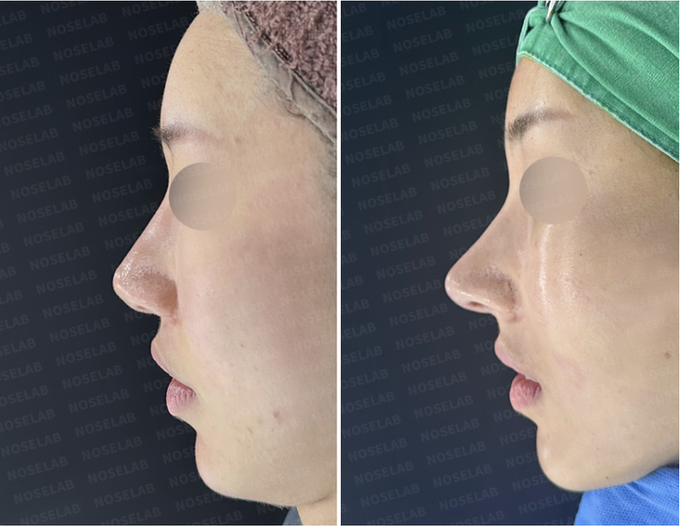
This revision rhinoplasty case involves a female patient who developed a progressively elongated and drooping nasal appearance after previous nasal surgery.
The patient presented with nasal tip ptosis, elongated nasal proportions, and imbalance between the nose and midface.
Clinical evaluation indicated insufficient internal tip support and an unfavorable nasolabial angle contributing to the long-looking profile.
In this case, structural correction was achieved through closed rhinoplasty korea, focusing on reinforcement of nasal tip support and controlled repositioning rather than simple reduction.
Long-looking nose deformity after rhinoplasty is primarily a structural issue related to tip support, requiring reconstruction rather than surface modification.
If you are experiencing a drooping nasal tip or a nose that appears longer over time after previous surgery, a detailed structural evaluation is essential before determining the appropriate surgical plan.
📩 International Consultation
→ LINE Consultation (Japan only)

Surgical Background – Closed Rhinoplasty Korea
Revision correction of nasal tip ptosis requires stable reconstruction of the internal support structures.
For this reason, closed rhinoplasty korea was selected to allow precise internal structural access, implant removal, and cartilage-based reinforcement without external incisions.

Structural Problems Identified
Preoperative evaluation revealed several structural causes:
Insufficient nasal tip support
Progressive tip descent
Elongated nasal appearance
Unfavorable nasolabial angle
Imbalance between nose and midface
These factors required structural correction rather than simple cosmetic adjustment.
Surgical Plan – Tip Reinforcement and Proportional Correction
Removal of Previous Materials
Removal of silicone implant and residual fillers
Establishment of a stable reconstruction base
Nasal Tip Reconstruction with Rib Cartilage
Reinforcement of tip support using autologous rib cartilage
Controlled repositioning of the nasal tip
Prevention of recurrent tip descent
Septal Reinforcement
Restoration of internal structural stability
Support for long-term tip position
Nasolabial Angle Adjustment
Optimization of nose-to-lip relationship
Improvement of perceived facial proportions
Surgical Results
Profile View
Stable elevation of the nasal tip
Reduction of elongated appearance

Nasal Length Perception
Visual shortening of nasal length
Improved midface balance

Tip Contour
Softer and more defined tip shape
Controlled projection without overcorrection
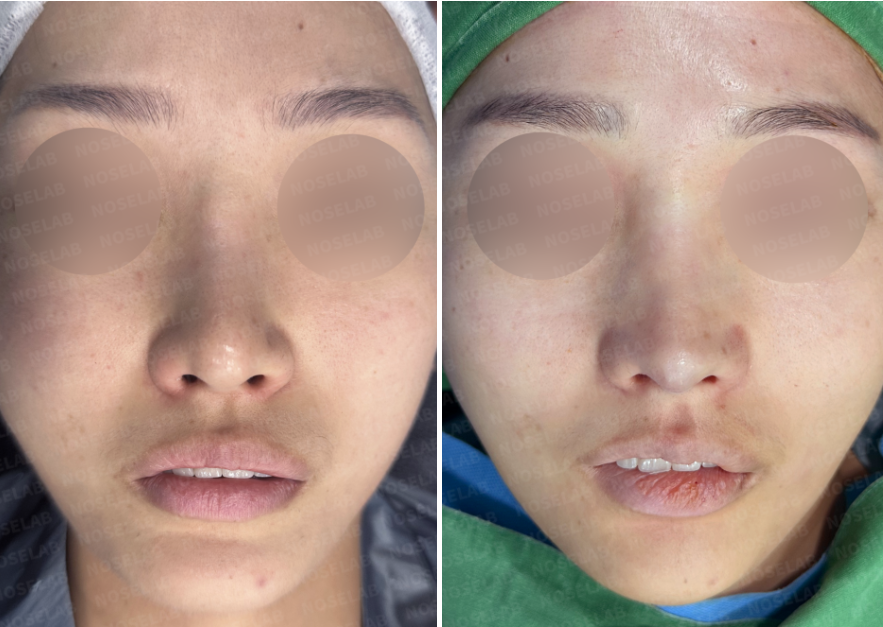
Facial Harmony
Balanced relationship between nose and midface

Surgeon’s Commentary
A long-looking nose after rhinoplasty is usually not caused by excessive length but by loss of structural support.
When tip support weakens, the nasal tip gradually descends, altering proportions and creating an elongated appearance.
In this case, autologous rib cartilage was used to reconstruct the internal support system, allowing stable repositioning of the nasal tip.
Rather than increasing height, the focus was on restoring structural balance and preventing future descent.
A structure-first approach ensures long-term stability and natural proportions in revision rhinoplasty.
Because each revision case presents different structural limitations, surgical planning must be based on precise anatomical analysis rather than a standardized approach.
If you are considering revision rhinoplasty due to a drooping tip or elongated nasal appearance, a comprehensive evaluation is essential to determine the most appropriate correction strategy.
📩 International Consultation
→ LINE Consultation (Japan only)
(FAQ)
Q1. Can a drooping nasal tip after rhinoplasty be corrected?
Yes. Structural reinforcement and tip support reconstruction can effectively correct tip ptosis.
Q2. Why is rib cartilage used?
Rib cartilage provides strong and reliable structural support in revision cases.
Q3. Will this make the face look shorter?
Yes. Correcting tip position and nasolabial angle can improve facial proportions and reduce the elongated appearance.
🎥 YouTube Reference
If you’re curious about Dr. Cha-Young Kang’s closed rhinoplasty approach, click to watch the video.

Read the author’s background and the original case context. About these articles
Source updated .