Closed Rhinoplasty Korea for Male Crooked Nose and Functional Correction
- Dr. Chayoung Kang
- 2024년 10월 15일
- 3분 분량
최종 수정일: 4월 6일
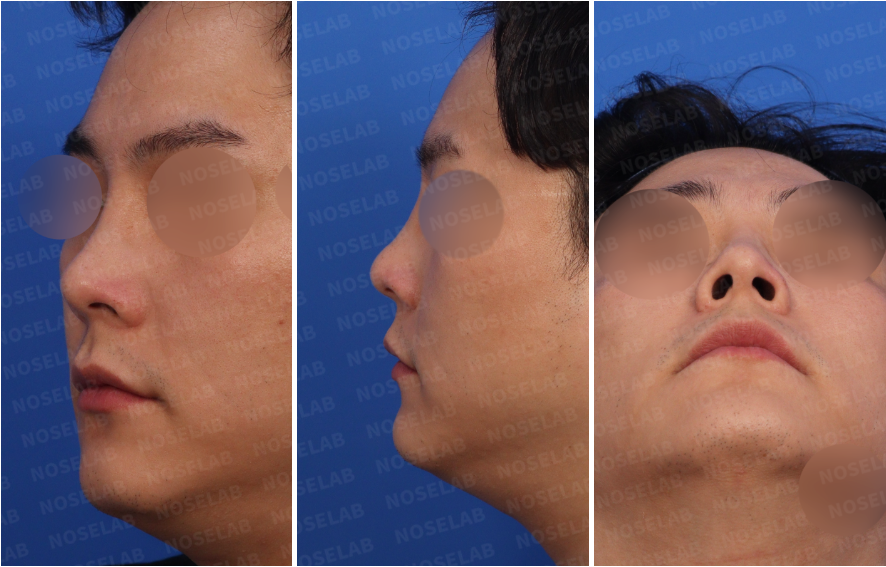
This case demonstrates closed rhinoplasty Korea for correcting a crooked and upturned male nose combined with functional nasal obstruction. Structural reconstruction using septal extension and rib cartilage was performed alongside airway correction to achieve a straight, masculine nasal profile with long-term stability.
Author: Dr. Cha-Young Kang, Director, NoseLab ClinicThis patient presented with a crooked nasal structure, upturned nasal tip, and significant right-sided nasal obstruction affecting breathing.
In this closed rhinoplasty Korea case, the goal was not only to straighten the nasal bridge but also to correct structural deviation and improve nasal airway function.
The patient’s primary concerns included:
Crooked nasal bridge with asymmetry
Upturned nasal tip creating excessive nostril exposure
Right-sided nasal obstruction due to septal deviation
Weak dorsal structure with imbalance in nasal height
This case required both functional correction and structural reconstruction rather than simple aesthetic modification.
If you are experiencing similar structural or breathing issues, a detailed evaluation of nasal anatomy is essential.
📩 International Consultation

✅ Surgical Background – Closed Rhinoplasty Korea
Closed rhinoplasty Korea allows internal structural correction without external incisions.
This approach is particularly effective in male rhinoplasty where preservation of tissue and precise structural alignment are critical.
In this case, both functional and structural corrections were required, including septal reconstruction and nasal framework realignment.
✅ Structural Problems Identified
Preoperative analysis revealed:
Septal deviation causing unilateral nasal obstruction
Crooked nasal axis with asymmetrical dorsal line
Over-rotated nasal tip leading to nostril exposure
Weak structural support of the nasal tip
Imbalance between radix height and dorsal line
These combined issues required a comprehensive structural reconstruction approach.
✅ Surgical Plan
1. Septal Reconstruction and Airway Correction
Septoplasty was performed to correct septal deviation, and turbinate reduction improved nasal airflow.
2. Structural Reinforcement with Rib Cartilage
Autologous rib cartilage was used to reconstruct septal support and stabilize the nasal framework.
3. Septal Extension Graft
A septal extension graft was used to reposition and stabilize the nasal tip while correcting asymmetry.
4. Dorsal Line Realignment
The previous implant was removed and replaced with a properly aligned structure to create a straight dorsal line.
5. Nasal Tip and Angle Correction
The nasal tip rotation was reduced, and the nasolabial angle was adjusted to approximately 90 degrees to achieve a masculine profile.
✅ Surgical Results
Frontal View
Crooked nasal bridge corrected
Nostril exposure reduced
Improved symmetry

Lateral View
Straight dorsal line achieved
Nasal tip repositioned
Balanced profile restored

Oblique View
Smooth transition from radix to tip
Improved structural alignment

Functional Outcome
Nasal obstruction resolved
Improved airflow
Stable nasal airway

✅ Surgeon’s Commentary
Male rhinoplasty requires a different structural approach compared to female rhinoplasty.
The goal is to achieve a straight, strong nasal profile with controlled tip rotation and stable structural support.
In this case, rib cartilage played a critical role in maintaining long-term stability while correcting multiple deformities.
Functional correction is equally important, as structural deviation often affects breathing.
Closed rhinoplasty Korea allows precise correction of both aesthetic and functional problems while preserving soft tissue integrity.
If you are considering male rhinoplasty or revision surgery, structural analysis is essential for long-term results.
📩 International Consultation
✅ FAQ
Q1. Why is rib cartilage used in male rhinoplasty?
Rib cartilage provides strong structural support, which is essential for maintaining a straight and stable nasal framework.
Q2. Can crooked nose correction improve breathing?
Yes. Correcting septal deviation and nasal structure can significantly improve nasal airflow.
Q3. What defines a masculine nasal profile?
A straight dorsal line, controlled tip rotation, and a nasolabial angle around 90 degrees are typical characteristics.
✅ Mandatory Disclosure
This case is for educational purposes and represents a clinical example.
Results may vary depending on individual anatomy and conditions.
All procedures were performed by a qualified specialist.
Messenger(WhatsApp) : +82 1057360302
Home page : www.noselab.co.kr
Instagram : noselab_global
YouTube : Noselab
Email : noselab@naver.com


댓글