Case at a glance
- Surgical plan
- Graft & material details
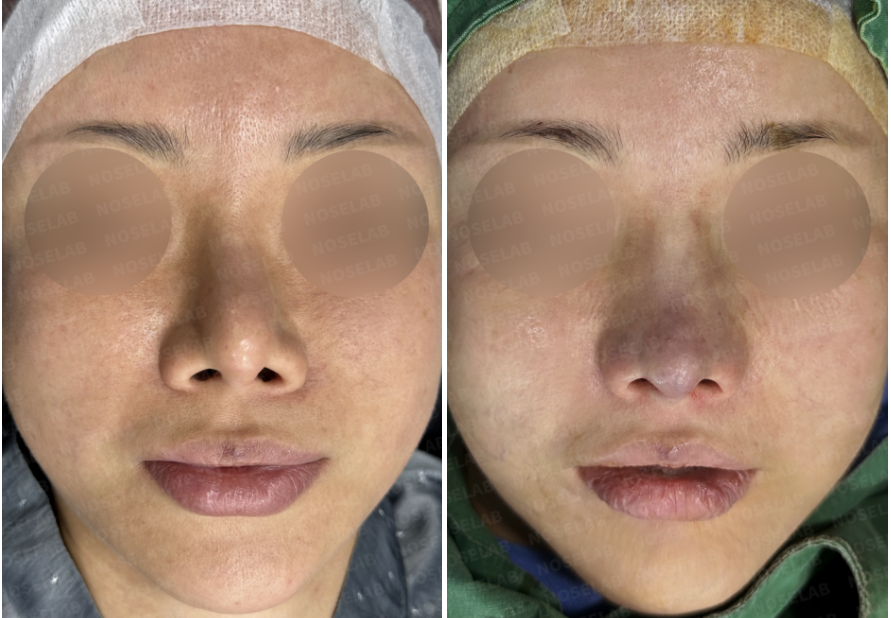
- Photo timing
These details are excerpts from the original article and captions. Follow a detail to read it in context.
(Revision Rhinoplasty Case)
Loss of the anterior septum leads to severe nasal tip instability, over-rotation, and alar deformities.
In this case, complete septal reconstruction using rib cartilage restored nasal support, corrected an upturned tip, and improved both nasal symmetry and breathing through a closed rhinoplasty approach.
Author: Dr. Cha-Young Kang, Director, NoseLab Clinic
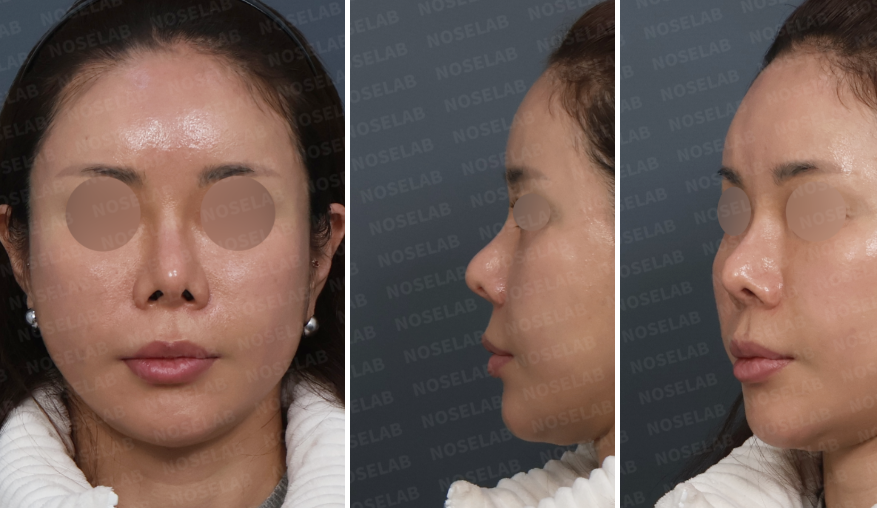
This case involves a revision rhinoplasty patient presenting with severe structural deformities following previous surgeries, including complete loss of the anterior septum, an excessively upturned nasal tip, and bilateral pinched alar deformities.
The patient had undergone two prior rhinoplasty procedures using silicone implants and cartilage grafts. During previous surgery, the anterior septum had been removed and used as graft material, resulting in loss of the primary support structure of the nasal tip.
As a result, the patient developed significant tip over-rotation, nostril overexposure, alar collapse, and dissatisfaction with both nasal appearance and function.
In this case, structural correction was achieved through closed rhinoplasty korea, focusing on reconstruction of the internal framework rather than superficial correction.
If you are experiencing similar structural problems after previous rhinoplasty or are considering revision surgery, an accurate assessment of the remaining nasal support structures is essential before determining the surgical plan.
📩 International Consultation
→ LINE Consultation (Japan only)
Surgical Background – Closed Rhinoplasty Korea
Revision rhinoplasty involving septal loss requires complete reconstruction of the internal nasal framework.
For this reason, closed rhinoplasty korea was selected to allow precise structural rebuilding while minimizing additional external tissue trauma and avoiding external incisions.
Structural Problems Identified
Preoperative evaluation revealed critical structural deficiencies:
Complete loss of the anterior septum
Excessive nasal tip over-rotation
Nostril overexposure
Bilateral pinched alar deformities
Depressed dorsal contour
Compromised nasal airflow
These issues required full structural reconstruction rather than partial correction.
Surgical Plan – Comprehensive Structural Reconstruction
Anterior Septal Reconstruction with Rib Cartilage
The absence of the anterior septum required full reconstruction.
Procedures performed:
Reconstruction of the septum using autologous rib cartilage
Restoration of central nasal support
Stabilization of nasal tip position
This step was essential to correct tip over-rotation and restore long-term stability.
Nasal Tip Support Restoration
The nasal tip lacked structural support and was excessively rotated.
Procedures performed:
Reinforcement of nasal tip support using rib cartilage
Controlled repositioning of the nasal tip
Reduction of nostril exposure
Alar Cartilage Reconstruction
The patient presented with bilateral pinched alar deformities.
Procedures performed:
Reconstruction of alar cartilages using rib cartilage grafts
Restoration of natural alar curvature
Improvement of nostril symmetry
Dorsal Contour Correction
The nasal dorsum showed areas of depression.
Procedures performed:
Application of crushed rib cartilage
Smoothing of dorsal contour
Creation of a natural nasal bridge line
Functional Nasal Surgery
Functional correction was necessary to improve airflow.
Procedures included:
Septoplasty for internal alignment
Inferior turbinate reduction to relieve obstruction
These procedures improved breathing and nasal function.
Surgical Results
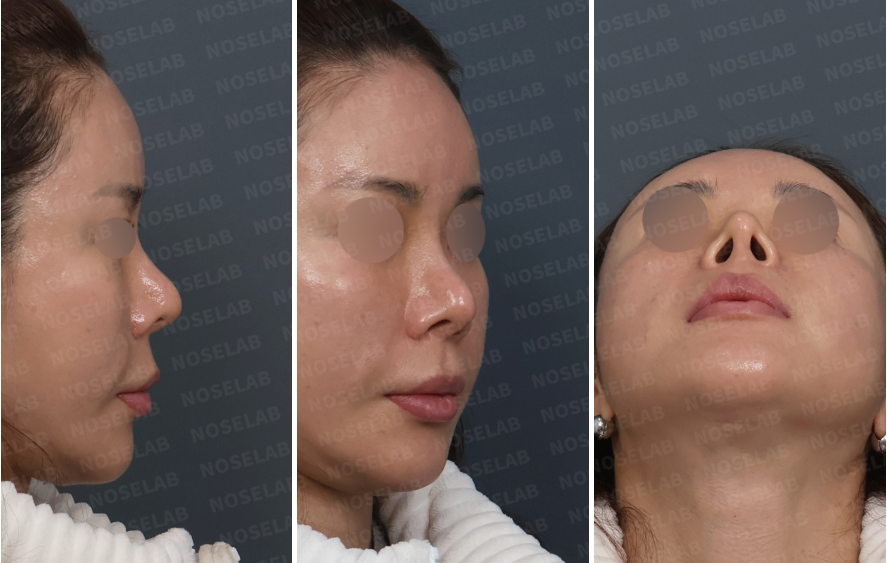
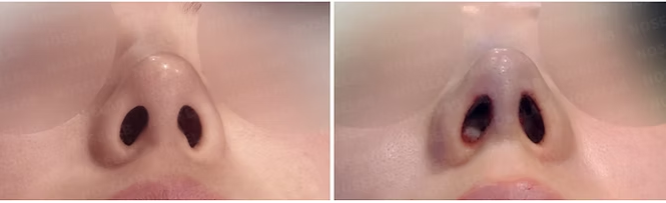
Frontal View
Reduction of nostril overexposure
Improved nasal symmetry
Correction of alar deformities
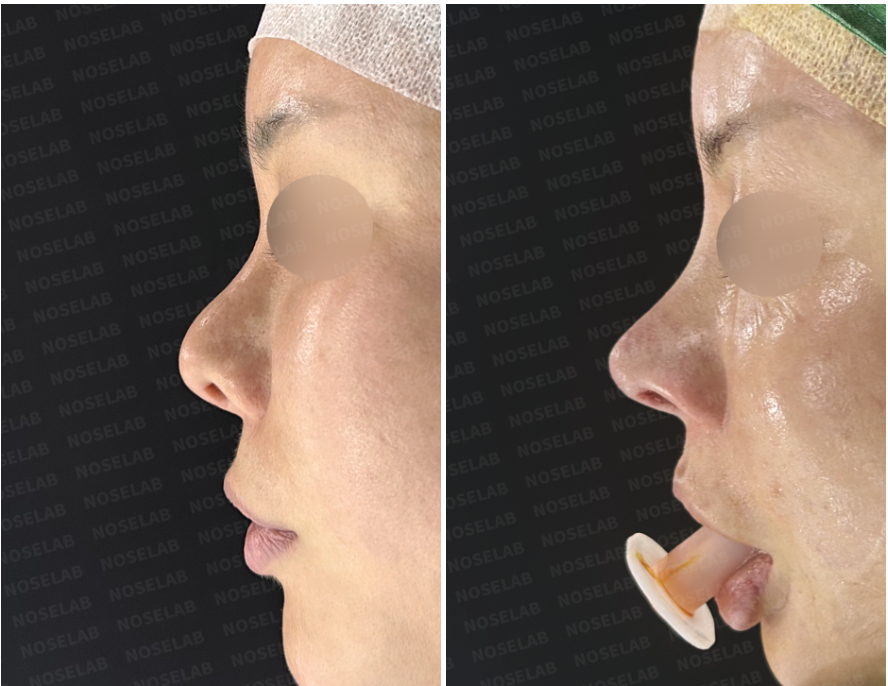
Lateral View
Upturned nasal tip repositioned to a natural angle
Stable nasal tip support restored
Smooth dorsal contour achieved
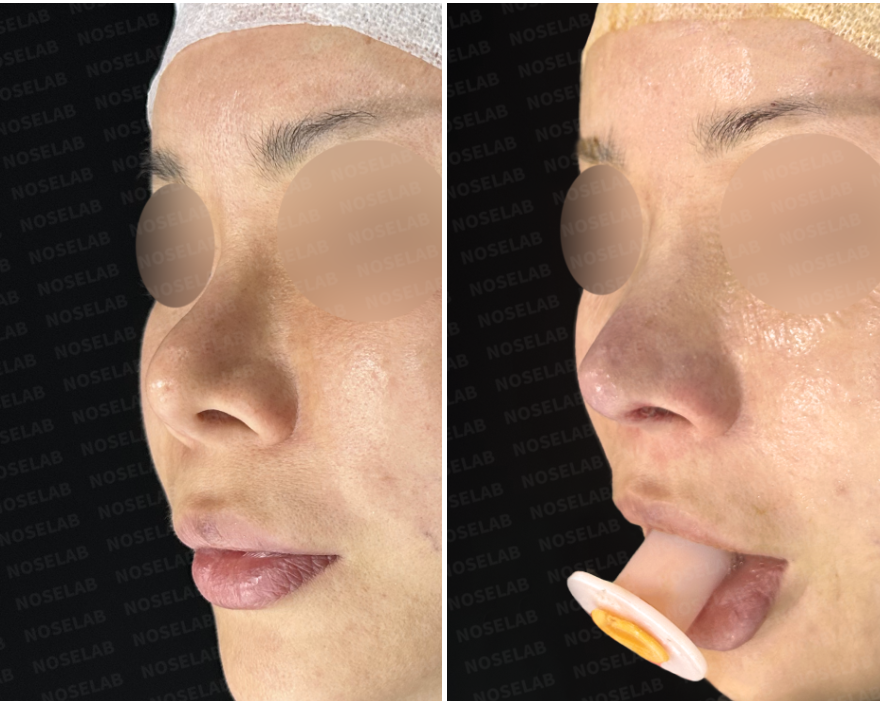
Oblique (45°) View
Harmonious nasal contour
Improved structural balance
Functional Outcome
Improved nasal airflow
Enhanced breathing comfort
Stabilized internal nasal framework
Surgeon’s Commentary – Managing Septal Loss in Revision Rhinoplasty
Complete loss of the anterior septum represents one of the most challenging conditions in revision rhinoplasty.
Without septal support, the nasal tip becomes unstable, often resulting in over-rotation, nostril overexposure, and alar collapse.
In this case, autologous rib cartilage was used to reconstruct the septum and restore a stable central framework. This allowed correction of the nasal tip position and provided long-term structural durability.
Pinched alar deformities were corrected through cartilage reconstruction, restoring natural curvature and symmetry. Crushed rib cartilage was used to address dorsal irregularities, allowing smooth contouring without excessive rigidity.
Revision rhinoplasty involving septal loss requires advanced surgical planning due to scar tissue, weakened structures, and limited native cartilage. A structure-first approach is essential to achieve both functional improvement and natural aesthetic outcomes.
Because each revision case presents different structural limitations, surgical planning must be based on precise analysis rather than a standardized approach.
If you are considering revision rhinoplasty due to previous surgical complications or persistent functional issues, a comprehensive evaluation is essential to determine the most appropriate reconstruction strategy.
📩 International Consultation
→ LINE Consultation (Japan only)
Frequently Asked Questions (FAQ)
Q1. What happens if the septum is completely removed?
Loss of septal support leads to nasal tip instability, over-rotation, and nostril overexposure.
Q2. Why is rib cartilage used in such cases?
Rib cartilage provides strong structural support when native cartilage is insufficient or absent.
Q3. Can breathing improve after complex revision rhinoplasty?
Yes. Functional procedures such as septoplasty and turbinate reduction can significantly improve airflow.
🎥 YouTube Reference
If you’re curious about Dr. Cha-Young Kang’s closed rhinoplasty approach, click to watch the video.
Read the author’s background and the original case context. About these articles
Source updated .


