Case at a glance
- Concerns & goals
- Graft & material details
- Autologous rib cartilage was used to reconstruct the septal support structure. This helped rebuild the central framework needed for nasal tip stability and airway support.
- The nasal framework was reinforced to reduce further collapse and improve overall stability. Rib cartilage support was used because the native support was insufficient after repeated surgeries.
- Photo timing
These details are excerpts from the original article and captions. Follow a detail to read it in context.
This case reviews dermal absorption revision rhinoplasty in a patient with repeated volume loss, nasal tip depression, nostril asymmetry, deviated nasal structure, scar contracture, and nasal obstruction after multiple previous rhinoplasty procedures. Reconstruction focused on rib cartilage support, controlled volume restoration, nasal tip reconstruction, nostril and columella correction, and functional airway improvement.
Author: Dr. Cha-Young Kang
Clinic: NoseLab Clinic
Published: 2025
Last Updated: 2026
Introduction
Hello, this is Dr. Cha-Young Kang of NoseLab Clinic.
This case involves dermal absorption revision rhinoplasty in a patient who developed repeated dermal absorption, progressive nasal deformity, nasal tip depression, nostril asymmetry, and nasal obstruction after multiple previous revision rhinoplasty procedures.
The surgery was performed using a closed rhinoplasty / endonasal approach with autologous rib cartilage reconstruction. The goal was to rebuild the nasal framework, improve structural support, reinforce areas affected by volume loss, and address functional airway obstruction.
Case Background
The patient presented after multiple revision rhinoplasty procedures with persistent dermal absorption and progressive nasal deformity.
Over approximately 10 years, repeated use of dermal grafts led to gradual volume loss, reduced structural support, and nasal asymmetry. As the soft tissue volume decreased, the nasal tip became depressed, and the nasal framework became less stable.
Key Concerns
The key concerns included:
Repeated dermal absorption
Nasal tip depression
Nostril asymmetry
Deviated nasal structure
Scar contracture
Columella deviation
Functional nasal obstruction
Progressive loss of nasal support
This case required structural reconstruction rather than simple volume replacement because the underlying framework and airway were also affected.
Preoperative Design and Structural Assessment
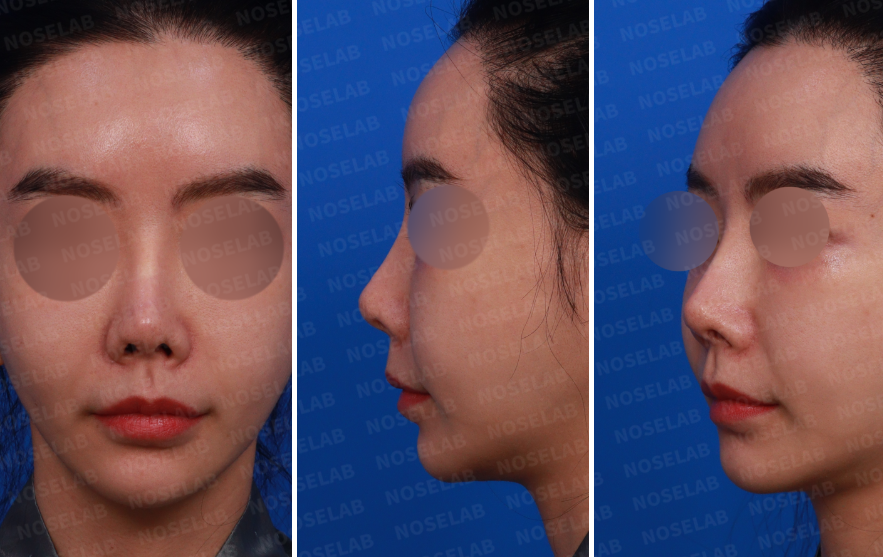
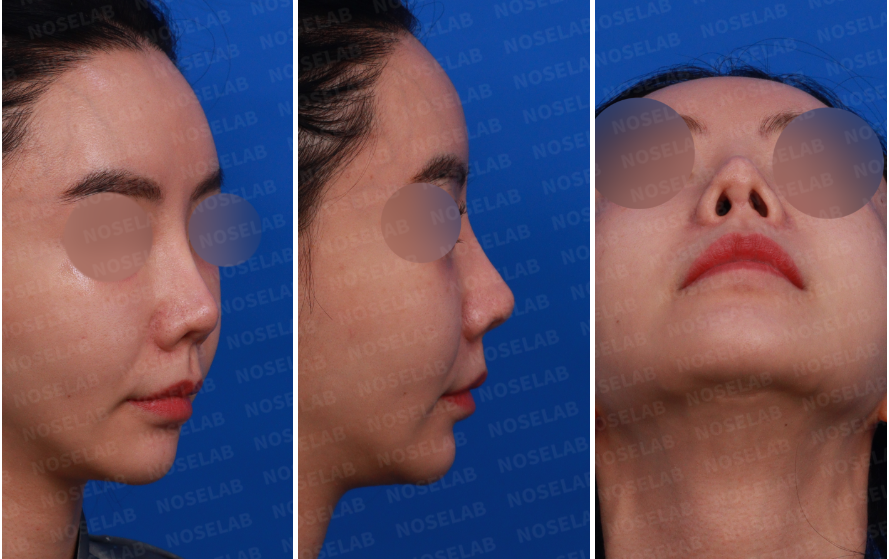
Preoperative design consultation photos were reviewed from the side, oblique, and nostril views. The patient also provided reference images showing preferred and disliked nasal shapes, which helped clarify the desired direction of correction.
Side View
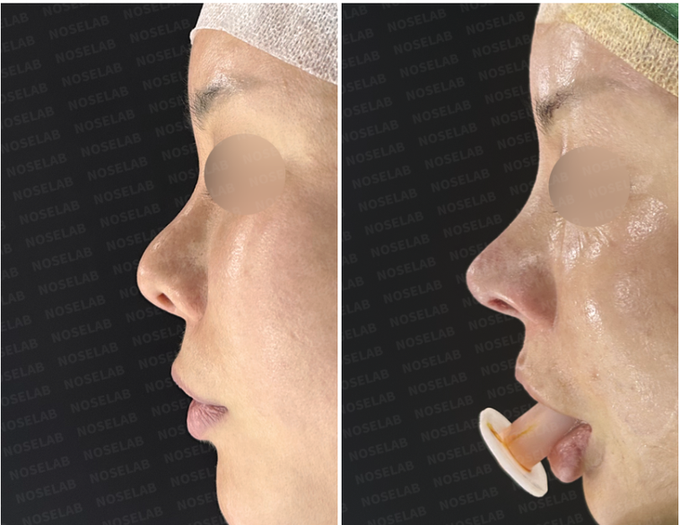
The side view showed nasal tip depression, imbalance of the nasal starting point, and weakened support of the nasal tip.
Oblique View
The oblique view showed contour irregularity related to volume loss and scar contracture.
Nostril View
The nostril view showed nostril asymmetry, columella deviation, and imbalance of the nasal base.
These findings indicated that both soft tissue volume loss and structural weakness had to be addressed together.
Surgical Background – Revision Rhinoplasty for Repeated Dermal Absorption
Repeated dermal absorption can lead to gradual loss of nasal volume and support. When this occurs after several revision surgeries, the problem is often not limited to the dermal layer.
A closed rhinoplasty Korea approach was selected to allow internal structural correction without adding an external columellar incision. The surgical plan focused on framework reconstruction first, followed by controlled reinforcement of areas affected by dermal volume loss.
Structural Problems Identified
Preoperative findings showed several structural and functional problems.
Main Structural Findings
The main findings included:
Severe volume loss from repeated dermal absorption
Nasal tip depression
Deviated nasal bridge
Nostril asymmetry
Columella deviation
Scar tissue accumulation
Functional airway obstruction
Weak structural support beneath the soft tissue envelope
These findings confirmed that simple dermal grafting alone would not be enough. A stronger structural foundation was needed to support the nasal shape and airway.
Surgical Plan
Septal Reconstruction
Autologous rib cartilage was used to reconstruct the septal support structure. This helped rebuild the central framework needed for nasal tip stability and airway support.
Structural Reinforcement
The nasal framework was reinforced to reduce further collapse and improve overall stability. Rib cartilage support was used because the native support was insufficient after repeated surgeries.
Controlled Volume Restoration
Stable dermal tissue was selectively reused where appropriate, with structural reinforcement underneath. The goal was to improve contour while avoiding reliance on dermal volume alone.
Nasal Tip Reconstruction
The depressed and over-rotated nasal tip was reconstructed with structural support. This helped improve tip position, projection, and nasal base balance.
Nostril and Columella Correction
Nostril asymmetry and columella deviation were corrected through structural alignment. This helped improve nasal base symmetry and lower nasal stability.
Functional Airway Correction
Septoplasty and airway correction were performed to improve nasal airflow. Functional correction was planned together with structural reconstruction because obstruction was part of the patient’s symptoms.
Surgical Results
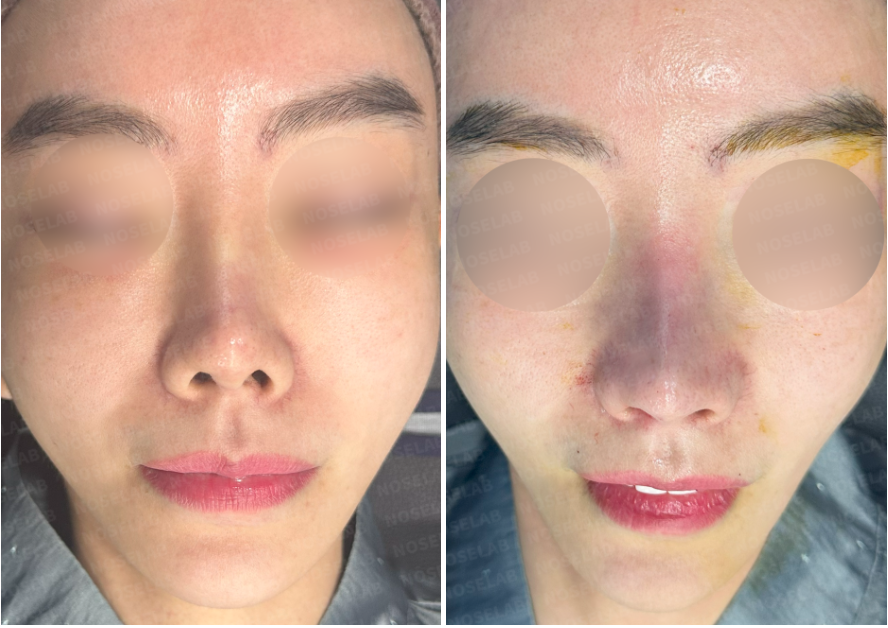
Frontal View
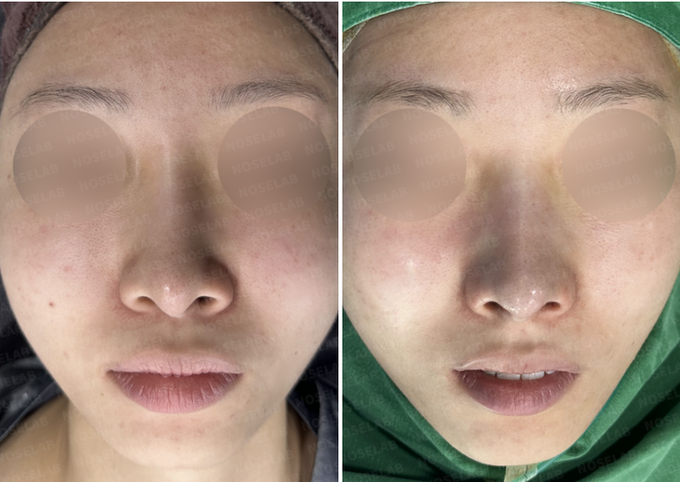
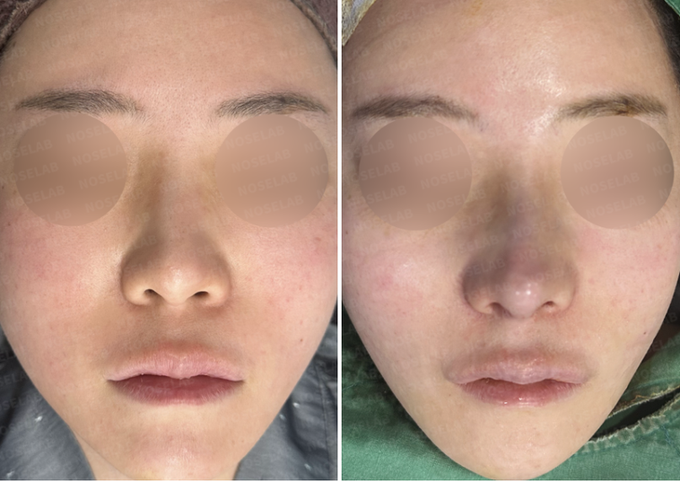
From the frontal view, asymmetry was reduced, nasal alignment improved, and the nasal tip position appeared more balanced after reconstruction.
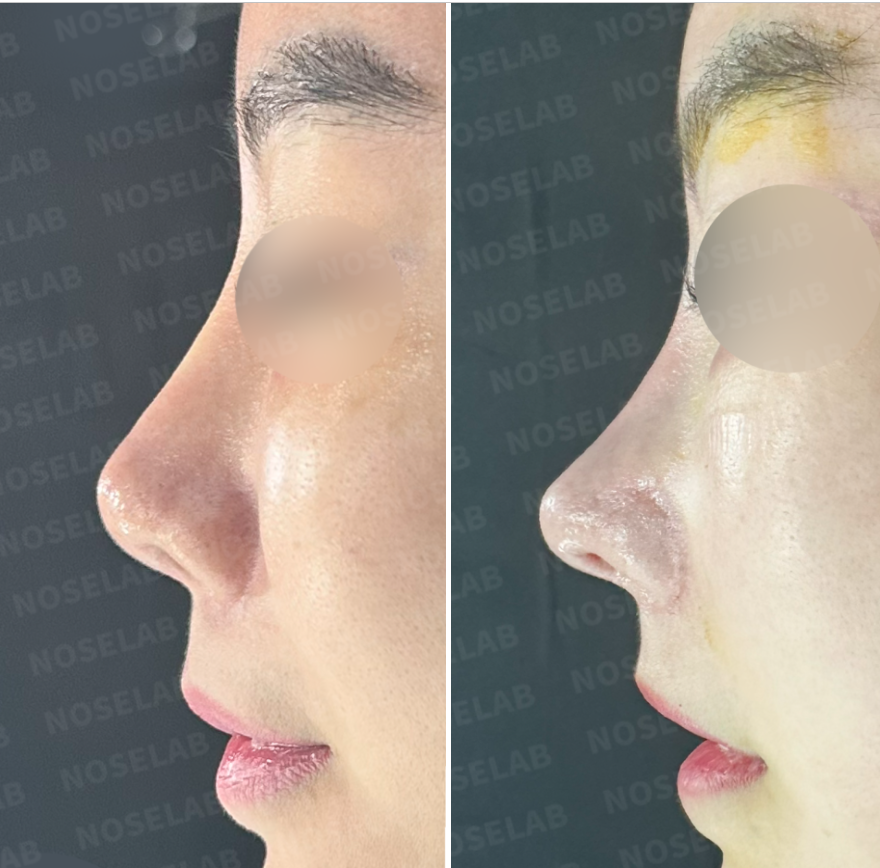
Side View
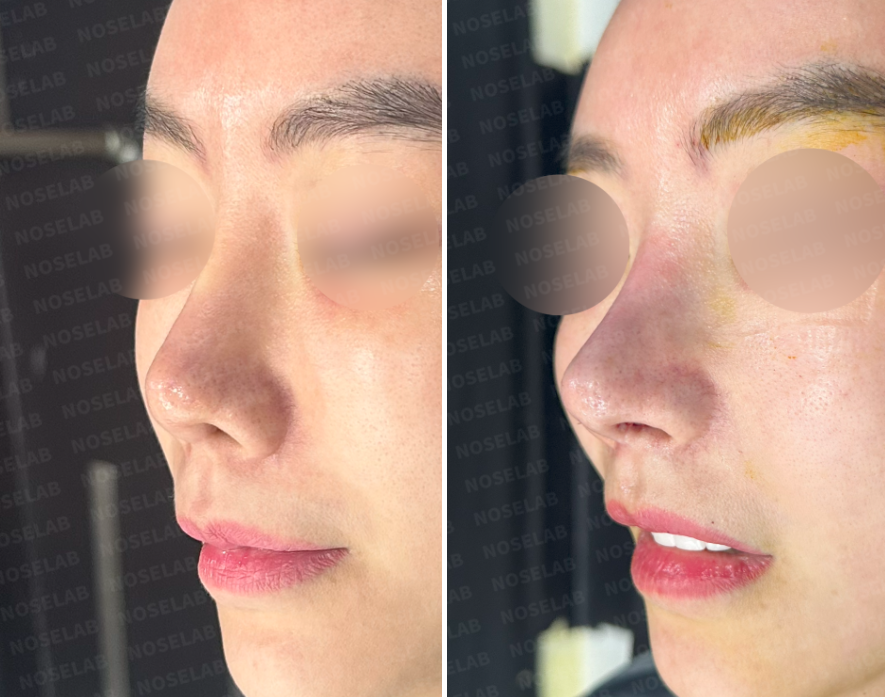
From the side view, the nasal starting point appeared lower, and the depressed nasal tip improved. The nasolabial angle also appeared more balanced after structural support was rebuilt.
Oblique View
The oblique view showed improved nasal contour and clearer structural definition after rib cartilage reconstruction and controlled volume reinforcement.
Nasal Base View
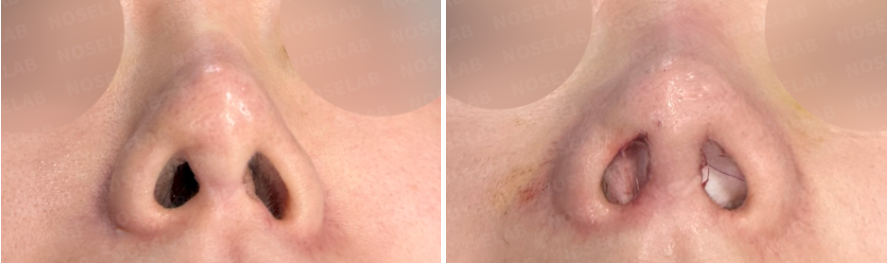
From the nasal base view, the columella appeared straighter, nostril symmetry improved, and scar visibility was reduced within the limits of the patient’s tissue condition.
Functional Outcome
Nasal airflow improved after airway correction and structural stabilization. The reconstructed internal framework provided better support for breathing.
Surgeon’s Commentary
Repeated dermal absorption is a challenging condition in revision rhinoplasty because soft tissue volume loss can return if the underlying structure is not stable.
Dermal grafts may gradually lose volume over time. When this happens repeatedly, the nasal shape may become depressed, asymmetrical, or unstable. In these cases, simply adding more dermis may not be enough.
In this case, autologous rib cartilage was used to rebuild the structural framework. The purpose was to provide stronger support beneath the soft tissue layer, so the nose would not depend only on dermal volume.
Controlled volume restoration was performed with attention to tissue condition and scar contracture. Nostril and columella correction were also necessary because repeated surgeries had affected nasal base alignment.
This case shows that dermal absorption revision rhinoplasty should be planned as structural reconstruction, controlled soft tissue reinforcement, and functional airway correction rather than simple volume replacement.
FAQ
Why does dermal absorption occur after rhinoplasty?
Dermal grafts can gradually lose volume over time as tissue remodels during healing. The degree of absorption may vary depending on tissue condition, graft thickness, blood supply, and previous surgical history.
Can repeated dermal absorption be corrected?
Repeated dermal absorption can often be improved, but treatment should not rely only on adding more dermis. Structural support with cartilage may be needed when the nasal framework is weak or unstable.
Why is rib cartilage used in dermal absorption revision rhinoplasty?
Rib cartilage can provide stronger support when the septum or nasal tip framework is insufficient. It helps rebuild the foundation beneath areas affected by volume loss.
Can nasal obstruction improve after revision rhinoplasty?
Nasal obstruction can improve when septal deviation, airway narrowing, or structural collapse is corrected. The degree of improvement depends on the patient’s internal nasal anatomy and scar tissue condition.
International Consultation
For international patients, a photo-based consultation may help clarify whether dermal absorption revision rhinoplasty, rib cartilage reconstruction, nostril correction, or functional airway correction may be needed.
Read the author’s background and the original case context. About these articles
Source updated .