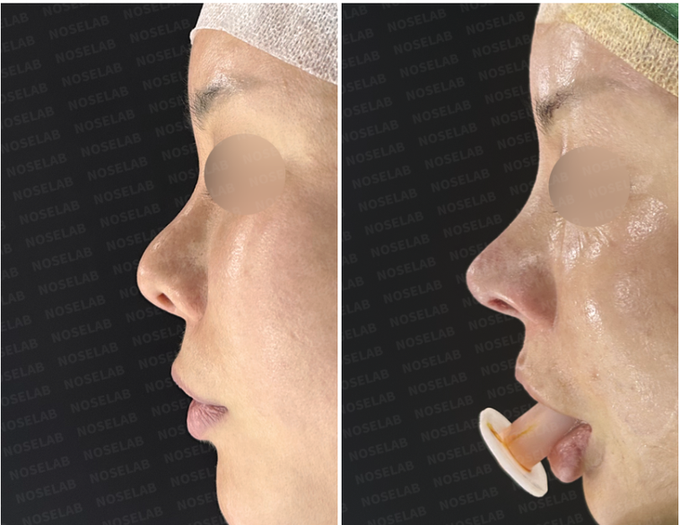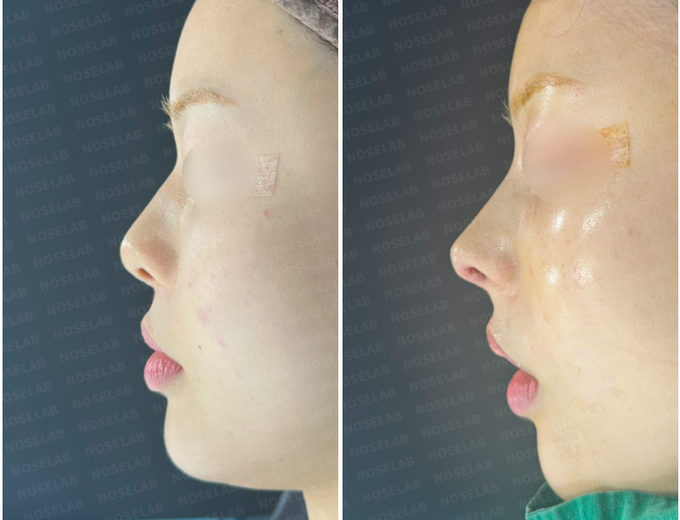
Case at a glance
- Photo timing
These details are excerpts from the original article and captions. Follow a detail to read it in context.
(Revision Rhinoplasty Case)
An upturned nose after multiple surgeries is usually caused by loss of septal support and structural instability.
In this case, septal reconstruction and septal extension using rib cartilage corrected tip over-rotation, improved nostril symmetry, and restored nasal breathing through a closed rhinoplasty approach.
Author: Dr. Cha-Young Kang, Director, NoseLab Clinic
This case involves a revision rhinoplasty patient presenting with an over-rotated (upturned) nasal tip, excessive nostril show, nostril asymmetry, and severe nasal obstruction following multiple prior nasal procedures.
The patient had undergone several surgeries over a long period, including filler injections, implant-based rhinoplasty, revision surgery, and eventual implant removal. Following these procedures, structural support weakened significantly, and chronic rhinitis led to severe functional impairment.
The patient sought both functional recovery and aesthetic correction, with a preference for a slightly longer and more natural nasal appearance.In this case, structural reconstruction was performed through closed rhinoplasty korea, focusing on rebuilding septal support and restoring nasal balance.
If you are experiencing similar problems such as an upturned nose, nostril asymmetry, or breathing difficulty after previous surgery, a detailed structural evaluation is important.
📩 International Consultation
Surgical Background – Closed Rhinoplasty Korea
Revision rhinoplasty for an upturned nose requires structural reconstruction rather than simple repositioning of the nasal tip.
For this reason, closed rhinoplasty korea was selected to allow precise internal structural reconstruction while minimizing additional tissue trauma in a revision setting.

Structural Problems Identified
Preoperative evaluation revealed several structural and functional problems:
Loss of septal support
Over-rotated nasal tip
Excessive nostril show
Nostril asymmetry
Septal deviation
Inferior turbinate hypertrophy
Chronic nasal obstruction
These issues required both structural reconstruction and functional nasal surgery.
Surgical Plan – Structural Reconstruction and Functional Recovery
Septal Reconstruction with Rib Cartilage
The septum had weakened due to previous surgeries and required reconstruction.
Procedures performed:
Septal reconstruction using autologous rib cartilage
Restoration of central nasal support
Stabilization of nasal structure
Septal Extension to Correct Upturned Tip
The nasal tip was excessively rotated upward.
Procedures performed:
Septal extension graft using rib cartilage
Controlled lowering of the nasal tip
Adjustment of tip projection and rotation
Creation of a slightly longer nasal line
Correction of Nasal Asymmetry
Structural asymmetry was corrected to improve nasal balance.
Procedures performed:
Correction of septal deviation
Adjustment of nostril asymmetry
Dorsal Augmentation Using Rib Cartilage
The dorsal contour was reconstructed without synthetic implants.
Procedures performed:
Dorsal augmentation using rib cartilage
Creation of a natural dorsal line
Avoidance of artificial implants
Functional Nasal Surgery
Functional procedures were performed to improve breathing.
Procedures included:
Septoplasty
Inferior turbinate reduction
These procedures improved nasal airflow and breathing comfort.
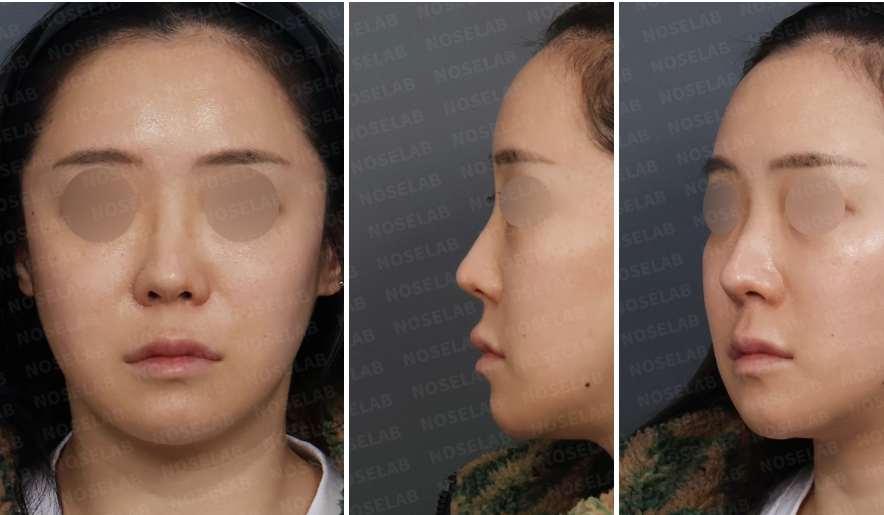
Surgical Results
Frontal View
Improved nostril symmetry
Balanced nasal structure
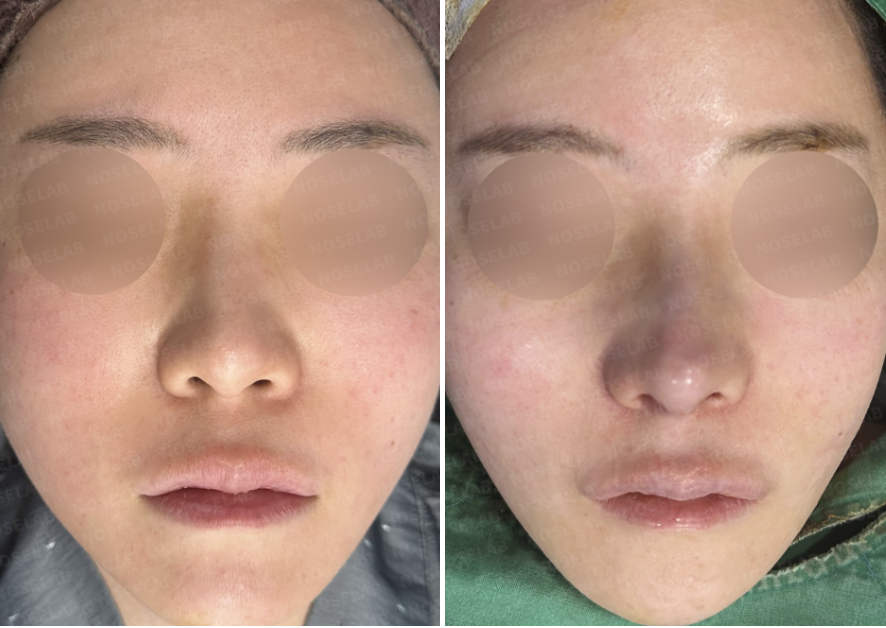
Lateral View
Upturned nasal tip corrected to a natural angle
Slightly longer and more balanced nasal profile

Oblique (45°) View
Natural nasal contour
Improved facial balance

Functional Outcome
Significant improvement in nasal airflow
Relief of chronic nasal obstruction

Surgeon’s Commentary – Structural Correction for Upturned Nose
An upturned nose after multiple surgeries is usually caused by loss of septal support and structural instability.
In such cases, simply repositioning the nasal tip downward is not sufficient. The underlying structural support must be rebuilt first.
In this case, septal reconstruction and septal extension using rib cartilage provided strong and stable support, allowing precise control of tip position and rotation.
Functional problems such as nasal obstruction and chronic rhinitis were addressed simultaneously through septoplasty and turbinate reduction.
Revision rhinoplasty requires careful evaluation of remaining cartilage, scar tissue, and structural stability. A structural reconstruction approach is essential for achieving stable and natural long-term results.
Complex revision rhinoplasty requires precise structural planning and surgical experience.
📩 International Consultation
(FAQ)
Q1.Why does the nose become upturned after multiple surgeries?
Loss of septal support can cause over-rotation of the nasal tip.
Q2.Why is rib cartilage used in revision rhinoplasty?
Rib cartilage provides strong structural support when native cartilage is insufficient.
Q3.Can breathing improve after revision rhinoplasty?
Yes. Septoplasty and turbinate reduction can significantly improve airflow.
🎥 YouTube Reference
If you’re curious about Dr. Cha-Young Kang’s closed rhinoplasty approach, click to watch the video.

Read the author’s background and the original case context. About these articles