Case at a glance
- Surgical plan
- Graft & material details
These details are excerpts from the original article and captions. Follow a detail to read it in context.
This patient visited NoseLab Korea for a deviated and upturned nose correction, combined with retracted columella and asymmetric nostril revision.
Although her nose appeared long and high, she wanted a sharper and higher nasal tip.
To achieve this, I designed a Closed Rhinoplasty Korea procedure that could safely raise the tip of the nose without cartilage visibility or skin tension.


Surgical Plan – Reconstructing the Septum and Correcting Asymmetry
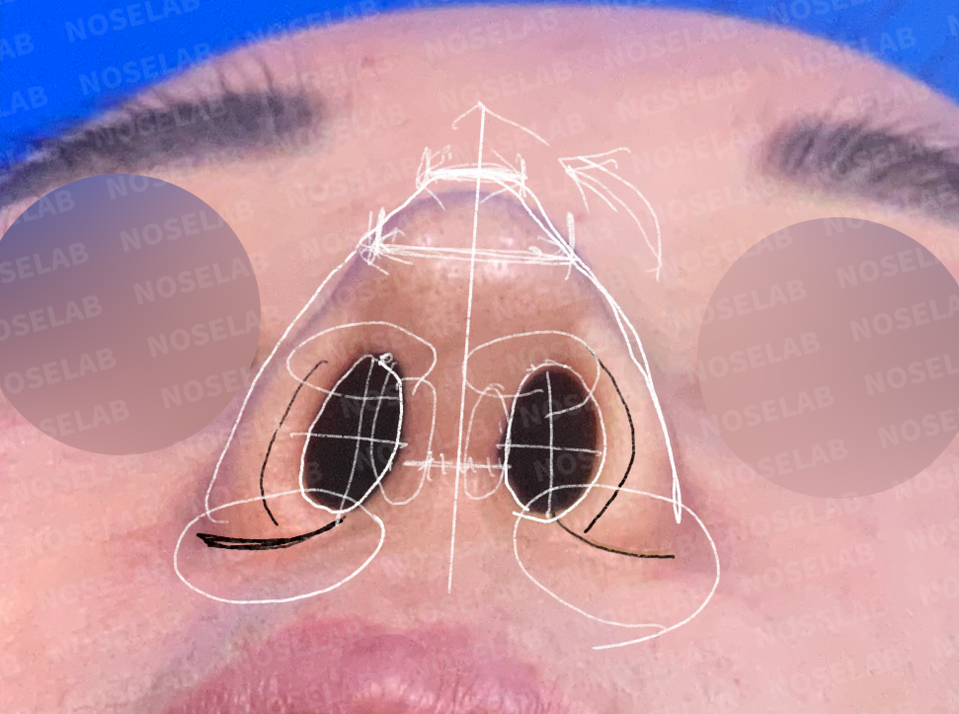
Preoperatively, the nasal tip was drooping and tilted left, causing nostril asymmetry from a previous alar base reduction performed elsewhere.
The Deviated Nose Correction Korea plan included:
Lowering the columella and adjusting the nasolabial angle to approximately 95 degrees
Reconstructing the septal cartilage using self-rib cartilage
Moving the tip slightly to the right and repositioning alar cartilages to restore symmetry
Lowering the nasal starting point to the pupil line to make the nose appear shorter and more balanced
Surgical Results – Natural Balance after Deviated Nose Correction Korea
Immediately after the surgery, the nasolabial angle was naturally corrected to 95°, and the tip of the nose was lifted to the desired height.
The starting point of the bridge aligned with the pupil line, creating a smoother nasal contour.
The left-side curvature and upturned nasal tip were corrected, producing a more symmetrical and natural nasal line.
The nostril asymmetry, previously caused by excessive alar resection, was significantly improved through precise cartilage repositioning.


General Review – Restoring Structure through Closed Revision Rhinoplasty
The patient’s nose was already long and high, but the goal was to make it more pointed while keeping a natural flow.
During surgery, it was confirmed that the septal cartilage was damaged and deviated; thus, it was reconstructed using autologous rib cartilage.
To prevent thinning of the nasal skin, AlloDerm (artificial dermis) was placed at the tip for protection.After recovery, the nasal tip is expected to become even slimmer and more defined, maintaining a natural balance through Deviated Nose Correction Korea.
Dr. Kang Cha-Young, Chief Director of NoseLab

Read the author’s background and the original case context. About these articles
Source updated .


