
This high-radix revision case addresses an elevated nasal starting point, an upturned tip and nostril asymmetry. The plan used the patient’s own rib cartilage for tip support and replaced the previous implant with a custom-carved silicone implant.
Case at a glance
- Surgical plan
- Graft & material details
- Photo timing
These details are excerpts from the original article and captions. Follow a detail to read it in context.
Surgical Background of High Radix Rhinoplasty Korea

The patient presented with an excessively high nasal radix, an upturned nasal tip, columellar deviation, and nostril asymmetry following a previous rhinoplasty performed four years earlier.The elevated radix created an artificial and overly prominent nasal starting point, while the upturned tip combined with a protrusive mouth resulted in a flat and heavy side profile.
In cases such as this, High Radix Rhinoplasty Korea requires not only lowering the nasal starting point, but also restoring proportional balance between the nose, lips, and overall facial structure. A revision approach focused on structural correction and harmony was therefore essential.
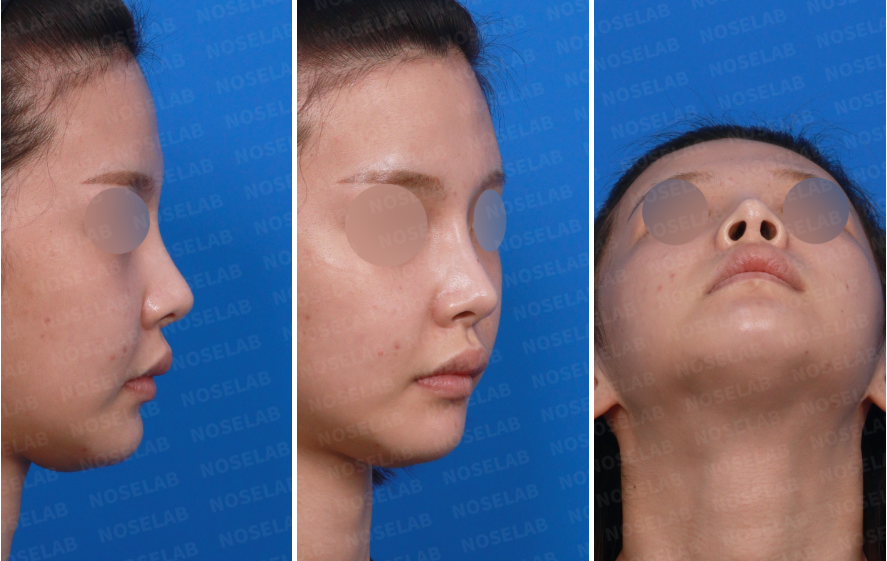
Surgical Plan for Structural and Aesthetic Refinement
Rib Cartilage Tip Correction for an Upturned Nasal Tip
To correct the excessively upturned nasal tip, autologous rib cartilage was used to provide stable and controlled support. Rib cartilage allows precise adjustment of tip rotation and projection, making it particularly effective in revision cases where long-term stability is required.
This step was crucial in achieving a more mature, refined nasal profile while avoiding overcorrection that could result in a drooping appearance.
Alar Cartilage Refinement for Natural Tip Definition
The alar cartilages were carefully sutured and trimmed to refine the nasal tip contour. Proper alar cartilage balance is essential for smooth transitions and a natural tip shape, especially when combined with rib cartilage support.
Columella and Nostril Asymmetry Correction
The columella, which was deviated to the left, was repositioned to the midline. Nostril asymmetry was corrected through precise adjustment of cartilage and soft tissue, significantly improving frontal view aesthetics.
Lowering the High Radix and Refining the Dorsal Line
The excessively high radix was surgically lowered to a more anatomically appropriate position. The previous implant was removed and replaced with a custom-carved silicone implant, designed to match the patient’s nasal bone structure and create a smooth, natural dorsal line.
Postoperative Results of High Radix Rhinoplasty Korea
Following surgery, the nasal starting point was lowered to a natural level, eliminating the artificial appearance caused by the high radix.The upturned nasal tip was corrected using rib cartilage, resulting in improved projection and a more balanced relationship with the lips and chin.
Columellar deviation and nostril asymmetry were resolved, and the nasal dorsum showed a smooth, refined contour.Overall, High Radix Rhinoplasty Korea in this case achieved facial harmony with a sophisticated yet natural appearance.


Surgeon’s Commentary on High Radix Rhinoplasty Korea
High radix correction is one of the most delicate aspects of revision rhinoplasty. An excessively high nasal starting point often creates an unnatural and rigid impression, particularly in Asian facial anatomy. Lowering the radix must be performed conservatively to preserve softness and proportion.
Similarly, correcting an upturned nasal tip requires precise control. Over-lowering can age the face, while insufficient correction leaves the nose appearing immature. Rib cartilage provides the structural reliability needed to fine-tune these adjustments with long-term stability.
In High Radix Rhinoplasty Korea, attention to symmetry—especially of the columella and nostrils—is critical. Even subtle asymmetries can be visually prominent. Addressing these details ensures refined, balanced, and natural results.
At NoseLab Plastic Surgery Clinic, we approach revision rhinoplasty with an emphasis on structural integrity, facial balance, and outcomes tailored to each patient’s unique anatomy.

Read the author’s background and the original case context. About these articles


