Case at a glance
- Concerns & goals
These details are excerpts from the original article and captions. Follow a detail to read it in context.
This case reviews high radix correction rhinoplasty in a patient with an excessively high nasal bridge starting point, droopy nasal tip, nasal deviation, nostril asymmetry, weak septal support, and left-sided airway narrowing after previous rhinoplasty procedures. Reconstruction focused on radix adjustment, nasal tip support, alar cartilage repair, scar adhesion release, and functional airway correction.
Author: Dr. Cha-Young Kang
Clinic: NoseLab Clinic
Published: 2024
Last Updated: 2026
Introduction
Hello, this is Dr. Cha-Young Kang of NoseLab Clinic.
This case involves high radix correction rhinoplasty in a patient who presented with an excessively high nasal bridge starting point, droopy and under-projected nasal tip, nasal deviation, nostril asymmetry, and left-sided airway narrowing after previous nasal surgeries.
The surgery was performed using a closed rhinoplasty / endonasal approach with autologous rib cartilage reconstruction. The goal was to lower the nasal starting point, rebuild nasal tip support, improve structural balance, and address functional airway narrowing.
Case Background
The patient had undergone two previous rhinoplasty procedures and nostril reduction surgery. After these surgeries, the nasal structure showed limitations related to support, symmetry, scar tissue, and internal airway balance.
The main concern was not only the high nasal bridge starting point. The nasal tip was droopy and under-supported, the nostril base was asymmetrical, and the left nasal airway was narrowed.
Key Concerns
The key concerns included:
Excessively high nasal bridge starting point
Nasal deviation
Droopy and under-projected nasal tip
Nostril asymmetry after previous alar reduction
Depressed alar cartilage region
Functional airway narrowing on the left side
Weak septal support
This case required structural reconstruction rather than simple bridge lowering because the nasal tip, septum, alar cartilage, nostrils, and airway were all involved.
Preoperative Design and Structural Assessment
Preoperative design consultation photos were reviewed from the frontal, side profile, oblique, and nostril views.
Frontal View
The frontal view showed nasal deviation, asymmetry, and imbalance between the nasal bridge and lower nasal structure.

Side Profile View
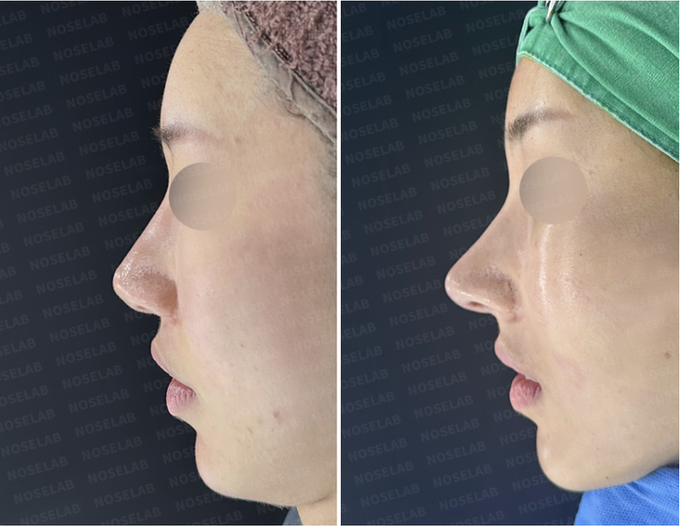
The side profile showed an excessively high radix, a droopy nasal tip, and poor balance between the bridge and tip. The nasal starting point appeared too high compared with the overall facial profile.

Nostril View
The nostril view showed asymmetry related to previous nostril reduction and depressed alar cartilage support. The left nasal airway appeared narrowed.

These findings confirmed that the surgery needed to address both external structure and internal airway function.
Surgical Background – High Radix Correction and Tip Reconstruction
In high radix cases, simply lowering the bridge is usually not enough. The relationship between the nasal starting point, dorsum, nasal tip, and columella must be balanced.
In revision cases, scar tissue, cartilage weakness, and previous implant placement can make the correction more complex. A closed rhinoplasty Korea approach was selected to allow internal reconstruction without adding an external columellar incision.
Structural Problems Identified
Preoperative analysis revealed multiple structural and functional problems.
Main Structural Findings
The main findings included:
Excessively high radix creating an imbalanced profile
Droopy and under-supported nasal tip
Nasal deviation
Nostril asymmetry after previous surgery
Depressed alar cartilage region
Weak septal support
Left-sided airway constriction
Severe scar adhesion from previous procedures
These findings required both structural reconstruction and functional correction.
Surgical Plan
Septal Reconstruction with Rib Cartilage
Autologous rib cartilage was used to reinforce weakened septal support. This provided a stronger central framework for tip support and airway stability.
Nasal Tip Reconstruction
A septal extension graft was used to elevate and stabilize the droopy nasal tip. This helped improve tip projection and balance between the bridge and tip.
High Radix Correction
The excessively high nasal starting point was corrected through implant repositioning and reshaping. The goal was to create a more balanced relationship between the upper nasal bridge and the rest of the nose.
Alar Cartilage Reconstruction
The depressed alar cartilage region was reconstructed, with attention to the right alar cartilage and nasal base balance. This helped improve nostril support and lower nasal stability.
Adhesion Release
Severe scar adhesions were released to restore soft tissue mobility. This step was important because scar tissue from previous procedures can restrict nasal movement and distort shape.
Functional Airway Correction
Septal deviation correction and turbinate reduction were performed to improve airflow. Functional correction was especially important because the patient had left-sided airway narrowing.
Surgical Results
Frontal View
From the frontal view, the nasal starting point appeared lower, symmetry improved, and the nasal contour became more balanced after reconstruction.

Side Profile View
From the side profile, the relationship between the bridge and tip appeared more balanced. Tip projection improved, and the nasolabial angle appeared more natural after structural support was rebuilt.

Oblique View
The oblique view showed a smoother dorsal line and reduced contour irregularity. Overall nasal balance improved after high radix correction and tip reconstruction.

Nasal Base View
From the nasal base view, nostril symmetry improved within the limitations created by previous alar reduction. The left airway opening also appeared improved after internal correction.

Functional Outcome
Airflow improved after septal correction, turbinate reduction, and structural stabilization. The reconstructed framework provided more stable internal support for breathing.
Surgeon’s Commentary
Correction of a high radix requires careful structural planning. If the nasal bridge is lowered without addressing tip support, the nose may still look imbalanced.
In this case, the high nasal starting point was only one part of the problem. The patient also had a droopy and under-supported tip, weak septal support, alar cartilage depression, nostril asymmetry, scar adhesions, and left-sided airway narrowing.
Autologous rib cartilage was used to rebuild the septal support and stabilize the nasal tip. This was necessary because native support was insufficient after previous surgeries.
Previous nostril reduction created some limitation in correcting nostril symmetry. In revision cases, complete symmetry may not be possible, so the goal is to improve balance and function within the available tissue condition.
This case shows that high radix correction rhinoplasty should be planned as a combined structural and functional reconstruction, especially when previous surgeries have weakened nasal support.
FAQ
What causes a high nasal bridge starting point after rhinoplasty?
A high nasal bridge starting point can occur when an implant is placed too high or when the upper nasal bridge is over-augmented. In revision cases, scar tissue and previous implant position can also affect the radix contour.
Can high radix correction be done without replacing the implant?
In some cases, implant adjustment may be enough, but many revision cases require implant repositioning, reshaping, or replacement. The decision depends on the implant position, nasal contour, and tissue condition.
Why is rib cartilage used in high radix correction rhinoplasty?
Rib cartilage may be used when septal support is weak or native cartilage is insufficient. It can provide stronger support for septal reconstruction, nasal tip stabilization, and functional airway correction.
Can breathing improve after high radix and tip reconstruction?
Breathing can improve when septal deviation, turbinate enlargement, or airway narrowing is corrected during surgery. Functional improvement depends on the patient’s internal nasal anatomy and airway findings.
International Consultation
For international patients, a photo-based consultation may help clarify whether high radix correction, nasal tip reconstruction, rib cartilage support, or functional airway correction may be needed.

Read the author’s background and the original case context. About these articles
Source updated .