Case at a glance
- Concerns & goals
- Previous treatment
- Surgical plan
- Graft & material details
- Photo timing
These details are excerpts from the original article and captions. Follow a detail to read it in context.
This case reviews long flat nose rhinoplasty in a patient with a long-looking and flat nasal appearance, excessive nostril exposure, nostril asymmetry, leftward nasal deviation, high glabella starting point, sagging columella, bumpy nasal bridge, flat dorsum, long philtrum impression, protruding mouth impression, and small nasolabial angle. Surgery focused on autologous rib cartilage septal extension, nostril asymmetry correction, columella alignment, silicone implant replacement, alar cartilage adjustment, nasolabial angle correction, glabella starting point adjustment, and closed rhinoplasty structural correction.
Author: Dr. Cha-Young Kang
Clinic: NoseLab Clinic
Published: 2024
Last Updated: 2026
Introduction
Hello, this is Dr. Cha-Young Kang of NoseLab Clinic.
This case involves long flat nose rhinoplasty in a patient who was concerned about a long-looking and flat nasal appearance after previous rhinoplasty procedures.
The patient wanted the nose to appear shorter while reducing visible nostril exposure and improving nostril asymmetry.
Because the patient strongly preferred not to make the nose look longer, the surgical plan needed to balance nostril correction, tip support, glabella starting point, nasolabial angle, and facial proportions.
The surgery was performed using a closed rhinoplasty / endonasal approach. The goal was to improve the long and flat nasal appearance, reduce excessive nostril show, correct nostril asymmetry, support the columella, replace the implant, and improve overall profile balance.
Surgical History Before Long Flat Nose Rhinoplasty
The patient had undergone two previous rhinoplasty procedures.
Previous Surgical History
The surgical history included:
2 years earlier: septoplasty, auricular cartilage graft, and silicone implant
6 months earlier: silicone implant replacement
Because this was a revision case, the surgical plan needed to consider scar tissue, implant history, septal support, cartilage condition, and the patient’s strong preference regarding nasal length.

Preoperative Findings for Long Flat Nose Rhinoplasty
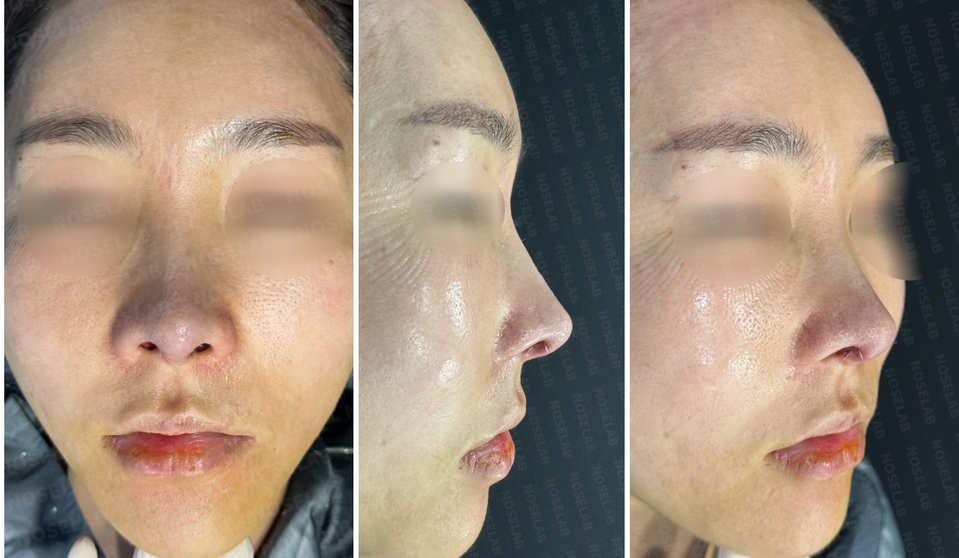
Preoperative design consultation photos were reviewed from the frontal, oblique, side, and nostril views.
Frontal View: Nostril Exposure and Nasal Deviation
From the frontal view, the nostrils appeared excessively exposed and asymmetric.
The nasal axis was deviated toward the left, and the lower nasal structure appeared imbalanced.
These findings suggested that nostril correction and columella alignment needed to be addressed together.
Side View: High Glabella Starting Point and Flat Dorsum
From the side view, the glabella starting point appeared high.
The dorsum appeared relatively flat, and the nasal bridge had a bumpy contour.
The columella appeared sagging, and the nasolabial angle was small, below 90 degrees.
Profile Balance: Long Philtrum and Protruding Mouth Impression
The flat dorsum, small nasolabial angle, and columella position contributed to a long philtrum impression and protruding mouth appearance.
For this reason, the side profile was evaluated together with the nose-lip relationship rather than nasal height alone.
Nostril View: Nostril Asymmetry and Columella Imbalance
From the nostril view, nostril asymmetry was present.
Because nostril shape is influenced by septal support, columella position, alar cartilage balance, previous surgery, and scar tissue, nostril correction was planned within the patient’s anatomical limits.

Patient Goals for Long Flat Nose Rhinoplasty
The patient wanted the nose to appear shorter and more balanced while improving nostril exposure and asymmetry.
Main Goals
The main goals included:
Reduce visible nostril exposure
Improve nostril asymmetry
Improve leftward nasal deviation
Make the nose appear shorter
Avoid unnecessary lengthening of the nose
Improve the flat dorsal line
Improve nasolabial angle balance
Reduce the protruding mouth impression
Because visible nostril exposure is often addressed by lengthening or supporting the nasal tip, this case required careful adjustment to respect the patient’s preference for a shorter-looking nose.
Surgical Plan for Long Flat Nose Rhinoplasty
Rib Cartilage Septal Extension for Nostril Asymmetry Correction
Autologous rib cartilage was used for septal extension and structural support.
This helped support the nasal tip, improve columella alignment, and address nostril asymmetry.
The degree of extension was planned carefully because the patient wanted to avoid an overly lengthened nasal appearance.
Silicone Implant Replacement for Dorsal Line Refinement
The previous silicone implant was removed.
A new silicone implant was placed only where needed to refine the nasal bridge and improve the dorsal line.
The goal was to avoid unnecessary height or length while improving definition.
Nasolabial Angle and Nostril Symmetry Correction
The alar cartilages were adjusted and sutured to improve nostril balance and support the lower nasal framework.
The columella position was refined together with the nasolabial angle to improve the relationship between the nose and upper lip.
Glabella Starting Point Adjustment
The glabella starting point was adjusted to help the nose appear visually shorter.
This step was important because a high starting point can make the nose look longer, especially from the side view.
The adjustment was planned to improve facial proportion without unnecessary lengthening.
Surgical Results After Long Flat Nose Rhinoplasty

Frontal View: Nostril Asymmetry and Nasal Alignment
From the frontal view, nostril asymmetry appeared improved after septal extension, alar cartilage adjustment, and columella alignment.
The nasal axis appeared more balanced after structural correction.
The glabella starting point adjustment helped reduce the long-looking nasal impression.

Oblique View: Nasal Length and Nostril Exposure
From the oblique view, the nasal length appeared more balanced after adjusting the glabella starting point and lower nasal support.
Visible nostril exposure appeared reduced, and the dorsal line appeared smoother.

Side View: Dorsal Line and Nasolabial Angle
From the side view, the flat dorsum appeared more defined after implant replacement.
The nasolabial angle appeared more balanced after columella and lower nasal framework correction.
The long philtrum and protruding mouth impressions appeared softer in relation to the revised nasal profile.

Nostril View: Columella and Nostril Balance
From the nostril view, nostril asymmetry appeared improved after septal support and alar cartilage adjustment.
The columella appeared straighter in relation to the lower nasal framework.
Because nostril shape can be affected by scar tissue, previous surgery, cartilage condition, and healing response, the result should be evaluated over time.
Surgeon’s Commentary
This long flat nose rhinoplasty case required balancing the patient’s request with surgical principles.
When nostril exposure is visible, one common approach is to support or lengthen the nasal tip. However, this patient was concerned about a long-looking nose and strongly preferred not to make the nose appear longer.
For this reason, the plan focused on improving nostril asymmetry, columella alignment, and nasal proportion while avoiding unnecessary lengthening.
Lowering the visual impression of the glabella starting point helped make the nose appear shorter, while rib cartilage septal extension provided structural support for the lower nasal framework.
The silicone implant was replaced to refine the flat dorsal line, and the nasolabial angle was adjusted to improve the relationship between the nose, philtrum, and upper lip.
This case shows that long flat nose rhinoplasty may require combined correction of glabella starting point, nasal bridge contour, tip support, nostril exposure, columella alignment, nasolabial angle, and facial balance.
FAQ
What is long flat nose rhinoplasty?
Long flat nose rhinoplasty addresses a nasal appearance that looks flat in height but long in proportion. The surgical plan may involve dorsal line refinement, tip support, nostril correction, glabella starting point adjustment, and nasolabial angle correction.
Can nostril exposure be reduced without making the nose look longer?
In some cases, nostril exposure may be addressed through tip support, columella alignment, alar cartilage adjustment, and proportional planning. However, the degree of change depends on anatomy, scar tissue, and healing response.
Why was rib cartilage used in this case?
Rib cartilage may be used when stronger structural support is needed for septal extension, tip support, or nostril asymmetry correction, especially in revision rhinoplasty.
Why was the glabella starting point adjusted?
A high glabella starting point can make the nose appear longer. Adjusting the visual starting point may help improve nasal proportion and create a shorter-looking nasal impression.
Can this surgery be performed with a closed approach?
A closed rhinoplasty / endonasal approach may be used depending on previous surgery history, scar tissue, implant condition, cartilage availability, nasal structure, and surgical goals.
International Consultation
For international patients, a photo-based consultation may help clarify whether long flat nose rhinoplasty, rib cartilage septal extension, implant replacement, nostril asymmetry correction, nasolabial angle adjustment, or closed rhinoplasty structural correction may be needed.

Read the author’s background and the original case context. About these articles


