Case at a glance
- Concerns & goals
- Previous treatment
- Surgical plan
- Graft & material details
- Photo timing
These details are excerpts from the original article and captions. Follow a detail to read it in context.
This case reviews short upturned nose revision rhinoplasty in a patient with a long history of multiple facial and nasal surgeries, including repeated silicone implant and auricular cartilage rhinoplasty, orthognathic surgery, rib cartilage rhinoplasty, and philtrum reduction. The patient presented with a short and upturned nasal tip, excessive nostril show, weakened structural support, limited remaining septal cartilage, and functional breathing concerns. Surgery focused on autologous rib cartilage septal reconstruction, intranasal mucosal advancement flap repair, silicone implant refinement, septoplasty, turbinate surgery, and closed rhinoplasty structural correction.
Author: Dr. Cha-Young Kang
Clinic: NoseLab Clinic
Published: 2026
Last Updated: 2026
Introduction
Hello, this is Dr. Cha-Young Kang of NoseLab Clinic.
This case involves short upturned nose revision rhinoplasty in a patient who had undergone multiple previous nasal surgeries over many years.
The patient was concerned about a short and upturned nasal tip, excessive nostril show from the frontal view, and an imbalanced columella position.
Because the patient had undergone several prior revisions, the remaining structural support and internal tissue condition were already weakened.
The surgery was performed using a closed rhinoplasty / endonasal approach. The goal was to lengthen and support the nasal tip, reduce nostril show, reconstruct the septal support with rib cartilage, improve columella position, refine the dorsal line, and address functional breathing concerns.
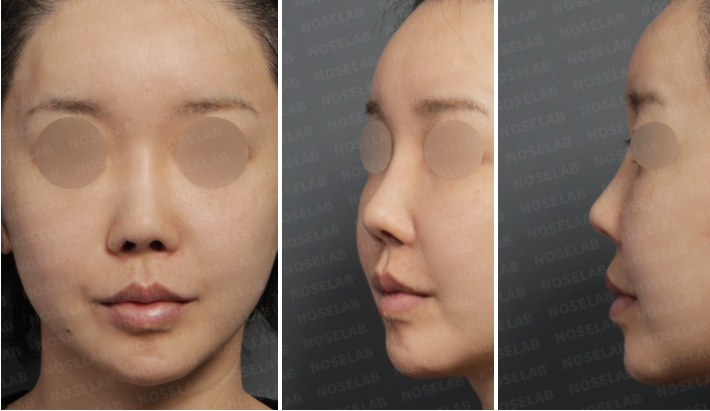
Surgical History Before Short Upturned Nose Revision Rhinoplasty
The patient had a long history of facial and nasal surgery.
Previous Procedures
The previous surgical history included:
About 17 years ago: rhinoplasty using a silicone implant and auricular cartilage, followed by implant shifting and deviation
About 15 years ago: revision rhinoplasty using silicone and auricular cartilage, followed by progressive tip lowering
About 12 years ago: rhinoplasty using silicone and auricular cartilage, with insufficient tip height
About 12 years ago: orthognathic surgery
About 10 years ago: silicone implant-only surgery, followed by implant movement
About 3 years ago: rhinoplasty using autologous rib cartilage and silicone
Recently: philtrum reduction at another clinic
This surgical history suggested significant structural depletion and repeated changes to the nasal framework.
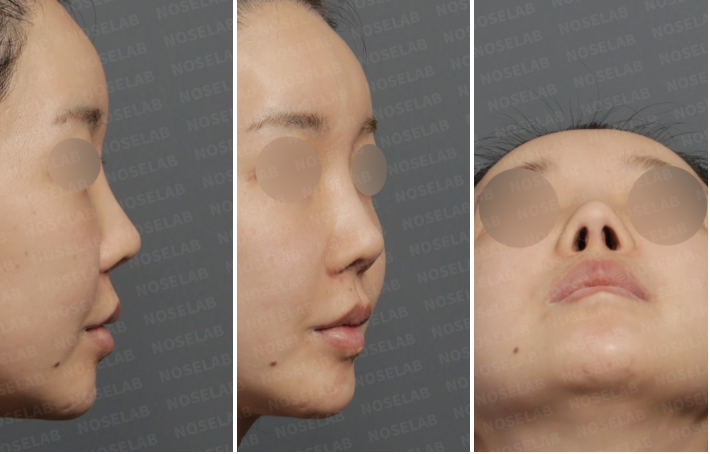
Patient Goals
The patient wanted a safe and natural correction despite the weakened tissue condition caused by multiple prior surgeries.
Main Goals
The goals included:
Lower the upturned nasal tip in a natural way
Reduce excessive nostril show from the frontal view
Lower and improve the columella position
Create a more balanced and natural nasal line
Achieve a stable result despite weakened tissue condition
Preoperative Assessment
The short and upturned appearance was mainly related to severe loss of septal support after multiple previous surgeries.
Because little usable septal cartilage remained, the nasal tip had become short, under-supported, and rotated upward.
The internal soft tissue was also insufficient, which made safe tip lengthening more complex.
In revision cases like this, both structural support and internal lining must be evaluated together before planning correction.
Surgical Plan
1. Septal Reconstruction Using Autologous Rib Cartilage
Because the septal cartilage had been severely depleted by previous surgeries, autologous rib cartilage was used to reconstruct the septal support.
This was the key step in restoring central support, improving tip stability, and allowing the short, upturned tip to be safely lowered.
2. Left Intranasal Mucosal Advancement Flap
A left intranasal mucosal advancement flap was performed to supplement the deficient internal lining.
This helped provide additional internal soft tissue coverage and supported the structural correction of the shortened nose.
3. Silicone Implant Refinement
The dorsal implant was carefully adjusted according to the patient’s nasal bone contour.
Refining the implant shape helped create a smoother and more natural dorsal line while maintaining harmony with the reconstructed tip.
4. Functional Surgery
Septoplasty and turbinate surgery were performed to address breathing concerns.
Functional improvement depends on septal alignment, turbinate condition, mucosal swelling, internal anatomy, and healing response.
Surgical Results
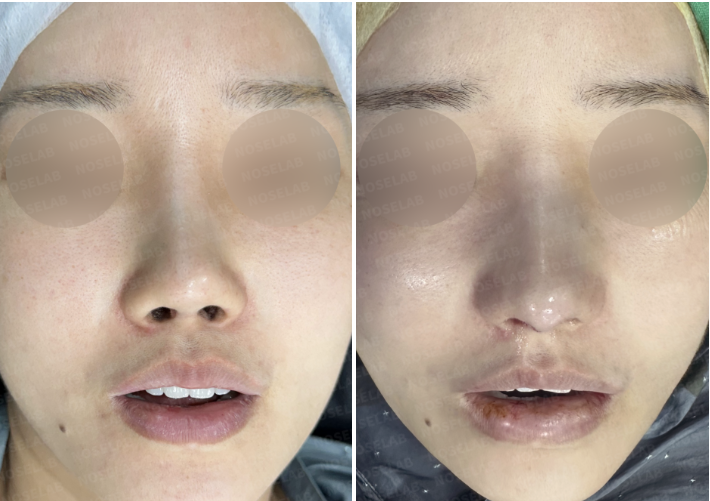
Frontal View
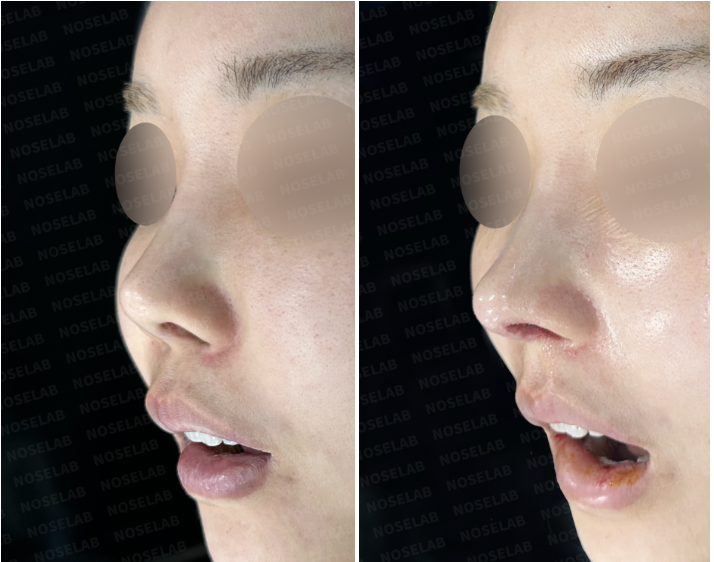
From the frontal view, the upturned nasal tip appeared lower and more balanced after structural reconstruction.
Excessive nostril show was reduced, and the overall lower nasal shape appeared more stable.
Side View
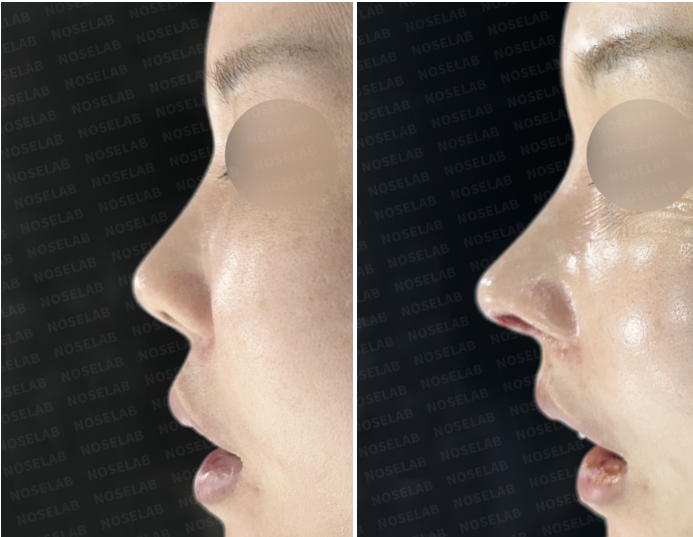
From the side view, the short nose appeared more balanced in length after septal reconstruction.
The tip height and projection were adjusted to a more appropriate range, and the columella position appeared lower and softer in profile.
Overall Impression
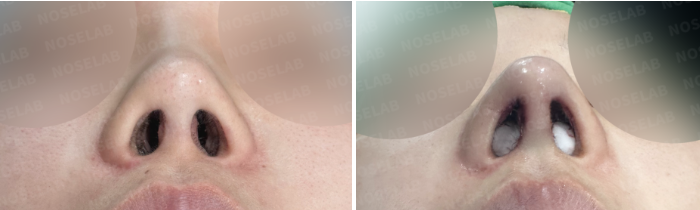
The dorsal line appeared more stable after implant refinement based on the patient’s nasal bone shape.
Breathing concerns were addressed through septoplasty and turbinate surgery, and functional improvement should be evaluated over time as swelling resolves and healing progresses.
Surgeon’s Commentary
In patients who have undergone multiple revision surgeries, the available cartilage and soft tissue are often very limited.
When the septal cartilage has been severely damaged or nearly exhausted, the nasal tip may gradually become short and upturned because the central support structure is no longer sufficient.
In this case, autologous rib cartilage was used to reconstruct the septum and restore stable support for the tip.
Because the internal lining was also insufficient, an intranasal mucosal advancement flap was performed to supplement the missing tissue and support safe correction of the shortened nose.
The dorsal implant was also carefully refined according to the nasal bone contour, and functional surgery was performed at the same time to address breathing concerns.
This case shows that revision rhinoplasty for a short and upturned nose may require combined correction of septal support, internal lining deficiency, tip position, dorsal balance, and airway structure.
FAQ
Why does the nose become short and upturned after multiple surgeries?
A short and upturned nose may develop when the septal cartilage and central support have been weakened or depleted after repeated surgery. Scar tissue and internal lining deficiency can also contribute.
Why is rib cartilage used in this case?
Rib cartilage may be used when stronger and larger structural support is needed, especially in revision cases where the septal cartilage is no longer sufficient.
What is a mucosal advancement flap?
A mucosal advancement flap is a technique used to supplement deficient internal nasal lining by advancing nearby mucosal tissue. It may be helpful in complex revision cases with tissue shortage.
Can nostril show be reduced in revision rhinoplasty?
Yes, nostril show may be reduced when the nasal tip is lowered and structural support is restored. The degree of change depends on anatomy, scar tissue, and internal tissue condition.
Can breathing improve after this type of surgery?
Breathing may improve when septal deviation, turbinate-related narrowing, or structural airway problems are corrected. The degree of improvement depends on airway anatomy, mucosal condition, swelling, and healing.
International Consultation
For international patients, a photo-based consultation may help clarify whether short upturned nose revision rhinoplasty, rib cartilage septal reconstruction, mucosal flap repair, implant refinement, septoplasty, or turbinate surgery may be needed.
Medical Disclosure
Surgical before-and-after photos show individual patient cases, and results may vary depending on each patient’s anatomy, previous surgical history, skin thickness, scar tissue, cartilage availability, internal lining condition, airway structure, and healing process. Please consult your doctor for an individualized assessment.
After surgery, complications may occur, including infection, bleeding, allergic reaction, asymmetry, limited aesthetic or functional improvement, excessive scarring, skin problems, necrosis, graft visibility, cartilage warping, persistent nasal obstruction, recurrent tip rotation, contour irregularity, or other complications.
Read the author’s background and the original case context. About these articles


