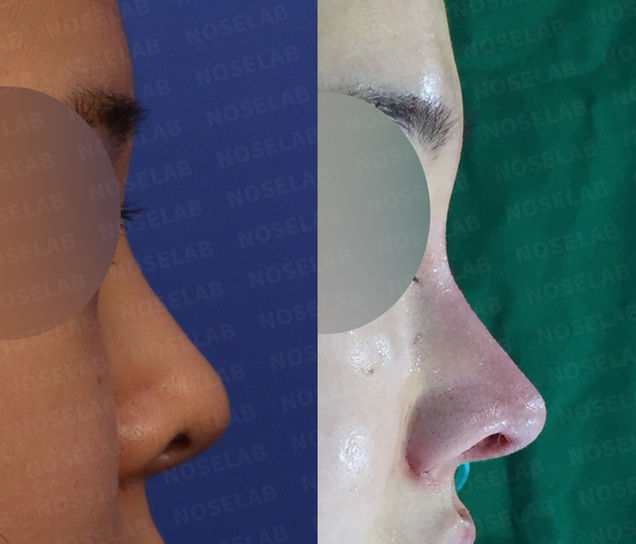
Closed Rhinoplasty Korea for Revision Deviated Nose and Structural Reconstruction
- Dr. Chayoung Kang
- 2025๋ 2์ 3์ผ
- 3๋ถ ๋ถ๋
์ต์ข ์์ ์ผ: 4์ผ ์
This case demonstrates closed rhinoplasty Korea for correcting a deviated nose and facial imbalance caused by a protruding mouth after previous surgery. Structural reconstruction using rib cartilage and septal extension restored nasal alignment, improved facial harmony, and ensured long-term stability.
โ Author / Published / Updated
Dr. Cha-Young Kang
NoseLab Clinic
Published: 2025
Last Updated: 2026
This patient presented for revision rhinoplasty after a previous silicone implant and septal cartilage graft procedure.
Over time, the patient developed nasal deviation, implant-related complications, and facial imbalance characterized by a protruding mouth and drooping nasal tip.
In this closed rhinoplasty Korea case, the goal was not only to correct the deviated nasal structure but also to restore facial balance through structural reconstruction.
Key concerns included:
Deviated nasal bridge
Implant translucency and instability
Bulbous and asymmetrical nasal tip
Pinched nasal tip on one side
Drooping nasal tip affecting profile
Protruding mouth due to unfavorable nasolabial angle
Functional discomfort including mucus retention
This case required removal of compromised materials and reconstruction of the nasal framework.
If you are experiencing similar issues after previous rhinoplasty, a structural evaluation is essential.
๐ฉ International Consultation

โ Surgical Background โ Closed Rhinoplasty Korea
Closed rhinoplasty Korea enables internal structural correction without external scars.
In revision rhinoplasty cases involving implant complications and structural instability, preserving soft tissue and rebuilding support structures is critical.
This approach allows precise correction of both functional and aesthetic issues while minimizing additional trauma.

โ Structural Problems Identified
Preoperative analysis revealed:
Nasal deviation caused by unstable structural support
Implant translucency indicating thin soft tissue coverage
Bulbous and asymmetrical nasal tip
Localized tip pinching due to uneven cartilage support
Drooping nasal tip
Imbalance in nasolabial angle contributing to protruding mouth appearance
Functional discomfort due to internal irregularities
These findings indicated the need for full structural reconstruction rather than simple reshaping.
โ Surgical Plan
1. Removal of Previous Implant and Damaged Tissue
Gore-Tex and compromised materials were safely removed to eliminate instability and inflammation risk.

2. Structural Reconstruction Using Rib Cartilage
Autologous rib cartilage was used to rebuild a stable nasal framework capable of long-term support.
3. Septal Extension Graft
A septal extension graft was created to stabilize the nasal tip and correct deviation.
4. Dorsal Line Realignment
The nasal bridge was straightened to restore symmetry and create a balanced dorsal aesthetic line.
5. Nasal Tip Refinement
The nasal tip was reshaped and reinforced to eliminate pinching and achieve a natural contour.
6. Nasolabial Angle Adjustment
The angle between the nose and upper lip was corrected to reduce the appearance of a protruding mouth and improve facial harmony.
โ Surgical Results
Frontal View
Nasal deviation corrected
Symmetrical nasal tip achieved
Improved structural balance

Lateral View
Drooping tip corrected
Nasolabial angle improved
Reduced protruding mouth appearance

Oblique View
Smooth nasal contour
Harmonized facial proportions

Functional Outcome
Improved internal nasal condition
Reduced discomfort
Stabilized nasal structure

โ Surgeonโs Commentary
Revision rhinoplasty requires a structural approach, especially when previous implants and cartilage grafts have compromised the nasal framework.
In this case, rib cartilage was essential for rebuilding stable support and preventing future deformation.
The relationship between the nose and upper lip is an important aspect of facial balance. Adjusting the nasolabial angle can significantly improve the perception of a protruding mouth without direct intervention on the lips.
Closed rhinoplasty Korea allows precise internal reconstruction while preserving soft tissue, which is critical in revision cases.
If you are considering revision rhinoplasty, structural analysis is key to achieving long-term stability and natural results.
๐ฉ International Consultation
โ FAQ
Q1. Why is rib cartilage used in revision rhinoplasty?
Rib cartilage provides strong structural support, especially when previous surgeries have weakened the nasal framework.
Q2. Can rhinoplasty improve a protruding mouth appearance?
Yes. Adjusting the nasolabial angle can improve facial balance and reduce the prominence of the upper lip.
Q3. Why remove Gore-Tex or implants in revision cases?
Artificial materials can cause complications such as translucency or instability, making removal necessary for long-term safety.
๐ฅ YouTube Reference
If youโre curious about Dr. Cha-Young Kangโs closed rhinoplasty approach, click to watch the video.
This case is for educational purposes and represents a clinical example.
Results may vary depending on individual anatomy and surgical history.
All procedures were performed by a qualified specialist.

Messenger(WhatsApp) : +82 1057360302
Home page : www.noselab.co.kr
Instagramย : noselab_global
YouTube : Noselab
Email : noselab@naver.com


๋๊ธ