Case at a glance
- Surgical plan
- Graft & material details
- Photo timing
These details are excerpts from the original article and captions. Follow a detail to read it in context.
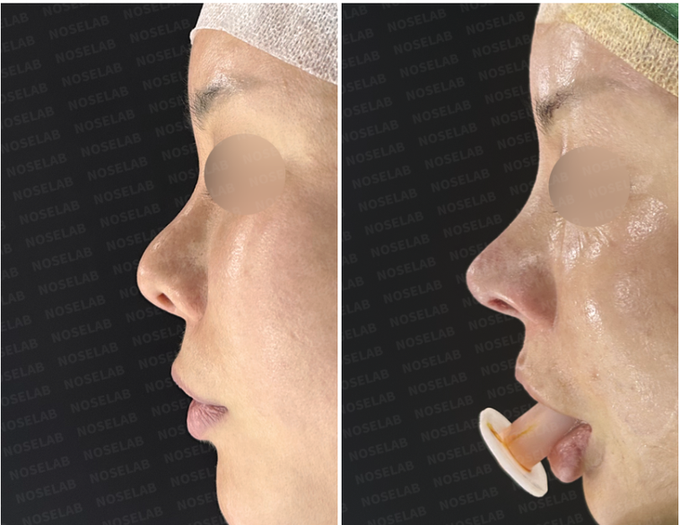
An upturned nasal tip combined with nostril asymmetry and columellar contracture often results from repeated surgeries and structural damage.
In this case, rib cartilage reconstruction, alar cartilage restoration, and dermofat grafting were performed to correct tip rotation, improve symmetry, and achieve a stable and natural nasal contour using a closed rhinoplasty approach.
Author: Dr. Cha-Young Kang, Director, NoseLab Clinic
✅ Case Background
This case involves a complex revision rhinoplasty patient presenting with a persistently upturned nasal tip, nostril asymmetry, and columellar contracture despite multiple prior surgeries.
The patient had undergone several procedures including implant augmentation, rib cartilage tip surgery, osteotomy, orthognathic surgery, and additional nasal revisions using ear cartilage, fascia grafts, and alar base repositioning.
Despite these interventions, the nasal tip remained over-rotated and sharp, and nostril asymmetry persisted, resulting in both aesthetic dissatisfaction and structural imbalance. Structural reconstruction in this case was performed using Closed Rhinoplasty Korea, focusing on restoring nasal tip support, correcting asymmetry, and achieving long-term stability.
If you are experiencing similar issues such as an upturned nasal tip, nostril asymmetry, or unsatisfactory results after multiple surgeries, a detailed structural evaluation is important.
📩 International Consultation

✅ Surgical Approach – Correction of Upturned Tip and Asymmetry Using Closed Rhinoplasty Korea
Revision cases with an upturned nasal tip and nostril asymmetry are typically associated with structural weakness, scar contracture, and improper tip positioning from previous surgeries.
For this reason, Closed Rhinoplasty Korea was selected to allow precise internal structural reconstruction while minimizing additional soft tissue damage. This approach enables controlled correction of tip rotation, reconstruction of nasal support structures, and restoration of symmetry without external incisions.

✅ Structural Problems Identified
Preoperative structural analysis revealed:
Over-rotated (upturned) nasal tip
Nostril asymmetry
Columellar contracture
Weak or damaged septal support
Distorted alar cartilages
Scar tissue from multiple prior surgeries
These issues required comprehensive reconstruction of both cartilage framework and soft tissue balance.
✅ Surgical Plan – Structural Reconstruction and Tip Correction
Septal Reconstruction with Rib Cartilage
Reconstruction of septal support using donor rib cartilage
Restoration of central nasal framework
Stabilization of nasal tip support
Alar Cartilage Reconstruction
Bilateral reconstruction of alar cartilages
Restoration of tip symmetry and support
Improvement of nasal base balance
Dermofat Graft for Soft Tissue Correction
Placement of dermofat composite graft to the soft triangle
Correction of localized asymmetry
Enhancement of soft tissue contour and volume
Tip De-rotation and Nasolabial Angle Adjustment
Correction of over-rotated nasal tip
Adjustment of tip projection and rotation
Creation of a natural side profile
Columellar Contracture Release
Release of contracted tissues
Repositioning of the columella
Improvement of nasal base alignment
✅ Surgical Results
Frontal View
Reduced nostril show
Improved nostril symmetry
Balanced nasal base

Lateral View
Correction of upturned nasal tip
Improved tip projection and rotation
Natural nasal profile line

Oblique (45°) View
Smooth nasal contour
Harmonized tip and bridge relationship

Overall Outcome
Stable structural support
Refined and natural nasal contour
Improved facial balance

✅ Surgeon’s Commentary – Managing Upturned Tip and Asymmetry in Revision Cases
This case highlights the complexity of revision rhinoplasty after multiple prior surgeries, where structural integrity is often significantly compromised.
When septal cartilage is severely damaged, donor rib cartilage provides a reliable solution for reconstructing the nasal framework. It offers sufficient strength and volume not only for septal reconstruction but also for supporting adjacent structures such as the alar cartilages.
Correction of nostril asymmetry often requires more than cartilage reconstruction alone. In this case, a dermofat composite graft to the soft triangle provided precise volumetric augmentation, allowing for improved contour and symmetry.
Additionally, releasing columellar contracture and controlling tip rotation were essential steps in restoring a natural nasal position and proportion.
Successful revision rhinoplasty depends on accurate structural analysis and reconstruction before aesthetic refinement.
A structural approach is essential to correct both deformity and asymmetry in complex revision cases.
✅ FAQ
Q1. Why does the nasal tip become upturned after multiple surgeries?
Weak structural support or excessive rotation during previous procedures can cause this issue.
Q2. What is the advantage of donor rib cartilage?
It provides strong and reliable structural support when native cartilage is insufficient.
Q3. Can nostril asymmetry be fully corrected?
Significant improvement is possible, but results depend on the degree of asymmetry and tissue condition.
✅ Mandatory Disclosure
This case is for educational purposes only.
Results may vary depending on individual anatomy and surgical history.
Read the author’s background and the original case context. About these articles