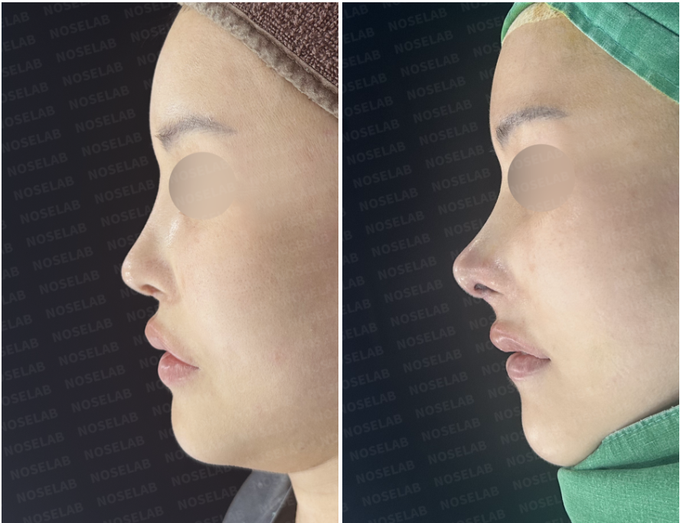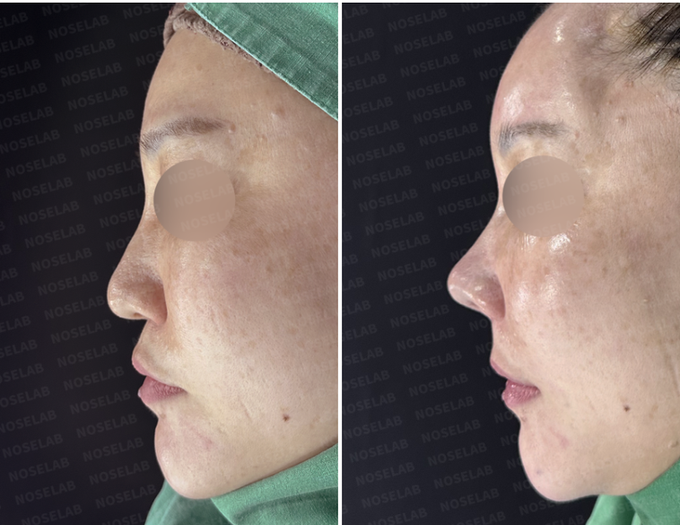
Case at a glance
- Concerns & goals
- Previous treatment
- Surgical plan
- Graft & material details
- Photo timing
These details are excerpts from the original article and captions. Follow a detail to read it in context.
This case reviews graft absorption revision rhinoplasty in a patient with previous donor rib cartilage and silicone implant surgery, followed by graft absorption, nasal tip shrinkage, shortened nasal length, drooping and over-rotated nasal tip, pinched nostrils, nostril asymmetry, dorsal scarring, and thin nasal skin. Surgery focused on autologous rib cartilage reconstruction, septal extension, bilateral alar cartilage reconstruction, scar smoothing, tip support, nostril correction, and dorsal contour refinement.
Author: Dr. Cha-Young Kang
Clinic: NoseLab Clinic
Published: 2025
Last Updated: 2026
Introduction
Hello, this is Dr. Cha-Young Kang of NoseLab Clinic.
This case involves graft absorption revision rhinoplasty in a patient who had previously undergone multiple nasal surgeries using donor rib cartilage and silicone implants.
Over time, graft absorption contributed to nasal tip shrinkage, shortened nasal length, drooping and over-rotated tip appearance, pinched nostrils, nostril asymmetry, dorsal scarring, and skin thinning.
The surgery was performed using a closed rhinoplasty / endonasal approach. The goal was to reconstruct the weakened nasal framework using autologous rib cartilage, improve nasal tip support, correct nostril asymmetry, and manage scar-related contour irregularity.
Surgical History and Key Problems
The patient had previous nasal surgeries involving grafted rib cartilage, silicone implant, auricular cartilage, and donor rib cartilage.
Previous Surgical History
The surgical history included:
Initial surgery using grafted rib cartilage, followed by inflammation
2018 surgery using silicone implant, auricular cartilage, and donor rib cartilage
After these procedures, the patient developed graft absorption and nasal tip weakening. The nasal tip became smaller and less supported, and the nostrils became pinched and asymmetric.
Main Problems
The main problems included:
Graft absorption and nasal tip shrinkage
Shortened nasal length
Drooping nasal tip
Over-rotated nasal tip appearance
Pinched nostrils
Nostril asymmetry
Dorsal scarring
Thin nasal skin
Irregular nasal contour
Because the case involved graft absorption and scar-related tissue changes, the revision plan needed to address both structural support and soft tissue contour.

Preoperative Design Consultation
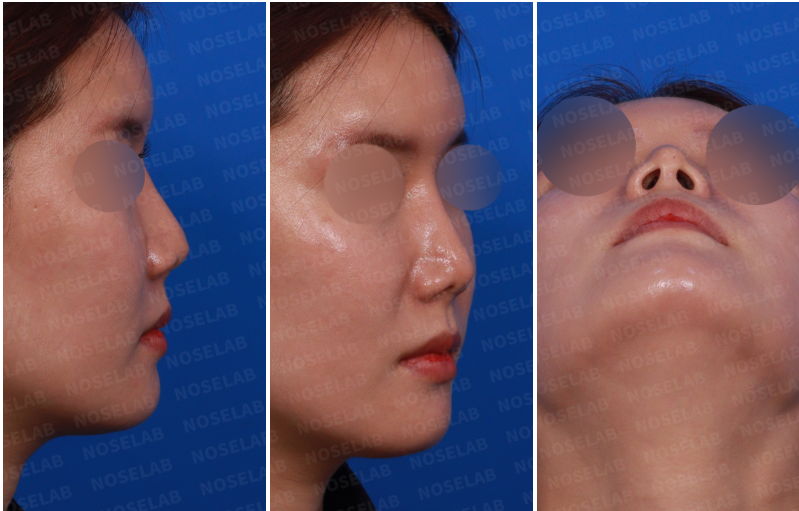
Preoperative design consultation photos were reviewed from the frontal, side, oblique, and nostril views.
Frontal View
The frontal view showed nostril asymmetry, pinched nostril shape, and imbalance of the lower nasal structure.
Side View
The side view showed shortened nasal length, drooping tip, over-rotated appearance, and dorsal contour irregularity.
Oblique View
The oblique view showed dorsal scarring, skin thinning, and irregular transition between the nasal bridge and tip.
Nostril View
The nostril view showed pinched and asymmetric nostrils, suggesting lower nasal support weakness and scar-related contraction.
These findings confirmed that the surgery needed to include nasal tip reconstruction, alar cartilage repair, scar smoothing, and nostril correction.
Patient Goals
The patient wanted correction of deformities caused by graft absorption and previous surgery.
Main Goals
The main goals included:
Improve deformities related to graft absorption
Restore nasal length and projection within tissue limits
Improve nostril symmetry
Reduce scar-related irregularity
Improve pinched nostril appearance
Rebuild nasal tip support
Improve dorsal contour
The surgical plan focused on structural reconstruction first, followed by contour refinement and scar-related soft tissue correction.
Surgical Plan and Reconstruction Techniques
The surgery combined rib cartilage support, septal extension, alar cartilage reconstruction, scar smoothing, and dorsal contour correction.
Rib Cartilage Septal Extension Graft
Autologous rib cartilage was used for septal extension to support and reposition the nasal tip.
This step was important because the previous graft absorption had weakened nasal tip projection and support.
Bilateral Alar Cartilage Reconstruction
Both alar cartilages were reconstructed to improve pinched nostrils and nostril asymmetry.
Alar cartilage reconstruction was necessary because the lower nasal structure had become contracted and poorly supported.
Correction of Over-Rotation and Columellar Angle
The over-rotated nasal tip and columellar angle were corrected by adjusting tip support and lower nasal framework alignment.
This helped improve the relationship between the nasal tip, columella, and upper lip.
Scar Smoothing with Dermal and Cartilage Grafts
Dermal and cartilage grafts were used to improve dorsal scarring and skin irregularity.
The goal was to reinforce thin skin and soften visible contour irregularities caused by previous surgery and graft absorption.
Tip Projection and Dorsal Contour Correction
Nasal tip projection was improved using autologous rib cartilage support. The dorsal contour was also refined to create a smoother transition between the bridge and nasal tip.
Because this was a multiple revision case, the correction was planned according to the patient’s skin condition, scar tissue, and remaining tissue flexibility.
Surgical Outcome
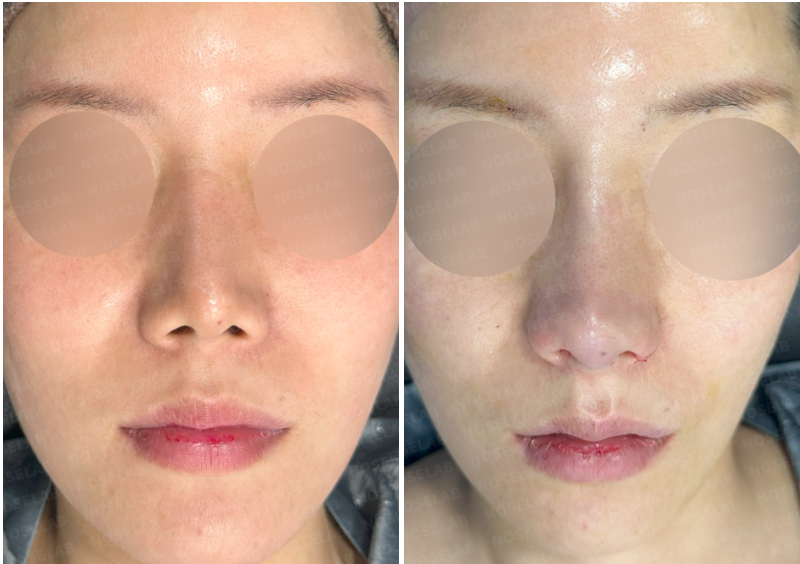
Frontal View
From the frontal view, alar symmetry improved, and the nostril lines appeared softer after alar cartilage reconstruction and tip support correction.
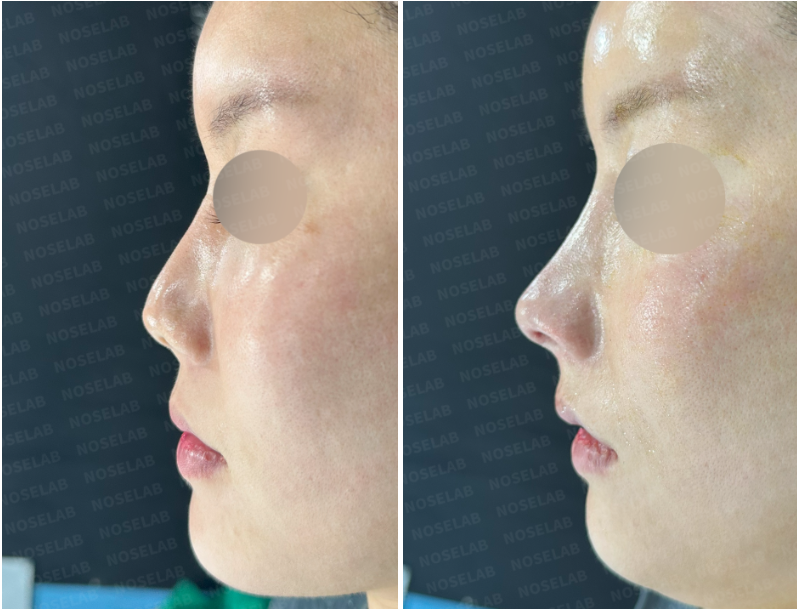
Side View
From the side view, nasal length and tip support improved after rib cartilage septal extension and nasal tip reconstruction.

Nostril View
From the nostril view, nostril shape became more balanced, and excessive nostril exposure was reduced after lower nasal framework reconstruction.
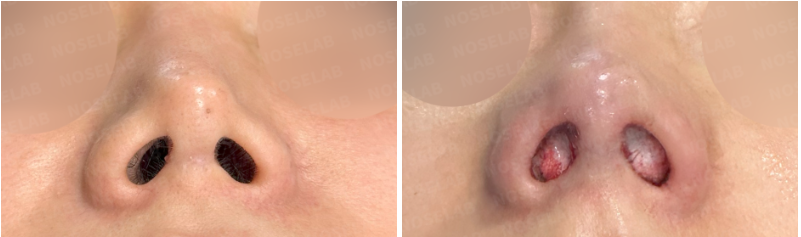
Overall Structural Outcome
The nasal framework was reconstructed using autologous rib cartilage. The nasal tip, alar cartilage, and dorsal contour were corrected together to improve support and balance.
Because this case involved graft absorption, inflammation history, scarring, and thin skin, the outcome was planned within the limits of the patient’s tissue condition and previous surgical changes.
Surgeon’s Commentary

This patient had chronic issues after previous nasal surgeries, especially graft absorption and nasal scarring. Donor cartilage absorption can reduce tip support and contribute to nasal tip shrinkage, shortened nasal length, and nostril distortion.
In this case, autologous rib cartilage was used to reconstruct the nasal framework. This provided structural support for septal extension, tip projection, and alar cartilage reconstruction.
The pinched and asymmetric nostrils required bilateral alar cartilage reconstruction. This step was important for improving nasal base balance and reducing the contracted appearance.
Dorsal scarring and thin skin were addressed with dermal and cartilage grafts to improve soft tissue coverage and smooth visible irregularity.
This case shows that graft absorption revision rhinoplasty should be planned as a combined structural and soft tissue reconstruction procedure. The nasal tip, nostrils, dorsal scar, skin thickness, and previous graft absorption all need to be evaluated together.
FAQ
What is graft absorption after rhinoplasty?
Graft absorption means that previously placed graft material becomes partially reduced or loses volume over time. This can affect nasal tip support, projection, contour, and symmetry.
Can donor rib cartilage absorption cause nasal tip collapse?
Donor rib cartilage absorption may contribute to reduced support, tip shrinkage, or contour changes in some patients. The degree of change depends on graft material, tissue reaction, surgical history, and healing.
Why is autologous rib cartilage used in revision rhinoplasty?
Autologous rib cartilage may be used when stronger support is needed for septal extension, tip reconstruction, or alar cartilage repair. It can be useful in complex revision cases with weakened support.
How can nasal scarring and skin irregularity be improved?
Scar-related irregularity may be improved with careful soft tissue management, dermal grafting, cartilage grafting, or contour smoothing. The plan depends on scar depth, skin thickness, and tissue condition.
Can nostril asymmetry improve after graft absorption revision rhinoplasty?
Nostril asymmetry can improve when nasal tip support, alar cartilage structure, columella position, and nasal base balance are corrected together. The degree of improvement depends on scar tissue and previous surgical changes.
International Consultation
For international patients, a photo-based consultation may help clarify whether graft absorption revision rhinoplasty, rib cartilage reconstruction, nasal scar revision, alar cartilage repair, or nostril correction may be needed.
Read the author’s background and the original case context. About these articles