Case at a glance
- Concerns & goals
- Previous treatment
- Surgical plan
- Graft & material details
- Photo timing
These details are excerpts from the original article and captions. Follow a detail to read it in context.
This case reviews nostril exposure correction rhinoplasty in a patient with an upturned nasal tip, excessive nostril show, high radix, columella deviation, nostril asymmetry, and residual foreign material from a previous non-medical filler injection. Surgery focused on foreign material removal, nasal tip reconstruction with autologous rib cartilage, nostril exposure reduction, radix lowering, nasolabial angle correction, and columella realignment.
Author: Dr. Cha-Young Kang
Clinic: NoseLab Clinic
Published: 2025
Last Updated: 2026
Introduction
Hello, this is Dr. Cha-Young Kang of NoseLab Clinic.
This case involves nostril exposure correction rhinoplasty in a patient with an upturned nasal tip, excessive nostril exposure, high radix, and asymmetrical nostrils.
The patient had a history of non-medical nasal filler injection approximately 15 years earlier. Although a previous surgery had attempted filler removal, residual foreign material remained and contributed to ongoing contour and structural problems.
The surgery was performed using a closed rhinoplasty / endonasal approach. The goal was to remove residual foreign material, reconstruct the nasal tip with autologous rib cartilage, reduce nostril exposure, correct columella deviation, and improve nasal balance.
Patient Background and Surgical History
The patient had a long surgical history involving non-medical filler injection, filler removal attempt, silicone implant surgery, septal extension, and additional dorsal augmentation.
Previous Surgical History
The history included:
15 years ago: Non-medical nasal filler injection
Later in the same year: Rhinoplasty with silicone implant, septal extension, and filler removal attempt
Two weeks later: Additional dorsal augmentation with synthetic implant
Despite the previous filler removal attempt, residual foreign material remained inside the nose. This contributed to nasal shape distortion, upturned tip appearance, and nostril imbalance.
Because this case involved both residual foreign material and structural deformity, the revision plan required careful tissue evaluation and reconstruction.

Initial Presentation Before Revision Surgery
Preoperative design consultation photos were reviewed from the frontal, side, oblique, and nostril views.
Frontal View
The frontal view showed a prominent upturned nasal tip, excessive nostril exposure, and a flat, wide nasal contour.
Profile View
The side view showed a high radix, poor nasolabial angle, and the visual impression of upper lip protrusion. The relationship between the nasal tip, columella, and upper lip appeared imbalanced.
Nasal Base View
The nasal base view showed asymmetric nostrils and columella deviation leaning toward the left side.
These findings indicated that the surgery needed to address the nasal tip position, nostril show, columella axis, radix height, residual filler material, and nasal base symmetry together.

Patient Goals
The patient’s main concerns were excessive nostril exposure, upturned tip shape, high radix, and imbalance of the nasal base.
Main Goals
The main goals included:
Reduce visible nostril exposure
Correct the upturned nasal tip
Remove residual foreign material
Lower the high radix for better balance
Improve nasal tip projection
Correct columella deviation
Improve nostril asymmetry
Adjust the nasolabial angle
The plan focused on both structural correction and soft tissue management because residual foreign material can distort the nasal framework and surrounding tissue.
Surgical Approach for Nostril Exposure Correction Rhinoplasty
The surgical approach combined foreign material removal, nasal tip reconstruction, radix adjustment, columella correction, and nostril reshaping.
Removal of Residual Foreign Material
Residual foreign material was found despite the previous filler removal attempt. The material was carefully removed to create a cleaner foundation for reconstruction.
Foreign material removal is important in revision rhinoplasty because residual injected material can interfere with contour, tissue quality, and surgical planning.

Nasal Tip Reconstruction with Autologous Rib Cartilage
Autologous rib cartilage was used to reconstruct the nasal tip and improve structural support.
This helped reposition the upturned nasal tip and reduce excessive nostril exposure. Rib cartilage was selected because stronger support was needed for tip projection and stabilization.
Correction of Upturned Nose Shape
The upturned nasal tip was corrected by adjusting tip position, reinforcing support, and improving the relationship between the columella and nostrils.
The goal was to reduce nostril show and create a more balanced lower nasal structure.
Columella Realignment
The deviated columella was realigned to improve nasal base balance. This step was important because columella deviation can make nostril asymmetry more noticeable from the basal view.
Radix Lowering
The high radix was lowered to soften the transition between the forehead and nasal bridge.
This adjustment helped improve the overall nasal profile and reduce the visual heaviness of the upper nasal bridge.
Nasolabial Angle Adjustment
The nasolabial angle was adjusted by repositioning the nasal tip and columella. This helped improve the relationship between the nose and upper lip.
Nostril Asymmetry Correction
Nostril asymmetry was improved by correcting nasal tip support, columella alignment, and lower nasal balance together.
Surgical Outcomes

Frontal View
From the frontal view, the upturned nasal tip improved, and visible nostril exposure was reduced. The nasal outline appeared more balanced after foreign material removal and tip reconstruction.

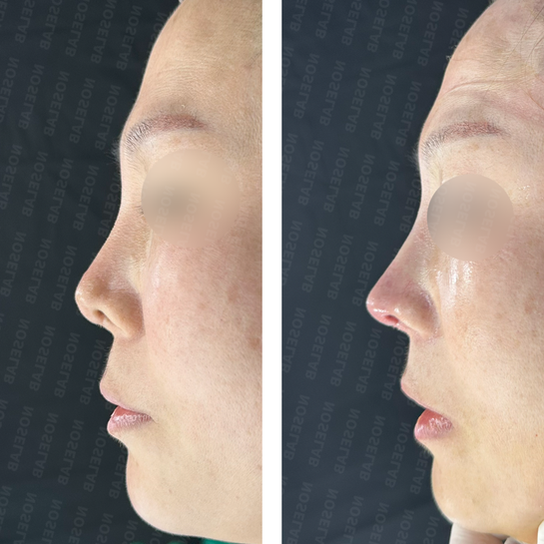
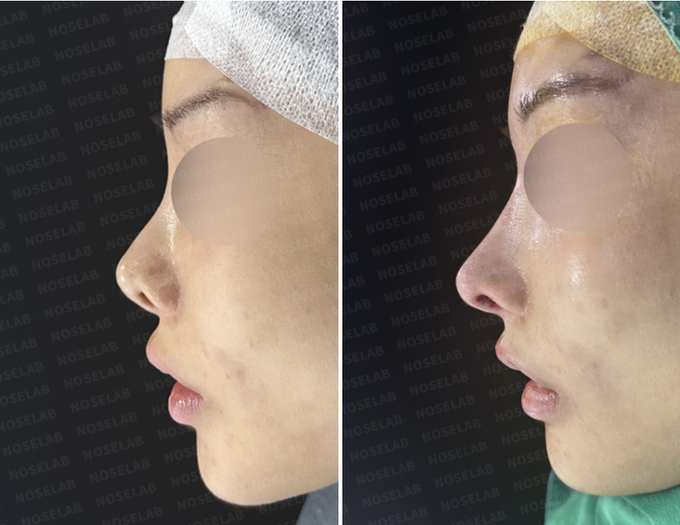
Profile View
From the side view, the radix appeared lower and more balanced. The nasolabial angle improved after nasal tip and columella correction.
The visual impression of upper lip protrusion was also reduced as the nasal tip and nasolabial angle became more balanced.

Nasal Base View
From the nasal base view, columella deviation improved, and nostril symmetry became more balanced after structural correction.

Structural Outcome
Residual foreign material was removed, and the nasal tip was reconstructed with autologous rib cartilage support. Nostril exposure improved after tip repositioning, columella realignment, and nasal base correction.
Because this case involved previous non-medical filler injection and prior surgery, the outcome was planned within the limits of scar tissue, foreign material adhesion, and soft tissue condition.
Surgeon’s Commentary

This case involved long-term complications after a previous non-medical nasal filler injection. Although the patient had previously undergone a procedure intended to remove filler material, residual foreign material remained inside the nose.
Foreign material can remain attached to surrounding tissue and may contribute to contour irregularity, stiffness, asymmetry, or distortion of the nasal framework. In these cases, careful removal is important before structural reconstruction.
The upturned nasal tip and excessive nostril exposure were corrected using autologous rib cartilage support. Rib cartilage provided the structural strength needed to reposition and support the nasal tip.
The high radix was lowered to improve profile balance, and the nasolabial angle was adjusted to reduce the impression of upper lip protrusion.
Columella deviation and nostril imbalance were also corrected to improve the nasal base appearance. These changes required combined correction of the nasal tip, columella, nostrils, and internal support.
This case shows that nostril exposure correction rhinoplasty after non-medical filler injection should be planned as a combined foreign material removal and structural reconstruction procedure.
FAQ
Why can non-medical filler cause problems years later?
Non-medical or unknown injected material may not dissolve predictably and can remain in the tissue for many years. It may contribute to stiffness, irregular contour, inflammation, asymmetry, or distortion depending on the material and tissue reaction.
Can residual filler be completely removed during revision rhinoplasty?
Residual filler or foreign material may be removed when it is accessible, but the extent of removal depends on how the material is distributed and how strongly it adheres to surrounding tissue. Careful evaluation is needed.
How is excessive nostril exposure corrected?
Excessive nostril exposure may be improved by repositioning the nasal tip, reinforcing structural support, correcting columella position, and improving lower nasal balance. The exact method depends on the cause of nostril show.
Why is rib cartilage used for upturned nose correction?
Rib cartilage may be used when stronger support is needed to reposition and stabilize the nasal tip. It can be helpful in revision cases involving scar tissue, weak support, or previous surgery.
Can the appearance of upper lip protrusion improve after nasal tip correction?
The visual impression of upper lip protrusion may decrease when the nasolabial angle and nasal tip position become more balanced. This does not replace jaw or dental correction, but it can affect facial profile perception.
International Consultation
For international patients, a photo-based consultation may help clarify whether nostril exposure correction rhinoplasty, foreign material removal, rib cartilage nasal tip reconstruction, radix lowering, or columella correction may be needed.

Read the author’s background and the original case context. About these articles